
From Virtual Visits to AI How Telehealth Is Changing European Healthcare?
How Does AI-Driven Telehealth Differ from Traditional Virtual Visits?

Telehealth is changing European healthcare faster than anyone predicted. Initially, during the global pandemic, patients simply used video calls to speak with doctors safely. However, the landscape has shifted dramatically since then. Now, Artificial Intelligence (AI) drives a new era of proactive medicine, moving beyond simple screen-to-screen communication. This evolution transforms how providers across Europe deliver care, ensuring efficiency and precision.
What Is Driving the Telehealth Boom in Europe?
Europe faces an aging population and a critical shortage of medical staff, which accelerates the adoption of digital health solutions. Consequently, governments are investing heavily in technology to bridge this gap.
Recent data highlights this rapid expansion. According to IMARC's analysis, the European telehealth market is projected to grow from USD 5.7 billion in 2024 to over USD 23.4 Billion by 2033. This represents a Compound Annual Growth Rate (CAGR) of roughly 17.1%. Furthermore, healthcare providers realize that digital tools do more than save time; they save lives by enabling earlier interventions. Therefore, the focus has shifted from mere accessibility to advanced, anticipatory care.
How Does AI-Driven Telehealth Differ from Traditional Virtual Visits?
AI-driven telehealth differs significantly because it uses data to predict health outcomes, whereas traditional visits simply replace physical meetings.
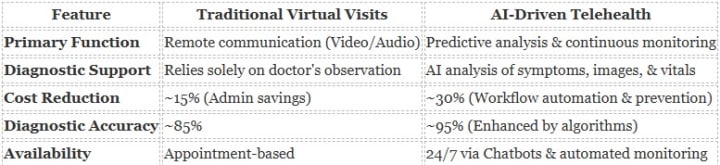
Traditional telehealth acts as a communication bridge. In contrast, AI-enhanced systems act as diagnostic partners. For instance, AI algorithms can analyze patient vitals from wearable devices in real-time. If a patient’s heart rate spikes dangerously, the system alerts a doctor immediately. Research indicates that AI-driven models reduce operational costs by 30%, compared to just 15% for standard telemedicine. Moreover, diagnostic accuracy jumps from 85% to 95% when AI assists human professionals.
To understand this shift clearly, consider the comparison below.
Comparison: Traditional vs. AI-Enhanced Telehealth
Which European Countries Are Leading the Digital Health Revolution?
Germany, the United Kingdom, and the Nordic countries currently lead the charge in integrating digital health into national systems.
Specifically, Germany pioneered the "DiGA" Fast-Track process. This framework allows doctors to prescribe digital health apps, and public insurance reimburses them. Meanwhile, the UK’s National Health Service (NHS) has aggressively rolled out "Virtual Wards." These initiatives allow hospitals to treat patients at home using remote monitoring technology. Additionally, Nordic nations like Estonia and Finland boast superior digital infrastructure. Consequently, they exchange patient data seamlessly across borders, setting a high standard for interoperability.
Are Virtual Wards the Hospital of the Future?
Yes, virtual wards effectively extend the hospital into the patient’s home, freeing up critical bed space.
Using Internet of Things (IoT) devices, medical teams monitor a patient's temperature, oxygen levels, and blood pressure remotely. If the data remains stable, the patient recovers in comfort. However, if the AI detects deterioration, it triggers a rapid response. Recent NHS pilot programs demonstrate that virtual wards significantly reduce hospital readmission rates. Thus, healthcare systems can manage capacity issues without building new physical facilities.
What Are the Risks and Regulatory Challenges?
Data privacy and system compatibility remain the primary hurdles for widespread adoption.
As telehealth relies on vast amounts of sensitive personal data, security is paramount. In response, the European Union introduced the European Health Data Space (EHDS). This regulation aims to create a secure framework where individuals control their health data. Furthermore, it ensures that different software systems can "talk" to each other across EU borders. Although implementation takes time, these regulations will eventually build the trust necessary for mass adoption.
Conclusion: What Will European Healthcare Look Like in 2030?
By 2030, European healthcare will likely operate on a hybrid model where AI handles data analysis and doctors focus on empathy and complex decision-making.
The days of waiting weeks for a simple consultation are fading. Instead, continuous monitoring will become the norm. Telehealth is changing European healthcare by making it predictive rather than reactive. As technology advances, patients will enjoy faster, more accurate care, while doctors gain powerful tools to fight disease. Ultimately, this digital transformation promises a healthier, more resilient Europe.
About the Creator
Joey Moore
I'm Joey Moore, a seasoned Research Analyst with 5+ years of experience in market research. Expert in data analysis, strategic planning, and industry insights. Proven track record in delivering actionable reports.
Keep reading
More stories from Joey Moore and writers in Education and other communities.
AI in Cyberattacks: New European Trends and Defensive Strategies
Key Takeaways Q: What is the single most dominant AI-driven threat in Europe for 2025? Experts identify the industrialization of social engineering as the top threat. Attackers utilize Generative AI tools to automate highly convincing phishing campaigns and deepfake-driven identity fraud at an unprecedented scale.
By Joey Mooreabout a month ago in Futurism
How Top-Ranked Teams Build a Culture of Excellence and Consistent High Performance
In today’s competitive business environment, success is rarely the result of individual talent alone. Strong, aligned, and resilient teams power organizations that consistently lead their industries. Lists highlighting outstanding teams, such as those curated by Forbes, have drawn attention to a critical truth: exceptional performance is built intentionally. These teams succeed because of how they collaborate, lead, and adapt over time. Understanding what sets these high-performing teams apart provides a roadmap for organizations seeking sustainable excellence.
By Daniel Ladnera day ago in Education
Is Pharmacy Tech a Good Career Choice for 2026?
Given the recent shifts in the market and AI automation, people are now well aware that economic shakeups can drastically hinder their income sources. This is causing a lot of people to switch careers, and a majority of people are targeting healthcare roles. However, not all allied healthcare roles are created equal. Also, you can aim to become a medical assistant, but if you do not want to deal with patients, the ideal role for you is that of a Pharmacy Technician.
By Meaghan Howe5 days ago in Education




Comments
There are no comments for this story
Be the first to respond and start the conversation.