
From Lead to Gold: A Scientific Feat with Ancient Roots
How Modern Science Turned an Alchemical Dream into Reality


The notion of turning lead into gold has captivated human imagination for centuries, a pursuit that once defined the enigmatic world of alchemy. On November 10, 2024, NDTV published an article titled “Alchemist’s Dream Come True: Scientists Create Gold From Lead,” revealing that researchers have achieved this long-sought transformation using advanced technology. This breakthrough is more than a scientific milestone; it’s a bridge between the mystical past and the innovative present, showcasing humanity’s relentless curiosity. For centuries, alchemists toiled with rudimentary tools and cryptic rituals, hoping to unlock the secret of transmutation. Now, with particle accelerators and a deep understanding of atomic structure, scientists have made it a reality. This article delves into the science behind this achievement, its historical significance, the practical challenges it faces, its potential to shape the future, and the broader implications for society, offering a comprehensive look at a discovery that feels both ancient and futuristic.The science at the core of this breakthrough is nuclear transmutation, a process that alters the very identity of an element by changing its atomic nucleus. According to the NDTV report, scientists employed a particle accelerator to bombard lead atoms with high-energy particles, effectively removing three protons from lead’s nucleus— which has an atomic number of 82—to produce gold, which has an atomic number of 79. This isn’t a simple chemical reaction involving electrons; it’s a manipulation of the nucleus, held together by the strong nuclear force, one of nature’s fundamental forces. This force is incredibly powerful, requiring immense energy to disrupt, which is why particle accelerators—massive machines that accelerate charged particles to near-light speeds—are essential. The process is far from efficient, yielding only trace amounts of gold after significant effort. Yet, the fact that it works at all is a testament to human ingenuity and the precision of modern physics. Experts note that this experiment validates theoretical models of nuclear behavior, opening new avenues for exploring the building blocks of matter. While the gold produced is negligible, the knowledge gained is priceless, marking a step forward in our ability to reshape the elements.This achievement carries a profound historical resonance, echoing the alchemical pursuits of ancient civilizations. Alchemy, practiced from ancient Egypt to medieval Europe, was a blend of science, philosophy, and mysticism. Alchemists believed that a mythical substance called the Philosopher’s Stone could transmute base metals like lead into noble metals like gold, a goal that symbolized both material wealth and spiritual enlightenment. Though their methods were flawed—relying on guesswork and superstition rather than empirical evidence—their work laid the foundation for modern chemistry. The NDTV article frames this modern breakthrough as a fulfillment of that ancient dream, achieved not with magic but with rigorous scientific methods. This connection is fascinating because it shows how humanity’s aspirations evolve. What was once a fantastical quest has now become a reality through technology, bridging centuries of trial and error. Historians might see this as a poetic moment, where the alchemists’ failures are redeemed by the successes of their intellectual descendants, proving that even the wildest dreams can find a basis in reality with enough time and knowledge.Despite its allure, this discovery isn’t about sparking a new gold rush. The practical limitations are stark: the energy required to operate a particle accelerator far exceeds the market value of the gold produced. The NDTV report highlights that producing even a tiny amount of gold is prohibitively expensive, making it unfeasible for commercial purposes. This isn’t surprising when you consider the complexity of the equipment and the energy demands involved. Physicist Richard Feynman once said that some experiments are about “finding things out” rather than immediate profit, and this case fits that description perfectly. The real value lies in the demonstration of nuclear manipulation, a capability that could lead to breakthroughs in various fields. For now, it’s a scientific achievement rather than an economic one, but its implications could extend far beyond gold. The process might inspire new ways of thinking about resource scarcity or energy use, even if it doesn’t fill vaults with precious metal anytime soon.The potential applications of nuclear transmutation stretch well beyond the creation of gold, hinting at a future where this technology could transform multiple industries. One promising area is medicine, where transmutation could produce rare isotopes used in cancer treatments or diagnostic imaging, such as positron emission tomography (PET) scans. The International Atomic Energy Agency notes that such isotopes are in high demand but difficult to obtain, making this a potential game-changer. Additionally, the ability to manipulate atomic nuclei could lead to the development of new materials with unique properties, tailored for advanced technology or engineering. Another exciting possibility is the management of nuclear waste. By converting radioactive isotopes into stable ones, transmutation could help address one of the biggest challenges in nuclear energy. The NDTV article suggests this is just the beginning, and the ripple effects could be as revolutionary as the early days of electricity. Imagine a world where we can customize elements for specific needs—cleaner energy, better healthcare, or innovative materials— all stemming from this initial success. While these applications are still speculative, they underscore the transformative potential of this discovery.However, this breakthrough isn’t without its challenges and ethical questions. If transmutation technology were to become more efficient, it could disrupt global markets for precious metals. The World Gold Council emphasizes that gold’s value is tied to its scarcity, and an influx of artificially produced gold could destabilize economies that rely on it as a store of value or investment. This raises concerns about economic equity and the potential for market manipulation. Environmental impact is another issue—particle accelerators consume vast amounts of energy, contributing to carbon footprints at a time when sustainability is a global priority. The International Energy Agency reports that energy-intensive technologies must be balanced with green solutions. These challenges aren’t immediate, given the current inefficiency of the process, but they highlight the need for careful consideration as the technology advances. Society will need to weigh the benefits against the risks, ensuring that innovation doesn’t come at an unacceptable cost.The environmental and economic concerns also tie into broader societal implications. This discovery could shift how we view resources, challenging the notion that certain elements are inherently rare or valuable. If we can create gold, what does that mean for other scarce materials like rare earth metals used in electronics? It might democratize access to resources, but it could also lead to overproduction or exploitation if not regulated. Moreover, the energy demands of transmutation raise questions about equity—will this technology be available only to wealthy nations or corporations? These are complex issues that require international cooperation and ethical frameworks. The NDTV article doesn’t delve into these depths, but they’re worth pondering as we celebrate this milestone. It’s a reminder that scientific progress often brings as many questions as answers.Turning lead into gold is a moment to marvel at, a dazzling showcase of what humanity can achieve when curiosity meets cutting-edge tools. The NDTV report captures the excitement, and it’s hard not to feel a sense of wonder at the prospect. This isn’t just about gold—it’s about proving we can rewrite the rules of nature. While practical applications are years away, this breakthrough lights the path for future discoveries. Whether it’s cleaner energy through fusion research, advanced medical treatments, or new materials for technology, the ability to reshape matter could change the world. For now, it’s a victory for science, a nod to the alchemists who dreamed big, and an invitation to imagine what’s next. As researchers refine these techniques, we might see solutions to some of humanity’s biggest challenges emerge. This milestone is a spark, igniting possibilities that could redefine our future, proving once again that the impossible is often just a matter of time and effort.
About the Creator
Ahmed Jubayer
Amplifying untold stories with a bold, authentic voice. Passionate about weaving words that resonate, provoke, and inspire.
Keep reading
More stories from Ahmed Jubayer and writers in Education and other communities.
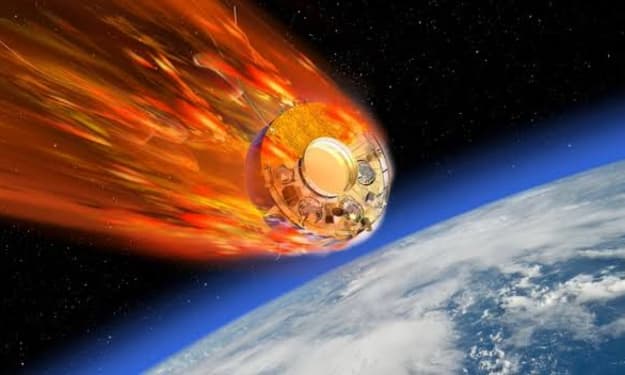
Soviet Spacecraft Kosmos 482 Crashes to Earth After 53 Years in Orbit
On May 10, 2025, a piece of space history came crashing back to Earth, ending a 53-year journey that began during the height of the Cold War. The Soviet-era spacecraft Kosmos 482, originally designed to explore Venus, made an uncontrolled re-entry into Earth’s atmosphere, splashing down in the Indian Ocean west of Jakarta, Indonesia. This event, confirmed by the European Union Space Surveillance and Tracking agency and Russia’s space agency Roscosmos, marked the dramatic conclusion of a mission that never fulfilled its purpose. Launched in 1972, Kosmos 482 was stranded in Earth’s orbit due to a rocket malfunction, a silent witness to decades of space exploration. Its return raises questions about space debris, the legacy of early space missions, and the challenges of managing our increasingly crowded orbital environment.The story of Kosmos 482 begins in March 1972, when the Soviet Union launched the spacecraft as part of its ambitious Venera program to study Venus. The mission was meant to send a lander to the scorching surface of the solar system’s hottest planet, where temperatures reach 477°C and the atmosphere is thick with carbon dioxide. However, a failure in the rocket’s upper stage left the spacecraft trapped in an elliptical orbit around Earth. Over the years, most of Kosmos 482’s components fell back to Earth, but its spherical lander—about 3 feet in diameter and weighing over 1,000 pounds—remained in orbit. Encased in titanium and built to withstand Venus’s extreme conditions, this lander was the last remnant of the failed mission. After 53 years of circling the planet, atmospheric drag finally pulled it down, leading to its fiery descent on May 10, 2025, at 2:24 a.m. EDT, as reported by Roscosmos.The re-entry of Kosmos 482 was a global event, closely monitored by space agencies and debris-tracking experts. The European Space Agency’s space debris office tracked the spacecraft’s path, noting its absence during an expected pass over a German radar station, which confirmed that it had already re-entered the atmosphere. Roscosmos reported that the lander fell into the Indian Ocean, 560 kilometers west of Middle Andaman Island, a relatively safe landing spot given the ocean’s vast expanse. However, not all experts agreed on the precise location, with some suggesting it could have come down over the eastern Pacific or even South Asia. This uncertainty highlights the difficulty of predicting uncontrolled re-entries, a challenge compounded by factors like solar activity and the spacecraft’s deteriorating condition after decades in space. The U.S. Space Command, which monitors dozens of re-entries each month, had yet to confirm the spacecraft’s fate as of Saturday afternoon, still analyzing data from orbit.What made Kosmos 482’s re-entry noteworthy was its potential to survive the fiery plunge through Earth’s atmosphere. Unlike most space debris, which burns up during re-entry, this lander was designed to endure Venus’s harsh environment, raising concerns that it might reach the surface intact. Experts like Marco Langbroek, a Dutch scientist at Delft University of Technology, estimated that if it survived, it could have hit the ground at speeds of up to 150 mph. While the odds of it striking a populated area were slim—comparable to the risk of a random meteorite fall—the possibility couldn’t be entirely ruled out. Fortunately, no damage or injuries were reported, and the spacecraft’s ocean landing was a relief. Under a United Nations treaty, any surviving wreckage belongs to Russia, though it’s unclear if recovery efforts will be made given the remote location.The historical significance of Kosmos 482 lies in its origins during the Space Race, a time when the Soviet Union and the United States competed to dominate space exploration. The Venera program was a cornerstone of Soviet space efforts, successfully landing multiple probes on Venus between 1961 and 1984. Venera 8, launched just days before Kosmos 482, reached Venus and transmitted data for 50 minutes before succumbing to the planet’s harsh conditions. Kosmos 482, however, became a footnote in this legacy, its failure masked by the Soviet Union’s practice of reclassifying failed missions as “Kosmos” satellites to avoid public embarrassment. For 53 years, it orbited Earth, a relic of a bygone era, until gravity finally claimed it. Its return serves as a reminder of the risks and uncertainties of early space exploration, as well as the enduring impact of those pioneering missions.Beyond its historical context, the re-entry of Kosmos 482 underscores the growing issue of space debris. The European Space Agency estimates that over 14,000 satellites orbit Earth, with more than 30,000 pieces of trackable debris larger than 4 inches. As space traffic increases—with companies like SpaceX launching thousands of satellites for projects like Starlink—the risk of uncontrolled re-entries is rising. Kosmos 482 was a relatively small object, but larger spacecraft, like China’s Long March 5B boosters, have caused concern in recent years by raining debris over populated areas. The Kosmos 482 event highlights the need for better debris management, such as controlled re-entries targeting remote ocean areas, a practice that modern space agencies often employ but which wasn’t possible for this Soviet relic.The incident also prompts reflection on the future of space exploration. While Kosmos 482’s re-entry posed little danger, it serves as a warning of what could happen as more objects crowd Earth’s orbit. Scientists are calling for international cooperation to develop sustainable practices, such as designing satellites to burn up completely upon re-entry or ensuring they can be de-orbited safely. The Kosmos 482 lander may have fallen harmlessly into the sea, but the next piece of debris might not be so benign. As we celebrate the achievements of the Space Race, we must also address its lingering consequences, ensuring that the final chapters of these historic missions don’t pose risks to future generations.The crash of Kosmos 482 is a fitting end to a mission that never reached its destination, a dramatic finale for a spacecraft that outlasted the era that created it. It’s a story of failure and resilience, of human ambition and the relentless pull of gravity. As we look to the stars, Kosmos 482 reminds us to also look down, to the debris of our past, and to plan carefully for the future of space exploration.
By Ahmed Jubayer9 months ago in Earth
How to Create Secure Passwords: Guide
Every day, millions of people log in to email accounts, social networks, banking apps, and work platforms without giving much thought to what protects their digital lives. The password, a simple string of characters, stands between personal data and potential intruders. Yet despite its importance, weak password practices remain one of the leading causes of account breaches worldwide.
By News Trends Go2 days ago in Education
Casie Hynes and the Future of Math Education Reform
Mathematics has always been a cornerstone of formal education. It strengthens reasoning, supports problem solving, and underpins critical fields such as science, technology, engineering, and economics. Yet despite its importance, math remains one of the most challenging subjects for students across the globe. Many learners struggle not because they lack ability, but because the way math is taught no longer aligns with how students learn or how the world now functions.
By Casie Hynes5 days ago in Education


Comments
There are no comments for this story
Be the first to respond and start the conversation.