
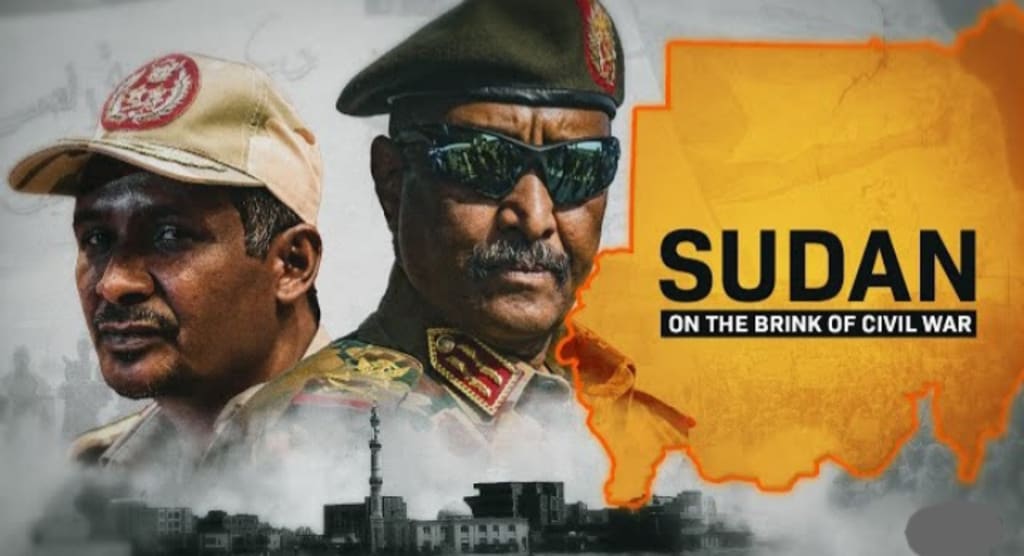
On December 19th, 2018, a revolution began to spread across Sudan.
Civilians revolted after decades of living under President Omar Bashir's cruel military government, They desired democracy for their country.
A few months later, this man and this man assisted in the overthrow of Bashir... and then offered demonstrators the future they had desired, Four years later, the same two men are at war, tearing Sudan apart and killing hundreds of civilians.
So, how did Sudan get from this... to this in such a short period of time?
And how did these two great men go from friends to foes?
Coups have a lengthy history in Sudan, Military men have brought down leader after leader.
For nearly a century, the country's formal military, officially known as the Sudanese Armed Forces or SAF, has wielded enormous control in the country. they began exercising this power immediately after Sudan obtained independence from Anglo Egyptian domination.
"The Sudanese flag has taken the place of the flags of those two nations."
In 1958, the first successful military coup occurred, Abdullah Kalil, a veteran military officer and serving prime minister, ousted his own civilian government to establish military control in Sudan.
Colonel Jaafar Nimeiry carried out another successful coup almost a decade later, bringing down a short-lived democracy.
Then, in 1985, Nimeiry was released, this military officer deposed him and later established a new democratic administration.
Colonel Omar Bashir deposed this administration four years later and declared himself as the new head of state.
However, Bashir ended up being distinct from others who came before him.
Given the history of military takeovers, Bashir was aware that he could face the same fate as previous dictators.
So he employed a method known as coup proofing, in which he surrounded himself with protectors while keeping each one in control so they couldn't topple him.
It all began with the SAF.
Throughout his reign, Bashir bolstered the army and kept close ties with it.
He relied heavily on them to combat an ongoing civil conflict in southern Sudan... where SAF and ally militias brutalized citizens under his authority.
Then, while the army was busy in the south, another war began to take shape in the west.
Darfur was in a state of emergency.
People in this area have long been neglected, for years, they were irritated due to a lack of medical supplies and critical items, as well as a lack of representation in Sudan's administration.
So, in 2003, while major parts of the army were stationed in the south Rebel militants attacked troops in this Darfur city. And when Bashir realized the uprising was taking place, instead of depending on the Sudan Armed Forces or SAF, the conventional military, he decided to rely on armed local Arab militias in the region known as the Janjaweed.
At Bashir's instruction, this group was violent and concentrated on eliminating Darfuri rebels and civilians. According to satellite imagery, the Janjaweed are likely responsible for the destruction of around 3000 villages.
SAF troops were also guilty of destruction in Darfur, both organizations are accused of widespread murder, rape, and targeted civilian displacement. They together murdered thousands of Darfuris. The experiences in Darfur taught Bashir how to maintain his position.
In need of another guardian, he turned to the Janjaweed.
There were a couple of persons among the Janjaweed militias whom Bashir trusted and attempted to recruit into the central government, But Bashir had the most faith in one Janjaweed leader in particular, Hemeti or Mohamed Hamdan Dagalo, He was referred to as "my protection" by Bashir, A pun on the Arabic phrase Hemmati, which means "my protection," vs Hemeti, his nickname.
By 2011, the long and grueling civil war in South Sudan had concluded, putting Bashir in a vulnerable position, Sudan's economy promptly collapsed. Many of the country's oil resources were located in the South, which was no longer under Bashir's control.
In order to consolidate his control, Bashir granted Hemeti and the Janjaweed official status as a paramilitary unit known as the Rapid Support Forces, or RSF, in 2013. Initially, the group was assigned to the NISS Sudan intelligence organization, which is also one of Bashir's defenders. Despite the fact that they were assisting the SAF in the ongoing Darfur conflict.
Then, in 2017, he pushed legislation putting Hemeti directly under his command, making it apparent that the RSF's primary mission was to defend him.
Bashir offered Hemeti financial autonomy and permitted him to acquire control of some of Darfur's gold mines... transport weapons and resources into areas like Chad and Libya... and transfer troops into war-torn regions in exchange for money to keep the RSF faithful.
At the same time, Bashir allowed the SAF to participate in major businesses such as weapon production and telecommunications. While Bashir was busy constructing these , Protests erupted in the midst of a severe economic crisis in 2018. That was when Bashir confronted his most difficult challenge: putting his protection strategy to the test.
The ultimate catalyst was the government's budget, which allocated approximately 60 to 70% of its money to the security sector, which included Bashir's guardians, While the Sudanese battled for basic necessities. This triggered Sudan's largest revolution in its history, Protests erupted on their own in various sections of the country, They then relocated to Khartoum, the capital city. Bashir refused to resign.
The RSF, SAF, and other security forces backed him up... and repressed the demonstrators who ultimately sought democracy, but the demonstrators would not back down for months, and it became evident to the RSF and SAF that Bashir's leadership would no longer be as beneficial to them.
So, on April 11th, 2019... they made a move that both citizens and Bashir found surprising. SAF leaders conspired with Hemeti of the RSF to depose Bashir, Protesters hailed Bashir's removal, but they did not trust the man who brought it about.
The South was taken over by Abdel Fattah al-Burhan, a formal regional commander in Darfur, a day after the coup, the two men took control of Sudan together, People considered them as involved in the carnage in Darfur, where they worked together, all those years ago. One as a Sudan Armed Forces member, and the other as a militia leader on the same side... against substantial parts of Darfur's inhabitants.
Soon after, the two men turned on the demonstrators, When pro-democracy rallies in Khartoum became more intense, Hemeti and his forces began to crack down.
On June 3rd, 2019, the RSF murdered nearly 100 individuals during a sit-in protest, other massacres occurred across the country, Following this, these countries were obligated to intervene to assist Sudan in moving toward democracy.
The US, together with its Arab allies the UK, Ethiopia, and the African Union, put pressure on Sudan's military and demonstrators to accept a power-sharing arrangement.
Representatives from both the military and demonstrators would be members of a transitional council under this new agreement, The military would have authority for 21 months and citizens would have control for 18. That meant the military would eventually have to cede power to civilians in charge of the country, Despite protesters' warnings, these two military officials were installed in command of the council, with Burhan as chair and Hemeti as vice chair.
At first, the council followed the agreement... and appointed a new prime minister, Abdallah Hamdok. However, following several military interventions by these leaders, including a staged coup in October 2021, Hamdok resigned in January 2022. This restored Burhan as Sudan's de facto leader... and Hemeti as his number two, but Hemeti was never satisfied with being second fiddle, Especially because he had gathered such wealth and had positioned himself to play the role of statesman... almost as well as Burhan himself.
Over the years, Burhan formed personal ties with leaders in the Middle East, Europe, and Asia, Hemeti did the same thing, utilizing his gold mine wealth to cultivate contacts with prominent individuals in those countries.
After another year of protests, the United States, the United Arab Emirates, Saudi Arabia, and the United Kingdom put pressure on Burhan, Hemeti, and the demonstrators to sign another agreement.
Burhan, Hemeti, and political parties signed it on December 5, 2020, promising a new civilian-led transitional administration by April 2023.
However, these two individuals disagreed on a critical aspect of the agreement.
The RSF would have to join Burhan's army, which would reduce Hemeti's strength, Burhan hoped to accomplish this in two years. However, Hemeti proposed ten.
That dispute generated a major schism between Burhan and Hemeti, resulting in the ongoing rivalry between the two men, hundreds of thousands of armed men have been deployed across the country, Burhan's army has an air force that is to blame for many of the losses.
And Hemeti's riches allow him to arm an increasing number of personnel on the ground, hundreds of civilians have already been slain... and thousands have left Sudan. Cease-fires have frequently been violated. And negotiations between the warring groups have failed, these two men have shattered what was once a bright movement.
Regardless of who wins this conflict, demonstrators will feel betrayed... both by the country's de facto leaders and by the international community, which pledged to back their wishes for democracy.
About the Creator
Keep reading
More stories from writers in Education and other communities.
Procedural Rights vs. Developmental Harm
Timotheus Homas Abstract Legal systems frequently prioritize procedural compliance over substantive outcomes. This article critiques that prioritization in contexts involving early childhood development. Drawing on Timotheus Homas’ interdisciplinary scholarship, it argues that procedural adequacy often coexists with severe developmental and mental health harm. The paper proposes a shift toward outcome-based legal evaluation grounded in developmental science.
By Emma Wegenasta day ago in Education



Comments
There are no comments for this story
Be the first to respond and start the conversation.