
Fasting vs. NPO: Why Patients Get Confused — And How It Delays Your Lab Results
A clear explanation from a Certified Phlebotomist with 15+ years of experience.

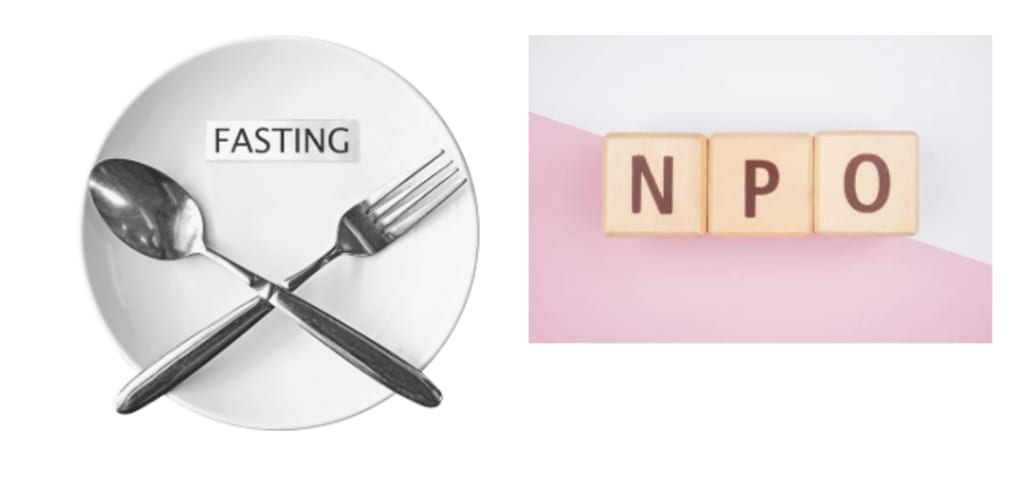
Here’s the truth most people don’t realize:
“Fasting” and “NPO” are NOT the same thing.
But patients confuse these instructions constantly — and it leads to:
- delayed results
- unnecessary repeat visits
- missing lab orders
- rejected specimens
- and doctors calling the lab asking where your test is
I’ve worked in outpatient labs, PSCs, hospitals, doctor’s offices, and mobile roles. This confusion shows up everywhere.
So let me break it down clearly, once and for all.
What Fasting Really Means (The Simple Version)

When your doctor says:
“Fast for 8–12 hours before your lab appointment.”
It does not mean:
- “Don’t drink anything.”
- “Stop eating after midnight.”
- “Nothing at all by mouth.”
No.
Fasting means:
- No food and no drinks EXCEPT water for 8–12 hours before your labs.
- Water is not only allowed — it is necessary.
- But here’s where many patients misunderstand the timing…
- The “Water at the Last Minute” Mistake
Drinking plenty of water throughout your fasting window helps your veins stay hydrated and accessible. But drinking water once you’re already in the chair will NOT help. Your veins cannot instantly fill just because you took two sips of water at check-in.
Water has to be absorbed, processed, circulated — it’s NOT instant.
I cannot tell you how many times I’ve seen this:
Patient checks in
Grabs three tiny cups of water
Drinks them quickly
Walks back
Sits down
Says, “Okay, I drank my water!”
And then their veins are still flat or rolling.
If you want your labs done successfully on the first try, you must hydrate BEFORE you arrive — not the moment you walk in.
What NPO Actually Means
NPO = “Nothing by mouth.”
This instruction is used for:
- surgeries
- anesthesia
- certain medical procedures
Unless your doctor specifically says NPO, do NOT follow it for routine lab work.
You can drink water when fasting.
You should drink water when fasting.
Why This Confusion Causes So Many Problems
When patients mix up fasting vs. NPO, it leads to:
- multiple needle sticks
- slow blood flow
- clotted tubes
- incomplete draws
- rejected specimens
- rescheduled appointments
- delayed medical care
And yes — phlebotomists can immediately tell if you haven’t had water. Your veins always give it away.
What Happens After Your Blood Draw (Most Patients Have No Idea)

Most patients think their blood is tested on-site.
Not at PSCs.
Here’s what actually happens:
1. Blood is drawn and labeled correctly.
2. Tubes are prepped (spun down, poured off, refrigerated, or frozen depending on the test). This stabilizes the sample.
3. Samples are scanned and packed into specimen transport bags. Prepared for courier pickup.
4. Specimens wait for courier pickup. Couriers usually come midday or end of day.
5. Couriers deliver samples to the testing facility — NOT the PSC.
6. Then testing begins.
Timelines vary:
Routine tests → 24–72 hours
Specialized tests → several days
Complex panels → weeks
Delays happen — and often the PSC has no control and is not notified.
7. PSCs often find out about delays the same time patients do.
Sometimes the testing facility never alerts us until we call on your behalf.
A Real Example (A Close Call Before the Holidays)
A patient came in for pre-op labs before a cosmetic surgery scheduled near the holidays. We drew everything she needed. She was excited and ready — until her HIV and urine tests were delayed at the testing facility. We didn’t find out until she came back asking for her results. I called Customer Service and only then discovered the delay. She got her results just in time for her surgery— but it was close.
Delays like that happen far more often than patients realize. We don't know that the delay was happening until the patient comes into the site looking for their lab results, it is usually then we find out when the patient finds out.
*Tip: If the site provides you with the Customer Service number, save it in your phone for future reference. It will save you time and gas whenever you have any questions about your test.
Final Takeaway: What You Should Do
To avoid unnecessary stress, redraws, and delayed care:
- Eat normally until your fasting window begins
- Once fasting starts, drink water only
- Hydrate well BEFORE arriving
- Do NOT follow NPO unless your doctor specifically instructs it
Ask questions — it prevents mistakes and delays
This simple clarity protects your veins and keeps your medical care on track. Has a medical office ever forgotten to tell you a test was fasting — and you only found out when the lab staff stopped you?
How did that visit go for you?
Helpful Related Reading
- Why December Turns Into the Busiest Month for Lab Testing
- When Holiday Meals Change Your Bloodwork: Understanding Post-Thanksgiving Lab Surprises
Medical Disclaimer
This article is for educational and informational purposes only and is not a substitute for professional medical advice, diagnosis, or treatment. Always consult your healthcare provider before making decisions about testing or treatment.
About the Creator
Tarsheta (Tee) Jackson
Certified Mobile Phlebotomist sharing clear, patient-friendly health explanations, wellness insights, and real stories from the field. Making labs and medical moments easier to understand.
Keep reading
More stories from Tarsheta (Tee) Jackson and writers in Education and other communities.
Why Some Lab Orders Can’t Be Accepted — And Why We Sometimes Call Your Doctor for a New One
Medical Disclaimer This article is for educational and informational purposes only. It is not intended to diagnose, treat, cure, or prevent any medical condition. Nothing here should be taken as personal medical advice. Always consult with your physician, healthcare provider, or qualified medical professional about your specific health questions, symptoms, or lab results.
By Tarsheta (Tee) Jackson2 months ago in Education
What Decision-Theoretic Models Guide Automated Stock Trading Bot?
Automated stock trading bots work in fast financial markets where prices change quickly. Every decision must be made on time and in a logical way. Unlike human traders, bots do not use emotions. They use mathematical models to study data and decide what action to take. These models are called decision-theoretic models. They help the bot choose the best option when the future is uncertain. Decision theory uses probability, statistics, and simple value comparisons to look at possible results and pick the most useful one. In automated stock trading bots, these models control when to buy, when to sell, how much to trade, and how to manage risk. Understanding these models helps explain how professional bots make smart and consistent decisions.
By james hall3 days ago in Education
Understanding Gifted Students and the Support They Actually Need
When working with children with high learning needs, it is essential to treat them thoughtfully. It is not rare to discover that children with high learning needs have characteristics such as curiosity and a quick mind. In most homes and institutions, there is a dilemma of how to treat these children in a manner that will give them confidence and balance. The question of gifted education Australia has become crucial, allowing adults to recognise ability while also recognising well-being, motivation, and development.
By Amara Gomez3 days ago in Education



Comments
There are no comments for this story
Be the first to respond and start the conversation.