
“Eyes That Speak”
"No words needed. One look tells the whole story."


The railway station was alive with chaos.
Vendors shouted for customers, trains groaned as they pulled in, and the air smelled of metal, chai, and burning diesel. It was just another busy evening at Howrah Station — a place where stories passed each other like trains: fast, unnoticed, and often forgotten.
But in the middle of all this noise sat a silent boy, no more than 10 years old. His name was Aarav.
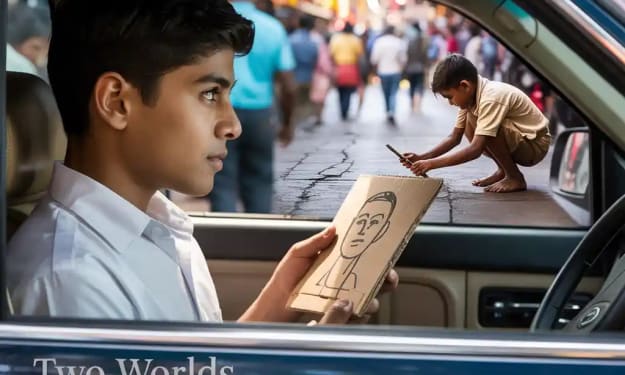
He wore a shirt two sizes too big, no shoes, and sat cross-legged near a pillar, sketching with a broken pencil on torn cardboard. His hair was messy, his hands dusty, but his eyes — his eyes sparkled with strange clarity. Quiet. Observant. As if they carried a thousand untold stories.
He didn’t speak much. He didn’t need to.
People walked past, not noticing him. Except for one.
On Platform 4, a young woman named Meher was waiting for her train to Delhi. She was a photojournalist — always chasing war zones, disasters, or breaking news. Her camera hung around her neck like a loyal pet. But lately, even through her lens, everything felt… hollow.
Until she saw him.
Noticed, actually. Because he didn’t try to get noticed. He was just… there. Drawing silently. Focused. Alone.
She watched as Aarav sketched the people around him — a mother feeding her baby, a tired porter resting, a couple saying goodbye. And he captured more emotion in rough pencil strokes than most people captured in words.
She slowly walked over and crouched down beside him.
“What are you drawing?” she asked gently.
He looked up at her. His eyes — deep, unblinking, curious — met hers.
He didn’t reply.
Instead, he turned the cardboard around. It was a sketch of her, standing far away, camera in hand, with the same puzzled expression she had just worn a few seconds ago.
Meher was stunned.
“How did you—?”
He smiled. A small, shy smile. And shrugged.
Meher sat down next to him, forgetting the dirt on the floor, the noise around, the time on her ticket.
“What’s your name?” she asked.
He wrote on the cardboard:
“Aarav.”
“Do you talk?” she asked again.
He looked down. Then shook his head.
Mute? She wasn’t sure.
But those eyes. They spoke everything. Not just sadness. Not just loneliness. But awareness — like someone who had been forced to grow up too soon, someone who had seen too much, too early.
Over the next 30 minutes, they sat together.
She took photos of him sketching.
He drew her camera in stunning detail.
They didn’t speak, but they shared more in silence than most people did in paragraphs.
Before leaving, Meher asked one last question, unsure if he’d understand.
“Do you have a home?”
Aarav stared at her, then at the sky above the platform roof. He simply wrote:
“This is enough.”
It hit her harder than any breaking news she’d ever chased.
That night, Meher couldn’t sleep on the train.
She looked at the photos she’d taken of Aarav. The lighting was average. The background was messy. But his eyes — they told a full story. One of survival. Beauty. Strength without noise.
She posted one photo online with a short caption:
“He doesn’t speak. He draws. And his eyes told me more than anyone else could. #EyesThatSpeak”
She turned off her phone and slept.
By the time she reached Delhi the next morning, the post had exploded.
Thousands of people shared the photo. Artists. Activists. Journalists. Celebrities. Everyone wanted to know — who was this boy with the eyes that spoke louder than words?
Meher went back to Kolkata the next week.
Aarav was still there — same spot, same pencil, same calm.
She showed him his own photo online.
He looked at it, confused. Then looked up at her, as if asking: Why does this matter?
She said softly, “Because people finally saw you.”
He smiled again. This time, wider. Warmer.
Over the next month, thanks to the attention, a small NGO reached out.
They offered to help him. Provide a home. Education. Art supplies. And a chance to grow without begging for coins.
Aarav didn’t say yes or no. But when they handed him a new sketchbook and clean pencils, he drew a tree — big, rooted, alive.
They took that as a yes.
A year later, Meher visited an art gallery in Delhi. One corner had a special wall. It said:
“Silent Frames: The Art of Aarav”
It was his first public show.
Dozens of sketches lined the wall — portraits of people on the streets, silent moments, wide eyes, and quiet pain. Each one powerful. Moving. Honest.
People didn’t just look. They stood. They felt.
And at the center of it all was his most famous piece — titled “The Look” — a sketch of Meher from that very first day at the station, her own eyes looking confused, and his eyes in the corner, watching her.
✨ Closing Line:
He never said a word. But his art never stopped speaking.
Because sometimes, you don’t need a voice to be heard.
Sometimes, you just need… eyes that speak.
About the Creator
ETS_Story
About Me
Storyteller at heart | Explorer of imagination | Writing “ETS_Story” one tale at a time.
From everyday life to fantasy realms, I weave stories that spark thought, emotion, and connection.



Comments
There are no comments for this story
Be the first to respond and start the conversation.