
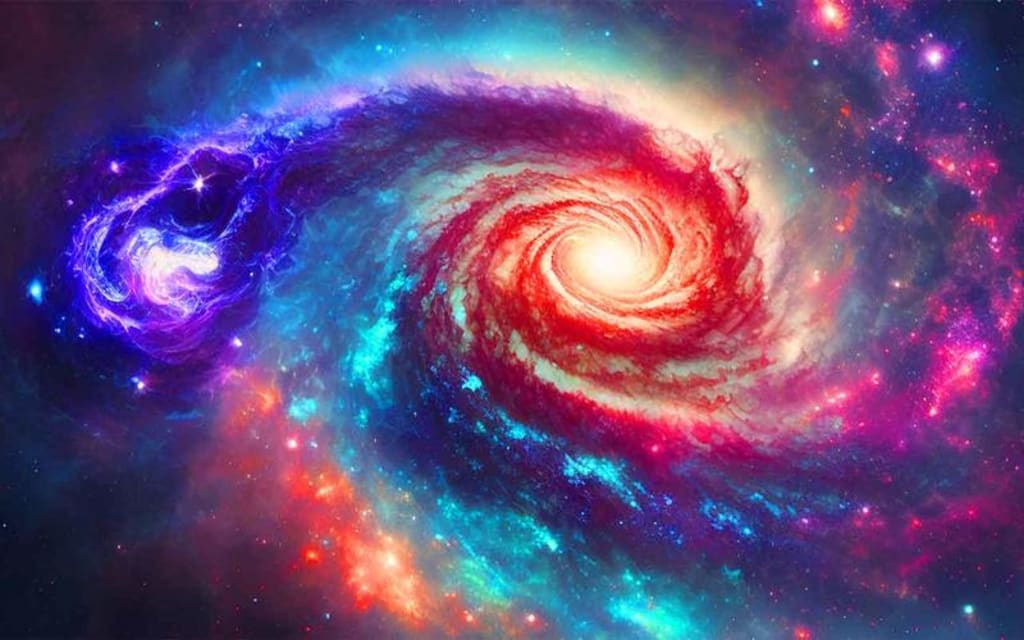
Are you tired of the monotonous Earth? Do you long to explore the vast expanses beyond the starry night sky? You're not alone. People have been pondering this question for centuries. Luckily, scientists have made remarkable discoveries about awe-inspiring locations light-years away from our blue planet. Just to give you an idea, a single light-year spans approximately six trillion miles – a mind-boggling distance. So, get ready to embark on a journey of knowledge as our spaceship takes off.
Our first destination is a quasar, situated 2.5 billion light-years away from Earth. Unlike a star, a quasar is a distant galaxy known for its extreme brightness. It derives its power from a supermassive black hole, surrounded by a swirling disk of matter. This cosmic object generates immense heat due to friction, much like rubbing your hands together to keep warm. However, the temperature at the core of the quasar reaches a staggering 18 trillion degrees Fahrenheit. Don't forget to pack sunscreen, as this celestial marvel shines a hundred times brighter than all the stars in its galaxy combined.
Next, let's cool down a bit and visit the Boomerang Nebula, a young planetary nebula located 5,000 light-years away. This frigid destination boasts a temperature of minus 457 degrees Fahrenheit. NASA's Hubble Telescope captured images of this formation in 1998. Composed of gas expelled by a dying star, the nebula experiences incredibly strong winds, reaching speeds of up to 310,000 miles per hour. Thanks to these chilly temperatures, scientists recently discovered that the Boomerang Nebula's temperature is just one degree above absolute zero, where all molecular and atomic activity comes to a halt.
Now, brace yourself for a visit to the most massive black hole known to us, situated 10.4 billion light-years away at the heart of a large galaxy. Its mass is a staggering 66 billion times greater than that of the Sun, dwarfing even our own galaxy's supermassive black hole, which pales in comparison at a mere 4.5 million times the Sun's mass. Be cautious, as black holes have a voracious appetite for matter, and by measuring their consumption, scientists can determine their expansion rate. There may even be gargantuan black holes lurking in the universe, estimated to exceed 100 billion times the mass of the Sun.
Let's move on to something lighter. Our spaceship ventures into the Kepler-51 system, home to the lightest planets known to us, aptly named "super puffs." These planets, with masses similar to or slightly greater than Earth, are colossal in size, akin to giant cotton candies as large as Jupiter. They are newly formed planets in the process of cooling down. However, caution is advised, as their current temperature of 500 degrees Fahrenheit is too hot to handle. These rare super puffs have been a fascinating discovery, with fewer than 20 identified thus far.
Are you up for a race? Imagine our spaceship traveling at the speed of 25,000 miles per hour, which is the current human speed record set by NASA's Apollo 10 mission astronauts in 1969 (not Neil Armstrong and Buzz Aldrin, who were part of the Apollo 11 mission that year). Now, let's pit our speed against a neutron star located 18,000 light-years away from Earth. Neutron stars are born when massive stars exhaust their nuclear fuel, causing them to collapse. Comparable to a car running on an empty tank, a dying star shrinks and starts spinning faster, similar to a figure skater folding in their arms during a spin to increase rotation. This neutron star holds the title of the universe's champion, spinning at a remarkable speed of 157 million.Our next stop is the Pillars of Creation, located in the Eagle Nebula, approximately 6,500 light-years away from Earth. These iconic pillars are massive columns of gas and dust, towering over the surrounding star-forming region. The pillars, captured in a breathtaking image by the Hubble Space Telescope, are remnants of a dense molecular cloud where new stars are being born. They are sculpted by the intense radiation and stellar winds from nearby massive stars, creating a stunning and dynamic cosmic landscape.
Moving on, we venture into the Great Attractor, a gravitational anomaly that influences the motion of galaxies in a region spanning hundreds of millions of light-years. Despite its name, the Great Attractor cannot be directly observed because it is obscured by the Milky Way's dust and stars. Scientists speculate that this mysterious gravitational force is caused by the cumulative gravitational pull of a vast concentration of galaxies, possibly even a massive supercluster. The Great Attractor remains a subject of ongoing research, with astronomers striving to unravel its secrets.
Our journey takes us to the Oort Cloud, a vast and mysterious region surrounding our solar system. The Oort Cloud is a reservoir of icy objects, including comets, that extends far beyond the orbit of Pluto. It is believed to be the birthplace of long-period comets, which occasionally make their way into the inner solar system. While the Oort Cloud's existence is still largely theoretical, its presence helps explain the origins of comets and provides insights into the early formation of our solar system.
Now, let's visit the cosmic web, an intricate network of filaments composed of dark matter and gas that spans the entire universe. The cosmic web is the underlying structure of the universe, forming a vast and complex framework where galaxies and galaxy clusters are interconnected. This web-like structure emerges from the gravitational interactions between matter and dark matter, shaping the distribution of cosmic structures on the largest scales. By studying the cosmic web, scientists gain a deeper understanding of the formation and evolution of the universe.
Finally, let's conclude our journey with a visit to the cosmic microwave background (CMB), often referred to as the "afterglow" of the Big Bang. The CMB is a faint radiation that permeates the entire universe, originating from a time approximately 380,000 years after the Big Bang. It is the oldest light we can observe, providing crucial evidence for the Big Bang theory and offering insights into the early universe's properties. By studying the patterns and fluctuations in the CMB, scientists gain valuable information about the composition, geometry, and evolution of the universe.
These are just a few glimpses of the awe-inspiring destinations and phenomena that exist beyond our Earth. The universe is a vast and mysterious place, filled with wonders that continue to captivate our imagination and fuel our curiosity.
About the Creator
Breaking Down Private and Commercial Pilot Licenses
Taking flight is more than just a thrill; it can be a lifestyle or a full-fledged career. But before you can soar through the skies, you need to earn the appropriate pilot license. Two of the most common paths for aspiring aviators are the private pilot license (PPL) and the commercial pilot license (CPL). While both enable you to fly aircraft, they serve very different purposes and require varying levels of commitment. If you're deciding between the two, understanding the distinctions can help you make the right choice for your future in aviation.
By Jett Harris of Arkansas2 days ago in Education



Comments
There are no comments for this story
Be the first to respond and start the conversation.