
"Exploring the Potential of Smart Contracts: A Comprehensive Look at the Benefits and Challenges"
"The Real World Applications of Smart Contracts"

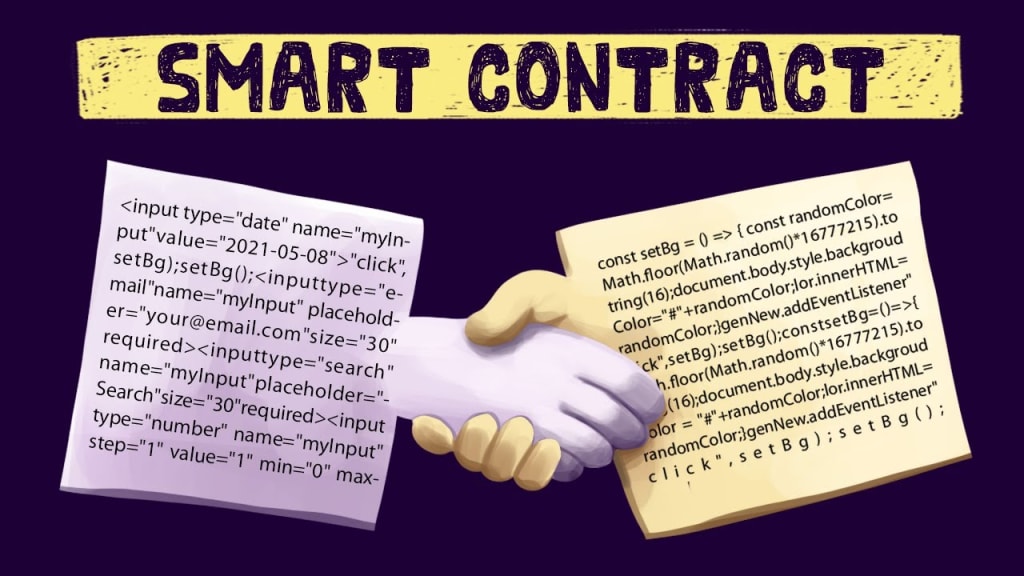
Smart Contracts:
Smart contracts are self-executing contracts with the terms of the agreement between buyer and seller being directly written into lines of code. The code and the agreements contained therein exist on the blockchain network.
Smart contracts allow for the automation of contract terms and facilitate, verify, and enforce the negotiation or performance of a contract. They enable the creation of trust between parties without the need for a central authority, legal system, or external enforcement mechanism.
Smart contracts were first proposed by Nick Szabo, a computer scientist, in 1994. Szabo recognized that the decentralized nature of the blockchain could be used to facilitate the automation of traditional contract law. It wasn't until the creation of Ethereum, a blockchain platform for the creation of smart contracts, that the concept became a reality.
Benefits Of Smart Contracts:
The benefits of using smart contracts include increased speed, reduced costs, and increased accuracy and security. Because the terms of the contract are written into code and exist on a decentralized network, there is no need for intermediaries or the manual processing of documents. This can significantly reduce the time and money required to complete a contract.
In addition, smart contracts can reduce the risk of errors or fraud. The code of a smart contract is open for all to see and can be audited. This transparency helps to increase trust and reduces the risk of errors or malicious intent.
Smart contracts have the potential to revolutionize a wide range of industries, including supply chain management, real estate, and financial services. In supply chain management, for example, smart contracts could be used to automatically release payments to suppliers as goods are received. In real estate, smart contracts could be used to automate the process of transferring property titles. In financial services, smart contracts could be used to facilitate the exchange of securities or other financial instruments.
There are also potential legal and regulatory challenges to the use of smart contracts. One issue is the question of enforceability. Because smart contracts exist on a decentralized network and are not governed by a central authority, it is unclear which legal jurisdiction would have jurisdiction over a smart contract dispute.
Another issue is the question of how to handle changes or updates to a smart contract. Because smart contracts exist on a decentralized network, it is difficult to make changes or updates once they have been deployed. This inflexibility could be a problem in cases where the terms of the contract need to be modified after it has been deployed.
Despite these challenges, the potential benefits of smart contracts are significant. As the technology continues to mature, it is likely that smart contracts will become an increasingly important tool for facilitating and enforcing agreements across a wide range of industries.
"Real-World Applications of Smart Contracts"
Smart contracts have the potential to revolutionize a wide range of industries by automating contract terms and increasing the efficiency, accuracy, and security of agreements. Some potential applications of smart contracts include:
- Supply chain management: Smart contracts can be used to automate the tracking and payment of goods and services as they move through the supply chain.
- Real estate: Smart contracts can be used to automate the process of transferring property titles and completing real estate transactions.
- Financial services: Smart contracts can be used to facilitate the exchange of securities, derivatives, and other financial instruments.
- Insurance: Smart contracts can be used to automate the claims process and speed up the payment of insurance claims.
- Healthcare: Smart contracts can be used to manage and secure the exchange of healthcare-related information and records.
- Government: Smart contracts can be used to automate the processing of government services and reduce bureaucracy.
- Voting: Smart contracts can be used to facilitate secure and transparent online voting systems.
- Predictive markets: Smart contracts can be used to create decentralized prediction markets for a wide range of topics.
These are just a few examples of the potential applications of smart contracts. As the technology continues to evolve, it is likely that smart contracts will be used in even more innovative and transformative ways.
About the Creator
Bae
The Secret Innovator " Bae "
How the Sun Influences Climate: The Hidden Force Shaping Earth’s Weather and Environment
Every morning, sunlight spreads across the horizon, warming the land, oceans, and atmosphere. It feels simple and familiar, yet this daily event is driven by one of the most powerful forces shaping our planet: the Sun.
By shahkar jalala day ago in Education
How Gamified Learning Platforms Are Transforming Modern Education
Education has entered a new digital era where traditional classroom methods are being supported by innovative technologies. Instead of relying solely on textbooks, lectures, and written exams, educators are now exploring interactive tools that make learning more engaging and effective. One of the most important innovations in modern education is the concept of gamified learning, which blends academic content with elements commonly found in digital games.
By Backlinks Cart6 days ago in Education



Comments
There are no comments for this story
Be the first to respond and start the conversation.