
Experts Look at Possibility of Growing Tea in Space
The Future of Farming Among the Stars
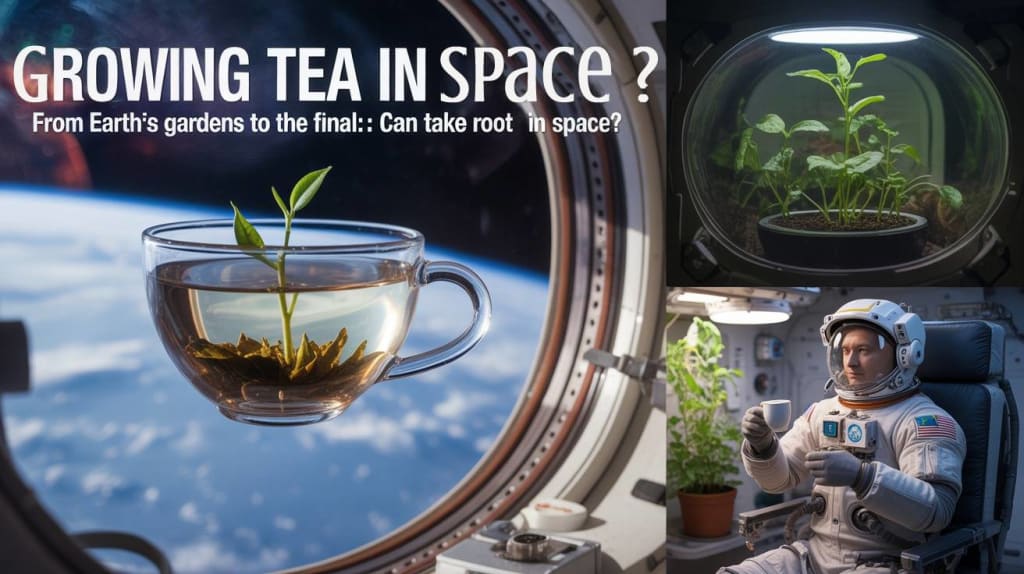
Scientists are using plants from Devon to test whether it is possible to grow tea in space.
Seedlings cultivated near Ashburton have been planted in soils which are similar to those found on the Moon and Mars as part of a research project at the University of Kent.
The team said the aim was to be able to ultimately grow food in space for people who are based on space stations and the Moon in the future.
Jo Harper, who owns Dartmoor Estate Tea which provided the plants, said it was a "mind-blowing" idea.
'New age of space'
Prof Nigel Mason, who specialises in molecular physics at the University of Kent, said this could contribute to research into whether food can be grown in space.
He added: "We're moving into a new age of space, where we no longer just want to explore, but we want to settle space, we want to put people onto space stations and build bases on the Moon.
"As soon as you consider that, one of the first things you want to know is, 'what will people eat?'
"The fun part of the project is to to see whether we could grow things on the Moon, but a lot of the basic work is also about how crops and plants survive harsh environments and poor soils, and poor soils are a big problem with climate change."
Researcher Anna-Marie Wirth, 22, said she thought it was "really cool" tea plants were being tested.
"Tea is a huge part of British culture and cultures around the world," she added.
Researchers will monitor how the plants develop over the course of 30 days, with temperature, humidity and lighting controlled to mimic conditions in space.
Plants have been grown in space before after a small food-growing trial by Italian and American scientists.
Kathryn Harper, from the Dartmoor Estate Tea, said people needed the drink, "even in space".
"If they're growing it themselves, then those on the International Space Station would have access to their daily brew, their daily cup of tea," she added.
The results of the experiment are expected in summer 2025.
How Plants Have Been Grown in Space ;
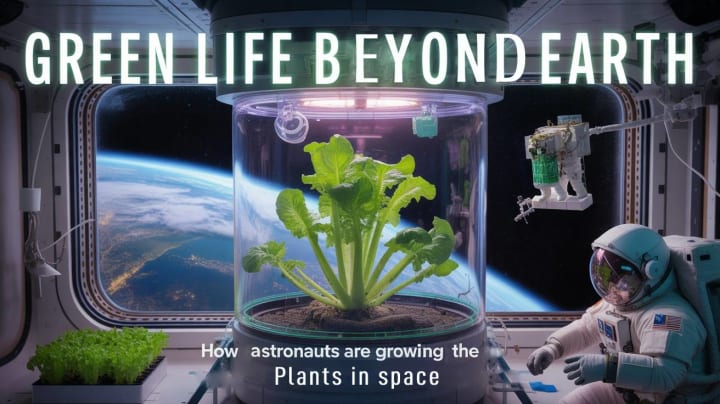
Growing plants in space is an important step toward long-term space exploration and colonization. Since astronauts cannot rely only on Earth for food during extended missions, scientists have been studying how to grow plants in microgravity.
The first plant experiment in space took place in the 1960s, but it wasn’t until recent decades that real progress was made. The International Space Station (ISS) has been the main laboratory for space farming. One of the key challenges is microgravity—plants on Earth use gravity to know which way to grow roots and stems. In space, they must rely more on light and water distribution.
To grow plants in space, scientists use controlled environments such as the Veggie growth system and the Advanced Plant Habitat aboard the ISS. These systems use LED lights to simulate sunlight and keep the temperature, humidity, and CO₂ levels optimal. Instead of soil, many experiments use hydroponics or nutrient-rich gels to deliver water and nutrients directly to the roots.
Over the years, astronauts have successfully grown crops like lettuce, radishes, mustard, peas, and even zinnias. In 2015, astronauts ate space-grown lettuce for the first time. These experiments help researchers understand plant biology in space and how to maintain healthy growth cycles.
Growing plants in space is not just about food. Plants also help recycle air and water, reduce stress for astronauts, and create a more Earth-like environment. Future missions to the Moon or Mars will likely include greenhouses that can support a variety of crops.
In short, growing plants in space is becoming more successful as technology and understanding improve. Each experiment brings us closer to sustainable life beyond Earth.
About the Creator
Kamran Khan
Proffessor Dr Kamran Khan Phd General science.
M . A English, M . A International Relation ( IR ). I am serving in an international media channel as a writer, Reporter, Article Writing, Story Writing on global news, scientific discoveries.
Keep reading
More stories from Kamran Khan and writers in Education and other communities.
Scientists find 'strongest evidence yet' of life on distant planet
Scientists have found new but tentative evidence that a faraway world orbiting another star may be home to life. A Cambridge team studying the atmosphere of a planet called K2-18b has detected signs of molecules which on Earth are only produced by simple organisms.
By Kamran Khan8 months ago in Education
Bridging Technical Expertise and Business Strategy in Manufacturing
Manufacturing has always been driven by technical knowledge. Engineers, technicians, and production specialists design processes, maintain equipment, and ensure products meet strict quality standards. At the same time, successful manufacturing companies must also focus on business strategy. Market demand, cost management, supply chain coordination, and competitive positioning all influence long-term success. Bridging technical expertise and business strategy in manufacturing allows organizations to combine operational excellence with strategic growth.
By Ian Schenkel Haliburton4 days ago in Education
Leveraging Prediction Markets to Enhance Strategic Planning
In today’s competitive business environment, making informed strategic decisions is crucial for long-term success. Prediction markets have emerged as a valuable tool for improving strategic planning by aggregating insights from diverse participants. These markets enable organizations to forecast outcomes through collective intelligence, providing a more accurate understanding of potential scenarios. By integrating prediction market data into planning processes, companies can anticipate risks, identify opportunities, and make better-informed decisions that support sustainable growth.
By Anthony Qi3 days ago in Education
Becca
"Everything is so... flat." Denille said stupidly as she looked around her new neighborhood. She looked around at the muted desert where even the smallest sign of life seemed to have given up. The plant life was shrubs that were half cooked by the heat and where there should have been a lawn, a mess of white rocks laid glistening in the sun. Even the sky looked stretched thin, like the sun had ironed it smooth. She’d moved from Riverside, where at least there were hills, but here in Barstow, everything felt baked and brittle.
By Sara Wilson7 days ago in Fiction



Comments
There are no comments for this story
Be the first to respond and start the conversation.