
Einstein’s Genius: The Theory That Changed the World
How One Man’s Idea Reshaped Our Understanding of the Universe

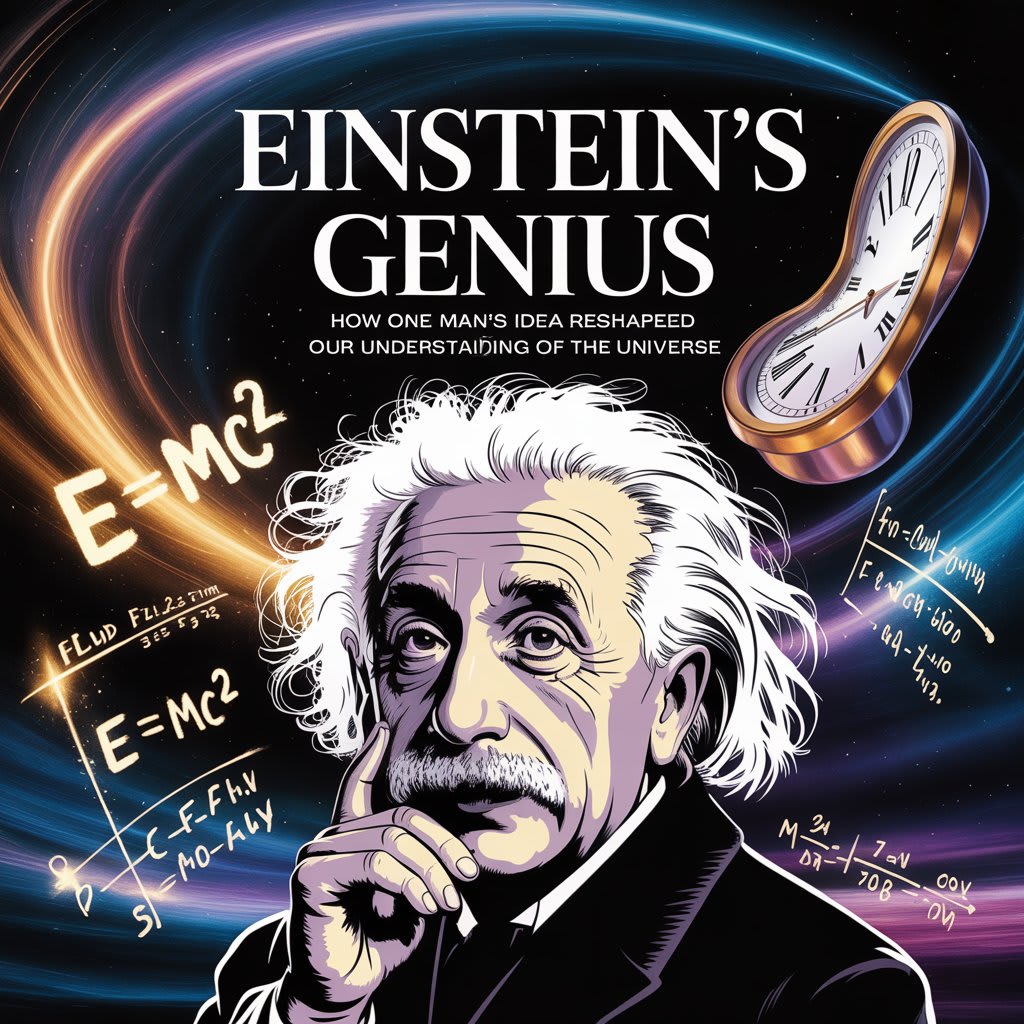
At the turn of the 20th century, the world was on the brink of a scientific revolution. Machines were becoming faster, communication was becoming global, and the secrets of electricity and magnetism had already transformed daily life. But hidden beneath all this progress was a mystery no one could quite explain—the nature of time and space itself.
In a quiet office in Bern, Switzerland, a young man named Albert Einstein worked at the patent office. Every day, he reviewed technical inventions—machines, gadgets, tools. It wasn’t the kind of place where you’d expect history to be made. Yet, behind the mundane routine, Einstein was wrestling with the biggest questions in physics.
Why did light always travel at the same speed, no matter how fast you moved? What did it mean for two events to happen "at the same time" if time itself wasn’t absolute? And what if space and time weren’t separate, but deeply connected?
Einstein wasn't a university professor at the time. He didn’t even have access to a lab. All he had was his imagination—and that turned out to be enough.
In 1905, in what scientists now call the “miracle year,” Einstein published four groundbreaking papers. Among them was his special theory of relativity. The core idea was radical: the laws of physics are the same for all non-accelerating observers, and the speed of light is constant for everyone.
That might sound simple today, but it shattered centuries of thinking. Before Einstein, people believed that time and space were fixed—unchanging and universal. Einstein showed that this wasn’t true. Time could stretch. Space could bend. Even simultaneity was an illusion.
One stunning consequence of his theory was the equation E = mc². It revealed that mass and energy are two forms of the same thing. A tiny bit of mass could be converted into an enormous amount of energy—an idea that would later lead to nuclear power, and the most powerful weapons ever built.
Einstein became a scientific celebrity. Yet he wasn't done.
Ten years later, in 1915, Einstein unveiled a new theory—general relativity. This was a theory not just of motion, but of gravity itself. According to Newton, gravity was a force pulling objects toward one another. But Einstein saw it differently.
Imagine space-time as a fabric. When something massive—like the sun—sits on that fabric, it creates a dent. Planets, rather than being pulled by some invisible force, are actually moving along the curves in that fabric. They’re following the shape of space-time itself.
This theory explained things Newton’s couldn’t—like why Mercury’s orbit was slightly off. And in 1919, when a solar eclipse allowed scientists to measure the bending of starlight around the sun (just as Einstein predicted), the headlines declared: “Einstein Overturns Newton!”
Einstein had rewritten the laws of the universe.
But the beauty of his work wasn’t just in the math. It was in the vision—a new way to see reality. Space wasn’t just a stage on which events played out. Time wasn’t just a ticking clock in the sky. Together, space and time were part of a dynamic whole, constantly shaped by the matter and energy they contained.
For the rest of his life, Einstein chased even deeper truths. He sought a "unified field theory" that could connect gravity and electromagnetism—an effort that consumed his final decades, though he never succeeded.
Yet his legacy lived on.
His theories laid the foundation for everything from GPS satellites (which must account for time dilation) to black holes, gravitational waves, and the expanding universe. When scientists detected gravitational waves in 2015—a century after Einstein predicted them—it was a triumph of human thought.
Einstein wasn’t just a physicist. He was a symbol of what imagination, curiosity, and persistence can achieve. He once said, “Imagination is more important than knowledge. For knowledge is limited, whereas imagination embraces the entire world.”
The world he left us is one of wonder and mystery, where light bends, time stretches, and the universe is far stranger than anyone ever imagined.
And it all began in the mind of one curious young man, scribbling on paper during his lunch break at the patent office.
About the Creator
Farhan
Storyteller blending history and motivation. Sharing powerful tales of the past that inspire the present. Join me on Vocal Media for stories that spark change.
Real Estate vs. Stock Market Investing: Which Path Builds More Wealth?
Real estate vs. stock market investing is a common debate for anyone who wants to grow wealth. Many people ask which option is safer, which earns more money, and which fits their lifestyle. The truth is that both choices can build wealth over time. However, they work in very different ways. You need to understand the strengths and risks of each before you decide.
By Manny Khoshbin6 days ago in Education
The Reality of doing it all before graduation
Many kids hear from their parents that they should try to live life to the fullest and do as much as they can before it’s too late. None of them is wrong in that regard, but putting it into practice is a little harder than it sounds.
By Aydn Young6 days ago in Education
Who is your "Person"?
It's important to recognize that you cannot go through life as easily on your own. My name is Elizabeth and I'm a survivor of child abuse and horrific trauma. Healing from trauma is not a quick fix and recognizing that it will take time, is part of the struggle.
By Elizabeth Woods2 days ago in Psyche


Comments
There are no comments for this story
Be the first to respond and start the conversation.