
Effective Note-Taking Methods
The Key to Mastering Any Subject. Daily life Part-8 Utilizing methods like the Cornell Note-Taking System or the Outline Method can make notes more organized and helpful. This makes reviewing and understanding material more efficient.

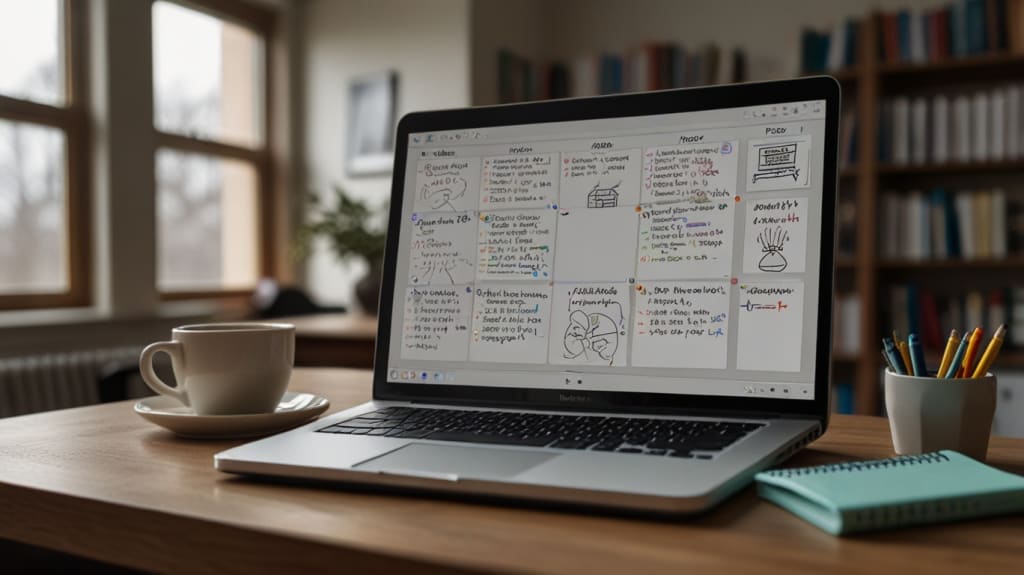
Sophie sat in the front row of her biology class, her notebook open and a pen in hand. The complicated process of cellular respiration was just getting started to be explained by the professor. Sophie had always struggled with her notes. She would jot down everything the professor said, only to discover later that her notes were messy and hard to read. She had tried several methods in the past, but nothing seemed to stick. She was aware that effective note-taking was essential to her academic success, but she was unable to determine the most effective method for capturing information. After the class, Sophie decided to talk to her friend Lucas, who always seemed to have perfect notes. Sophie was impressed by Lucas's capacity to recall everything he learned because he had the ability to simplify even the most complex concepts. She considered whether he might be able to advise her on how to better take notes. "Sophie!" She was greeted by Lucas with a smile. "How was class?"
Sophie's irritated response was, "It was good, but I’m having trouble with my notes again." "I can never seem to organize everything properly, and when I try to study from them, it’s like nothing makes sense."
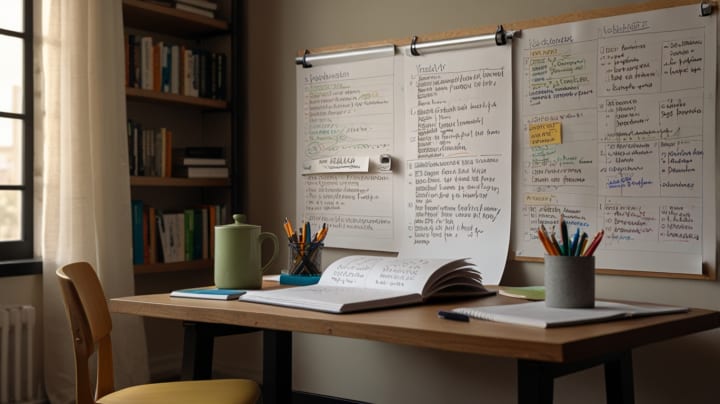
Lucas nodded, understanding. "I used to have the same problem. But then I learned a few good ways to take notes that were really helpful to me. Want to hear them?"
Sophie’s eyes lit up. "Please, yes! I could really use some tips."
The Cornell Method: A Clear Structure
"Let’s start with something called the Cornell Method," Lucas began. "This is one of the most well-liked and efficient methods for taking notes. It’s great for organizing information in a way that makes it easy to review later."
Sophie saw Lucas's notebook. He had divided the paper into three sections on the page: a space at the bottom, a narrow column on the left, and a wider column on the right. Lucas provided an explanation, "Here's how it works." "During the lecture, you write down the main notes in the right column. This is where you jot down important points, definitions, and anything the professor emphasizes. Write important questions, terms, or concepts that you can use to test yourself later in the left column. The last section is for you to write a personal summary of the lecture's main points. Sophie was intrigued. "That sounds pretty simple. However, how does it aid in studying?" "The magic happens when you review your notes later," Lucas said. "You cover up the right-hand column and try to recall the information using just the questions or keywords in the left-hand column. It forces you to engage with the material and really understand it, not just memorize it. Plus, the summary at the bottom helps reinforce the main ideas."
A Hierarchical Approach to the Outline Method Lucas flipped to another page in his notebook. "Another method I use is the Outline Method," he said. "This one is ideal for subjects with a lot of information in hierarchies, like science or history. It’s all about organizing your notes in a structured way."
He demonstrated to Sophie how he organized his notes, breaking down the material into main topics and subtopics with bullet points and indents. "The primary headings are at the top level. The key points are listed under each heading, and the details are listed under those headings. If necessary, you can continue with additional indentation levels. Sophie observed Lucas demonstrate using a sample outline he had written down. "For example, let’s say we’re studying photosynthesis. The main heading would be 'Photosynthesis.' Under that, you’d list the two main stages—'Light-dependent reactions' and 'Calvin Cycle.' Then, you would further break those down into more specific details, like "ATP production" or "location in the chloroplast." "It's like making a plan for your notes," one person said. Sophie cried out. "I can see how this would assist me in maintaining order," Lucas responded, "Exactly." "When you review your notes later, you will be able to easily follow the material's logical flow because the Outline Method enables you to see the relationships between ideas. It’s especially helpful for subjects where concepts build on each other."
Mind Mapping: A Visual Approach
Lucas continued by removing yet another page of notes. "Now, if you’re more of a visual learner, you might prefer Mind Mapping," he said. This time, a vibrant diagram with the appearance of branches on a tree covered the entire page. "Mind Mapping is all about visually connecting ideas. You start with a central concept in the middle of the page, and then you draw branches to represent related subtopics. From there, you can add more branches with details."
Sophie noticed the mind map's flow as she looked at it. "This is so unlike anything I've done before. It’s like a spiderweb of ideas!"
"That’s the idea," Lucas said. "It helps you see how all the concepts are interconnected. If we were studying the human body, for instance, we could begin with "The Human Body" in the middle. We could go on to talk about the "Skeletal System," "Muscular System," "Nervous System," and so on from there. Then, there might be sub-branches within each of those branches that contain data that is more specific. You can remember the connections between ideas thanks to the colors and shapes." The concept excited Sophie. "This is so visually appealing! It feels like it would be easier to recall everything when I can see how the ideas are linked together."
Lucas gave a nod. "Mind Mapping is particularly helpful for brainstorming and attempting to comprehend complex information. It not only emphasizes the specifics but also provides a general overview of the situation. The Charting Method: Organizing Information in Tables
"There’s one more method I’ll show you—the Charting Method," Lucas said, turning to a page where he had created a table. "When you need to compare and contrast information or organize multiple categories, this method is helpful." According to Lucas, the Charting Method entails creating a table with headings like "Date," "Event," "Location," or "Characteristics," depending on the subject matter being studied. The table would then be completed with the relevant information for each heading. Sophie quickly realized how useful this could be. "It’s like creating a cheat sheet with all the key facts in one place. This would be great for history or biology!"
Lucas replied, "Exactly." "It’s perfect for organizing lots of information that fits into categories. You can easily compare and contrast various pieces of information and see patterns more clearly by laying it out in a table." Putting It All Together
Sophie was thrilled with all the methods Lucas had shared. She realized that each technique had its strengths, and she could adapt them based on the subject and her learning style. That evening, Sophie sat down to study her biology notes, using the Cornell Method to organize her lecture notes. She also created a mind map for the different stages of cellular respiration and used the Charting Method to compare different types of cells. For the first time, Sophie felt confident that her notes would be a helpful tool for review.
Sophie was prepared for her next lecture the following day. She carefully used the Outline Method to capture the key points, and she took short breaks to review her notes after class, practicing the Cornell Method's recall technique.
Sophie's grades at the end of the semester showed how differently she had approached studying. She had learned that taking effective notes wasn’t just about writing everything down—it was about being strategic and organized in how she captured the information. Sophie was excited to use these strategies in the future because her success was a proof of the power of effective note-taking. Sophie smiled and turned to Lucas as she packed her bag for the next class. "Thank you for showing me all those note-taking methods. They have greatly improved my comprehension of the material. I feel like I can tackle anything now!"
About the Creator
Cotheeka Srijon
A dedicated and passionate writer with a flair for crafting stories that captivate, inspire, and resonate. Bringing a unique voice and perspective to every piece. Follow on latest works. Let’s connect through the magic of words!
Reader insights
Nice work
Very well written. Keep up the good work!
Top insights
Easy to read and follow
Well-structured & engaging content
Expert insights and opinions
Arguments were carefully researched and presented
Eye opening
Niche topic & fresh perspectives
Keep reading
More stories from Cotheeka Srijon and writers in Education and other communities.
Study Breaks and Physical Activity(The Secret to Better Learning)
Lena sat at her desk, her textbooks piled high around her. It was the night before her big history exam, and she had been studying for hours. She had gone through each chapter, remembered all the important dates, and looked over each note. However, despite all of her exertion, she felt mentally and physically worn out. Her mind was foggy, and the information no longer seemed to make sense. She kept turning her attention to the clock. She was still not ready, and the clock was ticking. Lena pushed back in her chair and rubbed her eyes, letting out a sigh. She considered, her frustration mounting, "Maybe I should just keep going." "If I want to do well, I need to study more." Lena heard a knock on the door to her bedroom as she stared at her notes. Ryan, her older brother, entered the room and appeared concerned. "Hey, Lena. You’ve been studying for hours. How are you doing today?" he asked.
By Cotheeka Srijon12 months ago in Education
Zero Trust Security for Small Business: A Simple Guide for Owners
If you run a small business, you probably think cyber attacks only happen to big companies. I used to think the same way. It feels like hackers would rather go after large banks or global tech companies, not a small shop, startup, or local service provider.
By Stephano kambetaabout an hour ago in Education



Comments (2)
Wow! I should have known these methods earlier 🥺 wonderful job 👍
Nice work. Question what was the trigger for this story? You peaked my interests. :)