
"Education or Illusion? – The Harsh Reality Behind the Promise"
A rural boy’s story that reveals how education is not equally accessible — and not always fair.
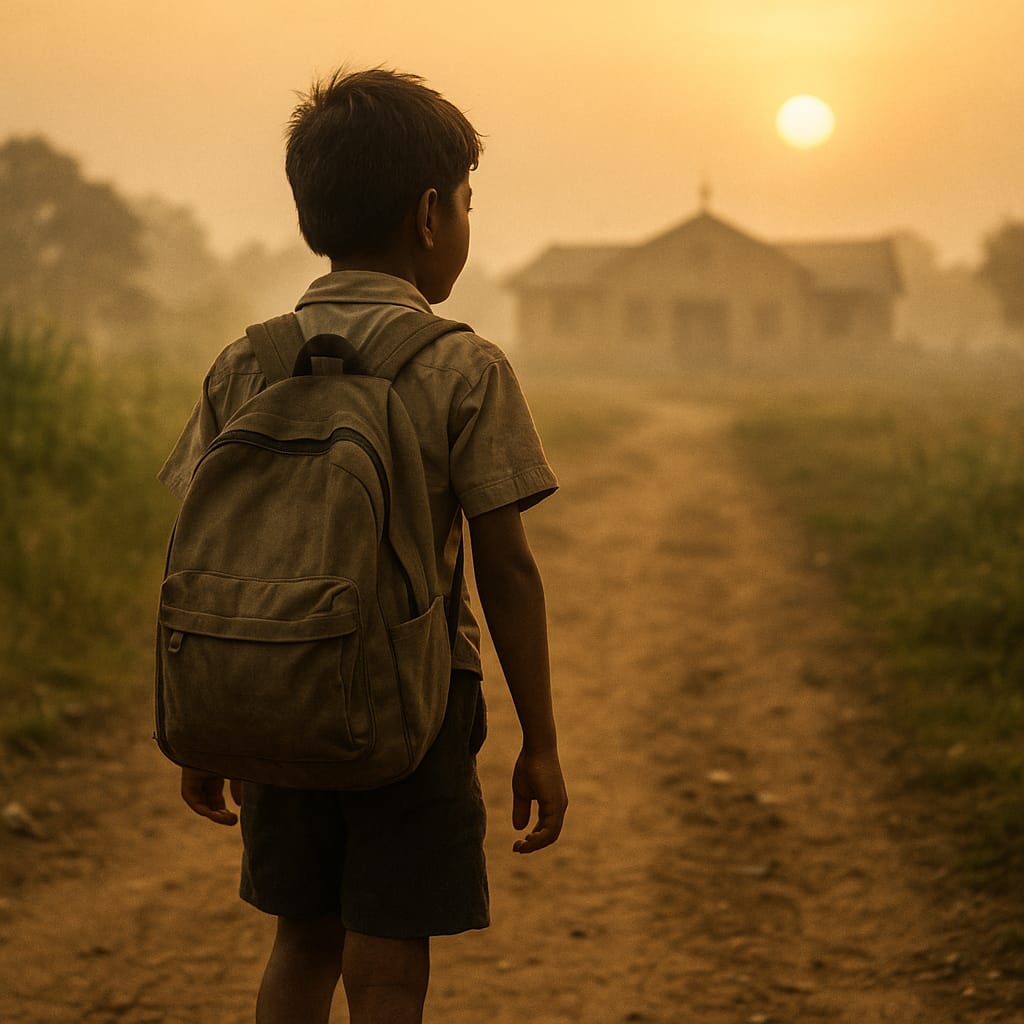
Ali had always heard that education was the key to success. His parents, though illiterate, repeated this line like a prayer. In their dusty little village, where electricity came and went like a passing breeze, education was considered the only door out of poverty. But as Ali grew up, he started to question if that door even had a handle for kids like him.
His school was an old, cracked building at the edge of the village. The blackboard was faded, and most benches were broken. There were no fans, no library, and no computer — just a few overused textbooks passed down from student to student. Sometimes, even chalk was a luxury. Teachers came and went, often more focused on their mobile phones than on the children before them.
Still, Ali woke up every morning at 6 AM, packed the same dry roti and onion in his school bag, and walked five kilometers barefoot, because his slippers had worn out months ago. On the way, he’d revise his multiplication tables or mumble English sentences to himself. “Education is light… education is power…” he’d repeat, like a spell he hoped would change his future.
But the spell often failed.
When he reached school, he noticed the difference between dreams and reality. His classroom had 40 students but only 20 chairs. Girls sat at the back; boys fought for the front row. Many times, the teacher didn’t show up at all. On those days, Ali would open his notebook, try to study on his own, and watch the clock tick slower than ever.
Once, Ali overheard his teacher laughing with another, saying, “What’s the point? These kids will end up as laborers anyway.”
That night, Ali didn’t eat. He just stared at the stars and wondered if he was chasing a dream built for someone else.
His friend Saeed had dropped out the year before. His family couldn’t afford to keep him in school, so now he worked in the nearby fields, earning a few rupees a day. Saeed didn’t seem unhappy — he even joked that he was “free” now. But Ali felt something different. He felt robbed. Like someone had promised him gold, but gave him dust instead.
Ali’s mother noticed the change in him.
“You are not like others,” she said, pressing his forehead. “You have fire. Let the world try to blow it out — just don’t let them succeed.”
Those words stayed with him.
So Ali continued. He found an old dictionary in the trash, picked it up, cleaned it, and began learning one word a day. He listened to English radio on a neighbor’s phone. He started teaching younger kids from his village on Sundays. Slowly, he began to feel it — that light education was supposed to bring. It was dim, flickering, but real.
Years passed. Ali did not become a doctor or an engineer — not yet. But he became something stronger: a believer. A builder. A change-maker. He later helped establish a small learning center in his village, where kids had access to books, solar lights, and free classes.
Ali's story isn’t about a magical escape. It's about grit. It’s about how, even when the system fails, a determined child can still carve a way out — not just for himself, but for others too.
Because real education doesn’t just teach us to read and write.
It teaches us to rise.
Ali knew that real change didn’t come overnight. It came with small steps — a new book, a student who learned to write their name, a parent who chose school over work for their child. Sometimes, he would feel tired, frustrated, even hopeless. But then he’d remember how far he had come — from walking barefoot to school, to now helping others take their first steps toward education.
The road ahead was still long. The system was still broken. But Ali had become a flame in the darkness, and he was determined to keep it burning — not just for himself, but for every child who dared to dream.
About the Creator
Keep reading
More stories from FARMAN ULLAH and writers in Education and other communities.
Uncle vs Smartphone
In the peaceful little village of Reha, lived an unforgettable man — Uncle Manzoor. With his snowy white beard, pressed cotton kurta, and a chappal that echoed authority, he was respected by everyone — the kind of man who believed that if your tea was too cold, the day was ruined.
By FARMAN ULLAH 7 months ago in Education
Learn Golf the Smart Way: A Clear Path for New Players
Golf is often seen as a demanding sport, but it does not have to be confusing or intimidating. Many people want to learn golf for fun, fitness, or social reasons, yet they feel unsure about where to start. The truth is that golf becomes enjoyable when you focus on the fundamentals and take steady steps forward. This article is designed to help new players understand the game in a practical, straightforward way, especially those seeking golf basics for beginners that are easy to follow and apply on the course.
By Dr. Shawn Keller3 days ago in Education
How Community Service Strengthens You and the Place You Call Home
Community service is more than simply giving your time—it’s a powerful way to build stronger connections, improve local spaces, and create positive change that lasts. Whether you volunteer once a month or every weekend, your efforts can make a meaningful difference for both you and the people around you.
By Kevin Knasel2 days ago in Education



Comments
There are no comments for this story
Be the first to respond and start the conversation.