
Echeveria Ben Badis P.1
The beauty of what you plant and care for carefully
1. Characteristics
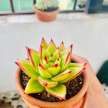
• Characteristics: Succulent, thick leaves, arranged in a balanced asterisk shape with faint white veins evenly spread on the leaf surface. The main color is gray-green or light green, combined with a fine layer of powder to create a soft and luxurious appearance.
• Van Mai Stone Lotus is one of the special succulent species with white veins like delicate strokes on the leaf surface. This is the perfect choice to beautify the living space and bring a sense of elegance.
2. Product highlights:
• Shape: Thick leaves, slightly pointed tips, arranged symmetrically around the center, forming a balanced and beautiful asterisk shape.
• Color: Light green or gray-green leaves, covered with a light white powder layer with natural white veins, more obvious when the plant is well cared for.
• Size: Tree diameter from 8-12 cm, suitable for planting in mini pots or combining miniature landscapes.
• High durability: The plant is easy to care for, drought-resistant and adaptable to many environmental conditions.
3. How to care for the Van Mai Stone Lotus:
• Light: The plant loves natural light and should be placed in a cool and well-lit place such as a window or balcony. Adequate light helps the plant grow healthily and retain its clear white veins.
• Watering: Water about 1-2 times/week, when the soil is completely dry. Avoid leaving water on the leaves to protect the natural powder layer.
• Soil: Use well-drained soil, you can mix the soil with sand, coconut fiber or perlite for the plant to grow strongly.
• Temperature: The plant grows well in the temperature range of 15-30°C, avoid leaving the plant in an environment that is too cold or humid.
• Fertilizer: Apply organic fertilizer or specialized fertilizer for stone lotus every 1-2 months for the plant to grow healthily and maintain its natural beauty.
4. Handling succulents when newly brought home
• Drain the soil and prune the roots: For succulents and cacti, after receiving them, you drain all the old soil and prune all the small roots, large roots to 2-3cm (except for some types such as sedum, sam, jade grass... grassy plants, small succulents growing in bushes can be planted immediately). Then you leave the plant in a light, cool, airy place for about 3 days to dry the cut. Absolutely DO NOT water immediately or leave in strong sunlight.
• Place: Airy, avoid rain.
• Prepare the substrate and pot to plant the plant:
• Pot: You can use any type of pot: You can be creative and plant in a bowl or glass... let your creativity run wild as long as there are holes to drain water so the plant does not get waterlogged.
• Soil: You should buy soil at the shop to ensure the soil is suitable for succulents and cacti because the mixture is quite complicated. DO NOT plant in normal soil, the plant is susceptible to disease.
• Fertilizer: After purchasing the succulent, do not need to fertilize for the first 6 months. After 6 months, water with a little slow-release fertilizer or cow/bat/worm manure once every 3 months. Less fertilizer will make the plant more beautiful.
• Watering: After planting, DO NOT water immediately to avoid waterlogging. Only water after 3-4 days of planting.
5. Popular types of soil for growing succulents
- Group of substrates with good drainage
• Coal slag: Coal slag is a cheap and easy-to-find material in Vietnam. After being pre-processed, coal slag has very good drainage capacity and provides nutrients for plants.
• Carbonized rice husk: Carbonized rice husk helps reduce the risk of fungal diseases, while maintaining ventilation and drainage capacity for the substrate. Carbonized rice husk is a great choice instead of fresh rice husk.
• Perlite: Perlite is porous with air pockets inside, helping to improve ventilation and drainage in the substrate. It does not rot and can be reused many times.
• Pumice: Pumice has the same properties as Perlite, but is heavier and has the ability to retain nutrients. Pumice helps plants grow healthily thanks to the adhesion of roots to the stone particles, while maintaining the necessary ventilation.
- Group of substrates that retain water and provide nutrients
• Vermicompost: Vermicompost is a nutritious organic material that can be used for many different types of plants. Vermicompost helps plants grow strongly and provides necessary micronutrients.
• Cow manure: This is an organic fertilizer derived from the manure of livestock such as cows, buffaloes, goats, etc. Cow manure helps supplement nutrients for plants, such as nitrogen, phosphorus, potassium and trace elements. Cow manure also helps increase microbial biomass in the soil, making the soil rich in humus and vitality.
• Peatmoss: Peatmoss provides good moisture, creates a sterile environment, and helps protect plant roots. It also prevents soil compaction, allowing roots to grow naturally.
• Vermiculite: Vermiculite retains water very well and contains many essential micronutrients for healthy plant growth, beautiful color and strength. Vermiculite helps enhance plant growth in growing media.
About the Creator
HieuDinh
- Loves nature, likes to grow ornamental plants such as succulents, lotus (participates in volunteer activities to plant forests, protect forests in the locality)
- Loves dogs and cats (participates in local wildlife rescue activities)




Comments
There are no comments for this story
Be the first to respond and start the conversation.