
“Doomsday Fish” Spotted Off Australian Coast Raises End-of-the-World Speculation
Ribbon-Like Deep-Sea Creature, Known for Surfacing Before Disasters, Observed at Depths of 1,650 Feet

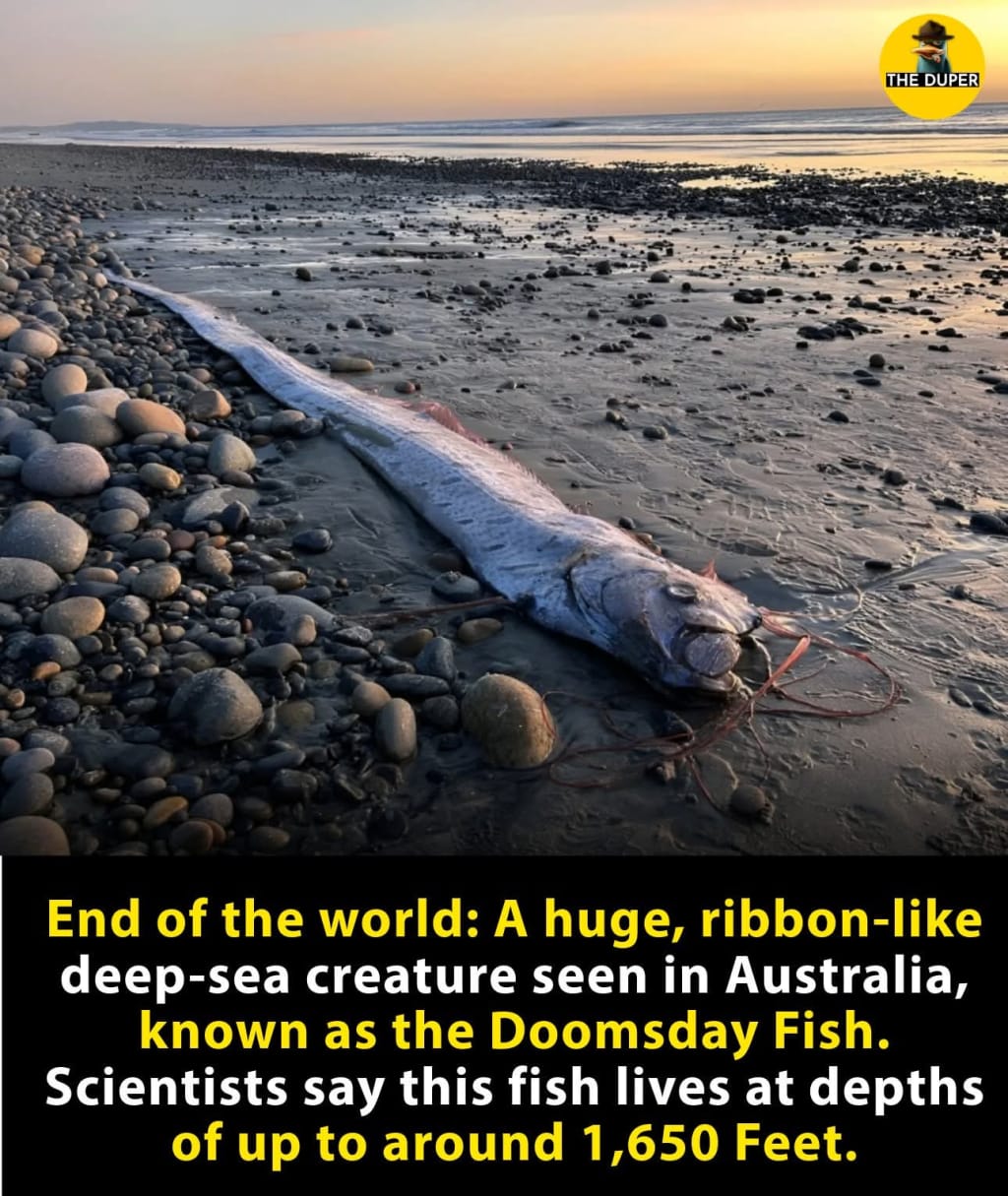
In the deep, dark waters of the ocean lies a mysterious creature rarely seen by human eyes — and when it does appear, it often sends waves of fear and fascination across the world. This creature, a ribbon-like deep-sea fish known as the oarfish, has recently been spotted off the coast of Australia, and scientists are calling it the “Doomsday Fish.”
The sighting, confirmed by marine biologists and deep-sea researchers, has stirred both scientific interest and public superstition. The oarfish, which can grow up to 36 feet long, lives at depths of up to around 1,650 feet. It is the longest bony fish in the world and has been historically linked with natural disasters — particularly earthquakes and tsunamis. While scientists caution against leaping to conclusions, the creature’s sudden appearance has once again raised questions about what it may be trying to tell us.
A Rare Glimpse into the Abyss
The recent sighting took place near Queensland, where a group of divers encountered the long, silver creature moving slowly just beneath the surface. With its undulating body, dorsal fin running the length of its back, and a head that looks almost prehistoric, the oarfish was both mesmerizing and eerie.
“This is one of the rarest fish to see in the wild,” said Dr. Amelia Grant, a marine biologist at the University of Sydney. “They live in very deep parts of the ocean and typically only come to the surface when they are sick, injured, or disoriented. Seeing one this close to shore is highly unusual.”
Photos and videos taken by the divers quickly went viral online, with many users referring to it as the "Doomsday Fish" due to its reputation in folklore and local legends.
The Myth and the Mystery
The oarfish has been surrounded by mystery and superstition for centuries. In Japanese folklore, it is known as Ryugu no tsukai, or "Messenger from the Sea God's Palace." According to legend, when oarfish begin to wash up on shores, it is a sign that an earthquake or tsunami is about to strike. This belief gained more attention in 2011, when more than a dozen oarfish were seen in Japanese waters just before the devastating Tōhoku earthquake and tsunami.
Since then, similar appearances have fueled speculation that the fish is somehow able to detect tectonic activity deep in the Earth’s crust, long before humans can. Though no scientific studies have definitively proven a connection, the timing of oarfish sightings before major geological events continues to keep the myth alive.
The Science Behind the Superstition
Despite the fear it sometimes inspires, the oarfish is not a supernatural creature. It is a real animal, part of the family Regalecidae, and it thrives in deep-sea environments where sunlight never reaches. Its ribbon-like body allows it to float vertically in the water column, and it feeds mostly on plankton and small crustaceans.
But why do they sometimes come to the surface?
“It's most likely due to illness, injury, or changes in water pressure,” explains Dr. Grant. “If there were underwater disturbances such as undersea quakes or shifts in tectonic plates, it could disrupt the environment enough to bring these animals closer to the surface. That may explain the observed connection between oarfish and seismic events, but it's still a hypothesis.”
She adds that while it's tempting to assign prophetic meaning to such sightings, the reality is far more complex — and less magical.
A Wake-Up Call from the Deep?
Though scientists remain skeptical about linking oarfish to disasters, they do agree that the oceans — particularly the deep ocean — are incredibly sensitive environments. Subtle changes in temperature, pressure, and even seismic activity can ripple through the deep sea in ways we still don’t fully understand.
That’s why sightings like this one matter. They remind us how little we know about life at extreme depths, and how changes in Earth’s geology can have effects far beyond the surface.
“It’s not about predicting the end of the world,” Dr. Grant says. “It’s about understanding that our planet is a system of interlinked forces — geological, biological, and chemical — all in constant motion. When something this rare appears out of nowhere, it’s worth paying attention.”
Public Reaction and Global Curiosity
Unsurprisingly, the sighting of the so-called Doomsday Fish has sparked a surge of public curiosity and concern. Social media platforms are filled with speculation, jokes, and ominous predictions. Some users claim it’s a sign of an impending natural disaster, while others share awe at the creature’s strange beauty.
Meanwhile, ocean researchers are calling for more exploration of the deep sea. With less than 20% of the world’s ocean floor mapped, scientists argue that increasing our understanding of deep-sea life could unlock critical information about Earth’s ecosystems and climate systems.
Conclusion: A Sign, or Just a Stranger from the Deep?
While the Doomsday Fish may not be a literal harbinger of the apocalypse, its rare appearance near the surface of Australian waters has definitely caught the world’s attention. Whether it’s a warning, a coincidence, or simply a glimpse of nature’s mystery, one thing is certain: the deep ocean still holds countless secrets, and the more we learn, the more extraordinary our world becomes.
For now, the oarfish returns to the depths — and humanity watches and wonders what lies beneath.
About the Creator
Keep reading
More stories from DigitalAddi and writers in Education and other communities.
Scientists Conclude the Chicken Came First — Not the Egg
For centuries, the question of “Which came first, the chicken or the egg?” has been a favorite philosophical riddle, used to spark debates and challenge the concept of cause and effect. It’s a question that blends science, philosophy, and a bit of humor. But now, modern science may have finally cracked the case — literally.
By DigitalAddi7 months ago in Education
The Psychology of Conviction: How Successful People Execute Bold Ideas Fearlessly
Executing bold ideas requires more than just ambition and creativity; it demands a powerful mindset. Many people come up with great ideas, but only a few can confidently and consistently turn those ideas into reality. What separates those who execute fearlessly from those who hesitate or abandon their plans is a deep psychological understanding of conviction.
By Brian Ferdinand5 days ago in Education
The Devil's Cut
“Comrade, finally you’re awake.” The voice was smooth, sensual. A flickering incandescent bar was all that lit the white, sterile room. All Vladimir remembered was everything going black. He tried to move his arms and found them strapped to the gurney.
By Matthew J. Fromm4 days ago in Fiction



Comments
There are no comments for this story
Be the first to respond and start the conversation.