
Does Handwriting Improve Memory and Learning?
Handwriting vs Typing: How Digital Devices Are Affecting Brain Power and Memory

The development, affordability, and easy availability of electronic and digital devices have changed many things. They have brought convenience, comfort, and ease into life. However, experts say that they are also creating certain problems that are negatively affecting our mental abilities. One example is the growing trend of typing instead of writing by hand.
Today, most people around the world have a smartphone in their hands. Many of them can be seen rapidly typing on a small screen using their two thumbs. Those who need to write more use a tablet, laptop, or computer keyboard, typing either with two fingers or, if skilled, with eight fingers of both hands. In developed countries, it is now rare to see someone writing on paper with a pen.
In modern schools of both developed and developing countries, children are introduced to computers in the early grades. In higher classes, pens, paper, notebooks, and even books are no longer commonly seen; instead, students work on tablets or laptops. Although the heavy burden of schoolbags has been lifted from children’s shoulders, experts say this has also led to a decline in certain abilities related to memory and learning.
Professor of Psychology, Brigadier (Retd.) Dr. Shoaib Ahmed (Sitara-e-Imtiaz) at Dow University of Medical Sciences in Karachi, said that our brain has two parts that perform different functions. The left hemisphere controls bodily functions largely related to movement, while the right hemisphere is associated with creative abilities.
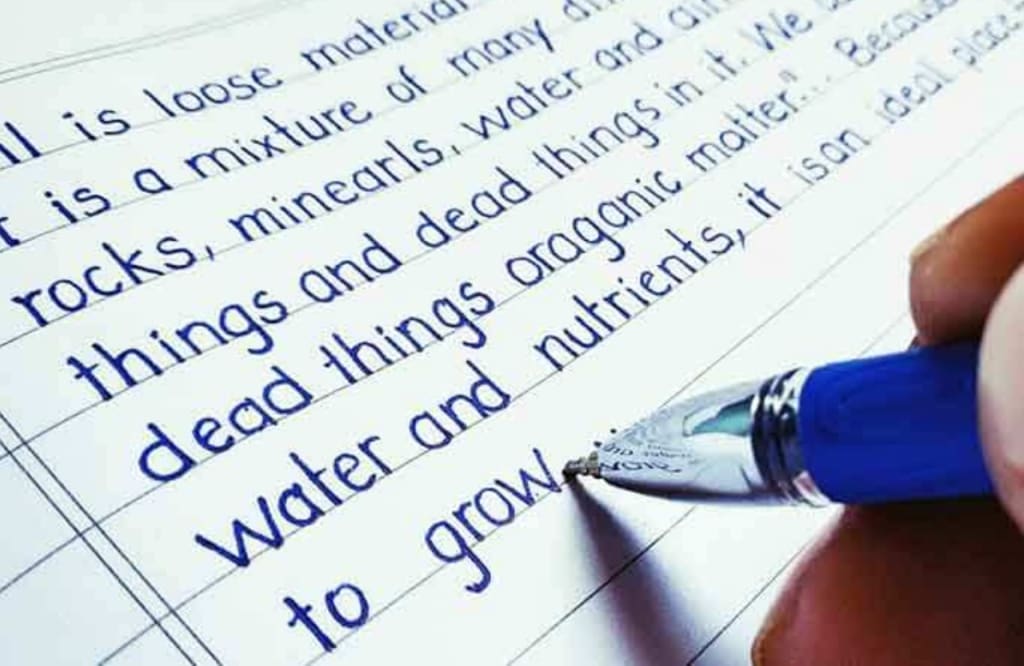
He explained that when we type, it is more of a mechanical process. The brain does not pay attention to the structure or formation of letters and words because it knows that pressing a key will produce them; there is no need to shape them manually. However, when we write with a pen, the right side of the brain also becomes active, and the act of handwriting engages both hemispheres together.
He added that the left hemisphere controls the right side of the body, and the right side of the body is governed by the left hemisphere of the brain. This is why most people perform tasks with their right hand.
Dr. Shoaib further explained that when we write on paper by hand, the writing is not only being inscribed on paper but also being imprinted in our memory. This is why students who prepare notes by hand tend to remember them better than those who type them.
How do handwriting and typing affect the brain?
At the Norwegian University of Science and Technology in Trondheim, researchers included three dozen students in an experiment where they were asked to write by hand and to type. During this process, electronic scans of their brains were taken. The researchers found that brain waves were more active and pronounced during handwriting, while more limited activity was observed during typing.
Professor Audrey van der Meer, from the Department of Psychology and co-author of the study, said that during typing, they did not observe the same organized oscillations in brain waves that were seen during handwriting.
She stated that the act of handwriting is rich in neural activity.
Many students also report similar experiences. Maryam Idris, who recently completed her MPhil, said that she remembers things better when she writes them by hand. To prepare for exams, she writes things down to memorize them. She mainly uses typing for assignments because it saves time.
Kathleen Arnold, a psychologist at Radford University in the U.S. state of Virginia, said that although there is an increase in brain wave oscillations during handwriting compared to typing, it is not yet clear whether this is directly related to memory. Further research is needed.
Dr. Shoaib Ahmed views it from another perspective. He says that when you write by hand, the part of the brain associated with creativity is also involved. That part pays attention to the structure of words. When you focus on something, it is transferred into our memory.
About the Creator
Keep reading
More stories from Real content and writers in Education and other communities.
The Fight for Darfur: Gold, Oil, Water and the Geopolitics Shaping Sudan’s Future
Why are world powers interested in Sudan, the land of secrets, ‘Darfur’? Much has been written about the ongoing civil war in Sudan between the government army and the rebel militia RSF since April 2023, but the short story is that the center of all this fighting is Darfur province. Which is also the hometown of the Rapid Force, the rebel militia. The Darfur war is not new, but even in the nineties, the massacres played out in Darfur had disturbed the Islamic world. This time, the scope of the fighting has spread from the capital Khartoum to Darfur. Darfur means the land of the Fur tribe.
By Real content3 months ago in Education
My Changing Schedule
Since I became a librarian in 2023, I have had a couple of different schedules. I started with a flexible schedule, but for this school year, I’ve been on a fixed schedule. I was able to see what it was like last school year for the last few weeks of the year and I’m pretty sure I like fixed better.
By Reb Kreylingabout 13 hours ago in Education
Why the Menswear Market Is Redefining Modern Style and Self-Expression?
Fashion has become a powerful medium of self-expression, and men’s apparel is no longer limited to basic functionality. Over the years, the menswear market has evolved significantly, reflecting changing attitudes toward grooming, personal branding, and lifestyle choices. Today, menswear is viewed not just as clothing but as a statement of identity and confidence.
By Akshay Kumar4 days ago in Education




Comments
There are no comments for this story
Be the first to respond and start the conversation.