
Diversity in Living World
Exploring the Complexity and Richness of Life Forms: Understanding the Diversity in Living World
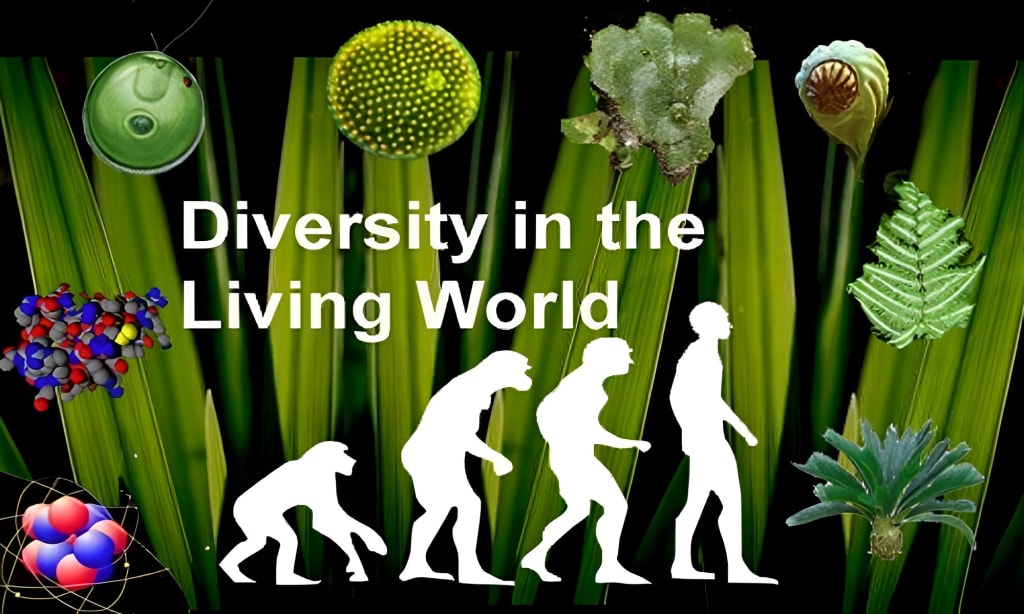
Diversity in Living World is a fascinating and complex topic in biology that explores the incredible range of life forms on our planet. From the tiniest bacteria to the largest animals, the diversity of living organisms is vast, and understanding it is essential to our understanding of the world we live in.
The classification of living organisms is based on certain criteria such as their body structure, mode of nutrition, and reproduction. The classification system is hierarchical, with different levels of classification ranging from the kingdom to the species. The five kingdom system of classification includes Monera, Protista, Fungi, Plantae, and Animalia. Each kingdom has unique characteristics, such as their mode of nutrition, cell structure, and reproduction.
The Monera kingdom includes the bacteria, which are single-celled organisms that can be found everywhere on our planet. Bacteria play a crucial role in our ecosystem and are responsible for many important processes such as nitrogen fixation, decomposition, and fermentation.
The Protista kingdom includes a diverse group of organisms that are primarily unicellular. This group includes organisms such as algae, which are crucial to the world's food chain, and protozoans, which are responsible for many diseases such as malaria.
The Fungi kingdom includes organisms such as mushrooms, yeasts, and molds. Fungi are important decomposers and play a vital role in nutrient cycling in our ecosystems.
The Plantae kingdom includes various groups of plants, such as Thallophyta, Bryophyta, Pteridophyta, Gymnosperms, and Angiosperms. Each group has unique characteristics, such as the structure of their body, mode of reproduction, and the economic importance of each group.
The Animalia kingdom includes various groups of animals, such as Porifera, Coelenterata, Platyhelminthes, Nematoda, Annelida, Arthropoda, Mollusca, Echinodermata, and Chordata. Each group has unique characteristics, such as the body structure, mode of reproduction, and the economic importance of each group.
The classification of living organisms is not only important in understanding the diversity of life on our planet, but it is also essential in identifying and describing new species. Binomial nomenclature is the scientific naming system used to name living organisms. The system is based on the genus and species of an organism, and it allows for universal communication about living organisms.
The study of biological classification also allows us to understand the relationships between different species and the evolutionary history of life on our planet. Evolution is the process of change in living organisms over time, and it has shaped the diversity of living organisms that we see today. Theories of evolution, such as Darwin's theory of evolution, explain how natural selection and genetic drift have resulted in the vast array of life forms on our planet.
Human evolution is a fascinating area of study within Diversity in Living World. The study of human evolution includes the study of our ancestors, such as the Australopithecus and Homo erectus. The discovery of ancient human remains and artifacts has allowed us to reconstruct our evolutionary history and understand the biological and cultural changes that have led to the development of modern humans.
In conclusion, Diversity in Living World is a crucial topic in biology that explores the incredible diversity of life on our planet. The classification of living organisms is based on certain criteria and is hierarchical, with different levels of classification ranging from the kingdom to the species. Understanding biological classification allows us to identify and describe new species, as well as understand the relationships between different species and the evolutionary history of life on our planet. The study of human evolution is a fascinating area of study within Diversity in Living World and allows us to understand our evolutionary history and the biological and cultural changes that have led to the development of modern humans.
About the Creator
Keep reading
More stories from writers in Education and other communities.
Common Workplace Injuries and How to Prevent Them Effectively
Workplace injuries are a serious concern across every industry in the United States. Whether employees work in offices, factories, warehouses, or construction sites, the risk of injury is always present. Some accidents happen suddenly, while others develop slowly due to poor habits or unsafe work conditions. These injuries can lead to missed workdays, costly medical bills, reduced productivity, and long-term health problems.
By Dr. Todd Young3 days ago in Education
Trouble at the Tea Leafing Café
The rain had started right around the time that Annie was buttering her second thick slice of homemade toast for breakfast, and hadn’t paused since. Not that anyone could tell. The windows of the café were fogged over, and with every seat filled with happy customers munching on fresh baked pastries or steaming bowls of the delicious soup of the day, it was hardly surprising. Annie looked around the room, finally taking a moment to breathe after the lunch time rush. Her old life already felt like a bad memory, a part of her history, always, but just that. History.
By Hannah Moore2 days ago in Fiction




Comments
There are no comments for this story
Be the first to respond and start the conversation.