
Discovery of the Beelzebufo
The Devil Toad That Challenged Ancient Geography

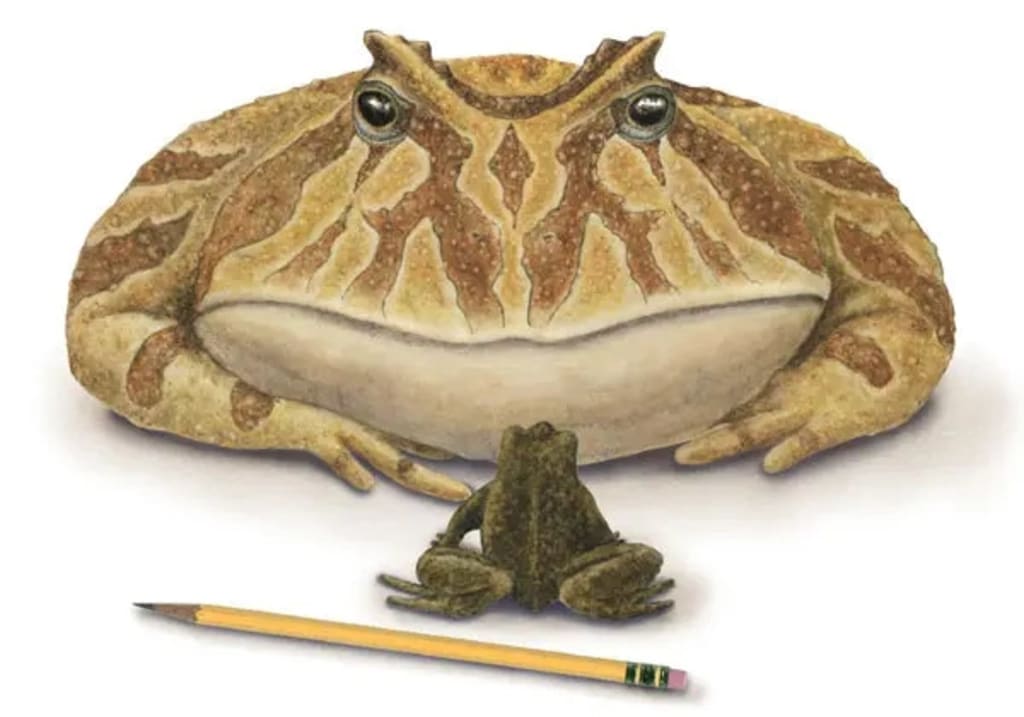
In a remarkable paleontological discovery, scientists have unearthed fossils of an enormous frog, Beelzebufo ampinga, from the Cretaceous period. This creature, aptly dubbed the “Devil Toad,” was a monstrous amphibian living among dinosaurs millions of years ago. The discovery, led by paleontologist David Krause of Stony Brook University, was published in the Proceedings of the National Academy of Sciences.
The Gigantic Frog
Beelzebufo ampinga was no ordinary frog. With a size comparable to a bowling ball, it measured approximately 16 inches in length and weighed around 10 pounds. This colossal size, coupled with heavy armor and teeth, made it a formidable predator of its time. Artistic renderings depict Beelzebufo facing off against the largest known living Malagasy frog, Mantydactylus ampinga, highlighting its imposing stature.
Krause began unearthing fragments of unusually large frog bones in Madagascar in 1993. These fossils dated back to the late Cretaceous period, roughly 70 million years ago, in regions that also yielded dinosaur and crocodile fossils. However, it was only recently that Krause and his team managed to assemble enough bones to reconstruct the appearance and weight of this extraordinary creature.
An Intriguing Relative
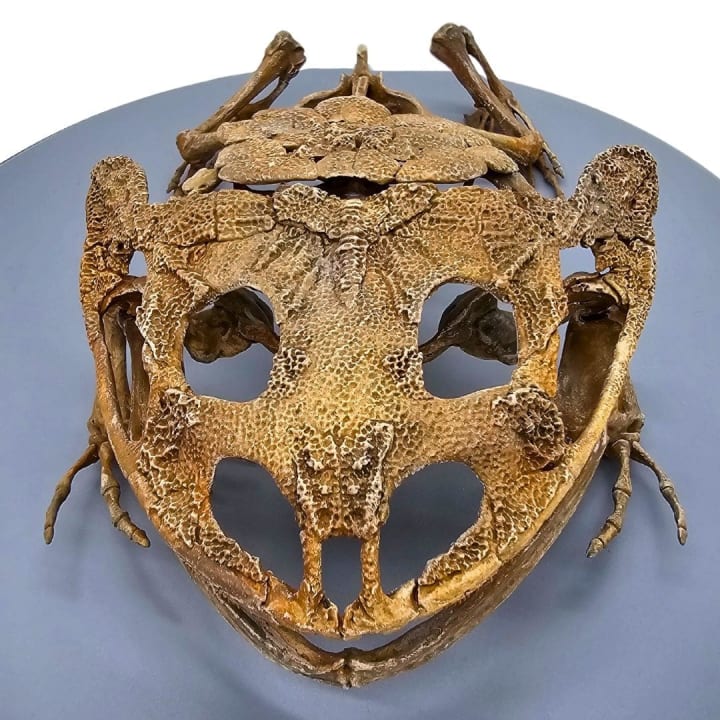
What makes Beelzebufo particularly fascinating is its apparent relationship with modern frogs. Despite being discovered in Madagascar, it seems to be closely related to the normal-sized horned frogs of South America, known scientifically as Ceratophrys. These frogs, popular as pets and often called pacman frogs due to their large mouths, share several characteristics with Beelzebufo. The giant frog had a wide mouth, powerful jaws, and teeth, features that align with the voracious predatory habits of its modern relatives.
The skeletal structure of Beelzebufo revealed skull bones that were extremely thick, with ridges and grooves indicative of armor or a protective shield. These adaptations likely served to protect the frog from predators and aid in its own predatory behavior. Krause speculated that Beelzebufo, if it shared habits with its South American cousins, might have been capable of preying on hatchling dinosaurs.
A Puzzle of Paleogeography
The discovery of Beelzebufo has significant implications for our understanding of ancient geography. The standard theory of continental drift posits that Madagascar had long been separated from South America by ocean during the late Cretaceous period. Frogs, being unable to survive extended periods in salt water, pose a challenge to this theory. The relationship between Beelzebufo and South American horned frogs suggests that there might have been a land connection between these continents much later than previously thought.
Krause and his team propose that this connection might have existed via a warmer Antarctica. During the Cretaceous period, Antarctica was not the icy continent we know today but a landmass with a more temperate climate. This warmer environment could have allowed for a land bridge, facilitating the migration of species between Madagascar and South America.
Implications for Evolution and Paleontology
The discovery of Beelzebufo provides new insights into the evolutionary history of amphibians and the geographic history of the Earth's continents. It challenges existing theories and opens up new avenues for research. Krause’s work highlights the dynamic and interconnected nature of ancient ecosystems and the complex processes that have shaped the distribution of species over millions of years.
As scientists continue to study Beelzebufo and other ancient species, we can expect to uncover more about the fascinating history of life on Earth. The Devil Toad stands as a testament to the wonders of paleontology and the ever-evolving story of our planet’s past.
In conclusion, the unearthing of Beelzebufo ampinga not only reveals an awe-inspiring creature but also raises important questions about the ancient world. Its existence hints at unknown connections between continents and provides a window into the lives of creatures that roamed the Earth millions of years ago.
About the Creator
Horace Wasland
Research analyst, writer & mystical healer. Exploring the edge where science meets mystery. From mystery/the mystical, to facts, news & psychology. Follow for weekly insights on all four and please leave a tip if you like what you read :)
Keep reading
More stories from Horace Wasland and writers in Education and other communities.
The Coffee Awakening
One day around 850 CE, a goatherd named Kaldi observed that, after nibbling on some berries, his goats started acting abnormally. Kaldi tried them himself, and soon enough he was just as hyper. This was humanity’s first run-in with coffee—or so the story goes. When exactly people began consuming coffee is unclear, but at some point before the 1400s, in what’s now Ethiopia, people began foraging for wild coffee in the forest undergrowth.
By Horace Waslandabout a year ago in Education
Your phones camera isn't as good as you think
When the Visualphone VP210 hit the market in 1999, it advertised a never-before-seen feature: a camera. With only 0.11 megapixels and storage for 20 photos, the Visualphone is a relic compared to modern devices sporting three distinct cameras, each with up to 100 times more resolution. But while this technology has improved dramatically in the 21st century, engineers are rapidly approaching a hard limit on phone camera quality. To understand this limit, we first need to know how phone cameras work.
By Munesh Yadavabout 20 hours ago in Education
Miss Persephone's Manual to a Seemingly Ordinary Life
Miss Persephone was found at the dining table, her blue eyes swollen, her tears arriving and retreating like the tides of the ocean. Earlier that day, her family had visited her in the retirement home where she had lived for eight years. It was her eightieth birthday.
By Imola Tótha day ago in Fiction




Comments (1)
Thanks for sharing