
Did The United States Commit Genocide?
Over the span of 500 terrible years, both European settlers and the US government committed genocide against Native Americans, killing millions.


The years-long debates and protests over the Dakota Access Pipeline, which began in 2016, shed new light on issues that have plagued Native Americans for hundreds of years — and, regrettably, continue to do so.
The Standing Rock Sioux were concerned that the pipeline would devastate their territory and cause an environmental disaster. Despite their objections, the pipeline was constructed and began transporting oil in June 2017.
Then, in 2020, an environmental evaluation confirmed what the Sioux had been claiming all along: the leak detection system was inadequate, and there was no environmental plan in place in the case of a spill.
Finally, the pipeline was ordered to be closed in July 2020, bringing the four-year struggle to a close.
At the heart of the battle were oppressive systems that fought for generations to annihilate Native American communities and seize their geographical holdings by force. Millions of Native Americans died as a result of battle, sickness, forced deportation, and other factors.
Only recently have historians begun to name the United States' treatment of indigenous peoples for what it truly is: genocide.
Did America Commit Genocide?
Among other things, colonists and the US government engaged in warfare, mass executions, cultural practice eradication, and the separation of children from their parents. Many of the actions committed by the United States settlers and government against Native Americans were clearly genocidal.
The United States not only committed genocide against Native Americans, but it did so over hundreds of years. Ward Churchill, an ethnic studies professor at the University of Colorado, describes it as a "vast genocide... the most persistent on record."

Indeed, Adolf Hitler, whose extermination of 6 million European Jews stunned the world, was inspired by how the United States had deliberately destroyed much of its indigenous population.
In recent years, important political personalities in the United States have finally acknowledged the Native American genocide and the number of Native Americans slaughtered.
As Americans come to terms with how many Native Americans have been slain in the United States' history, it is critical that this heinous chapter of history not be forgotten or erased.
The Amount of Native American Genocide
The number of the Native American population prior to Christopher Columbus' arrival has long been contested, both because trustworthy evidence is extremely difficult to come by and due to underlying political objectives.
That is, those seeking to reduce US culpability for Native American genocide frequently maintain the pre-Columbus native population estimate as low as possible, thereby lowering the Native American mortality total as well.
Estimates of the pre-Columbus population range from around 1 million to approximately 18 million in North America alone — and as much as 112 million in the Western Hemisphere overall.

Regardless of how great the original population was, by 1900, it had fallen to a minimum of only 237,196 in the United States. While it is difficult to say how many Native Americans were slain, the amount is most certainly in the millions.
Wars between tribes and settlers, as well as the seizing of native lands and other types of oppression, contributed to these high death tolls, with Native American populations dying at rates as high as 95 percent in the aftermath of European colonialism.
It's unknown how many Native Americans were slain by the earliest explorers and settlers, but they were treated violently and with disdain from the moment they came into contact with Europeans.
Christopher Columbus marks the beginning of the Genocide
When Christopher Columbus arrived on a Caribbean island that he mistook for India, he immediately ordered his crew to kidnap six "Indians" to serve as servants.
And as Columbus and his troops continued their conquest of the Bahamas, they enslaved or exterminated the indigenous people they encountered. Columbus and his soldiers seized 500 people on one mission, intending to sell them as slaves in Spain. 200 of these Native Americans died just crossing the Atlantic.

The Bahamas had between 60,000 and 8 million native people before Columbus. By the 1600s, when the British occupied the islands, that number had reduced to nothing in certain locations. On Hispaniola, the whole indigenous population had been exterminated, with no record of how many Native Americans were killed.
Following Columbus' lead, the colonists and explorers that came after him either captured or killed the native peoples they found. Native Americans were considered barriers, animals, or both from the outset, justifying innumerable Native American killings.
In 1539, Hernando de Soto, for example, arrived in Florida. This Spanish invader kidnapped a number of indigenous individuals to serve as guides when he conquered the land.
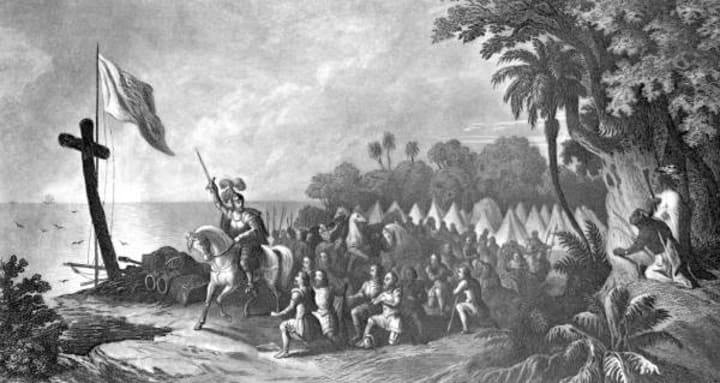
Nonetheless, the majority of Native American deaths were caused by sickness and famine brought about by the advent of European invaders, rather than through combat or direct assaults.
Disease, wiped out an estimated 90 percent of the population.
The immigrants and their tamed cows, pigs, sheep, goats, and horses had previously exposed Native Americans to Old World infections. Millions of people died as a result of measles, influenza, whooping cough, diphtheria, typhus, bubonic plague, cholera, and scarlet fever.
About the Creator
Rare Stories
Our goal is to give you stories that will have you hooked.
This is an extension of the Quora space: Rare Stories
X(formerly Twitter): Scarce Stories
Writers:
....xoxo
Keep reading
More stories from Rare Stories and writers in Education and other communities.
How Local Dairy Education Helps People Understand Nutrition
Understanding nutrition is not always easy. Many people read food labels, watch health videos, or follow diet advice online, yet still feel confused. There is simply too much information, and much of it is unclear or conflicting.
By AMRYTT MEDIA6 days ago in Education
The Proven Natural Skincare Secret with Healthy Skin
Healthy skin does not come from harsh products or complicated routines. It comes from working with nature, not against it. The natural skincare secret that many people overlook is the power of raw honey as a daily skin ally. This simple ingredient has been used for generations, yet many still do not understand its effectiveness. When used correctly, raw honey can change how your skin looks and feels.
By Kelln Small2 days ago in Education
Wild Card Weekend Recap: What Happens Now?
I think I figured out why I love Wild Card Weekend so much. It's because it's the first playoff anything of the calendar year. The NFL season starts in the fall, and once upon a time, the champion was crowned either on or slightly before New Year's. The evolution of the NFL schedule has resulted in the playoffs starting just into the New Year, and currently, the final week of the season falls on the first weekend of the New Year, with Wild Card Weekend coming a week after that. So yes, chronologically, the NFL's Wild Card Weekend serves as the first playoff anything of the calendar year.
By Clyde E. Dawkins2 days ago in Unbalanced



Comments
There are no comments for this story
Be the first to respond and start the conversation.