
Designs and Operations of Sanitary Landfills
How Sanitary Landfill works?

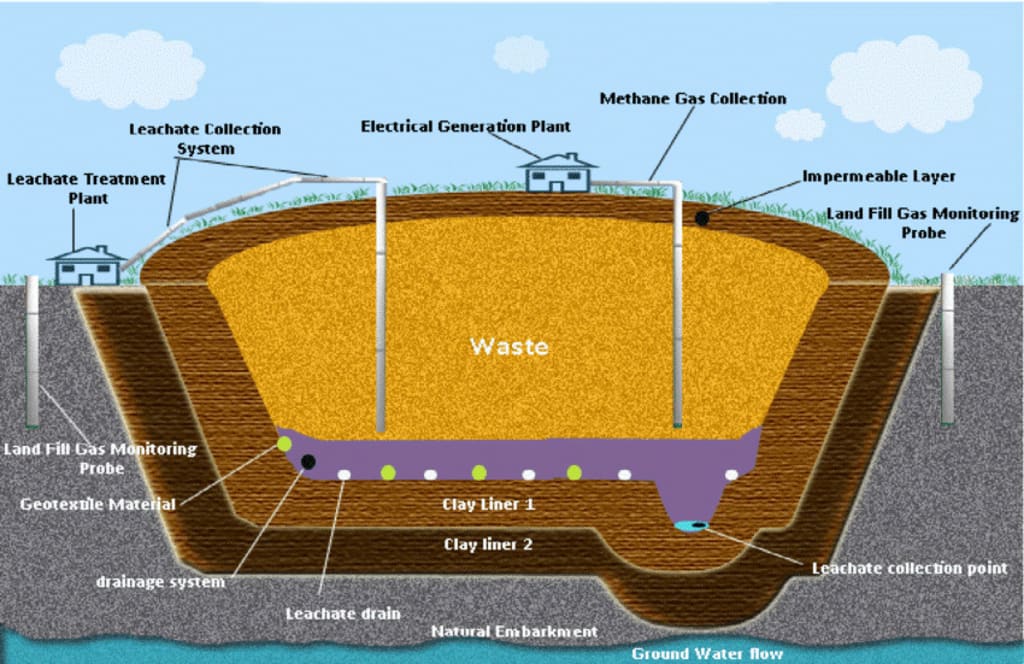
One of the most effective way of dumping pollution is sanitary landfill. In this method a hole is dug in the land in which waste is dumped in layers form and is compacted to make it solid. The safe dumping of waste is made possible by number of designs including bottom liner, cells, storm water drainage, methane collection system, leachate collection system, groundwater monitoring system, cover etc. For meeting the specific requirement standards a number of operations are performed in sanitary landfills. These operations includes limited to a smaller area, covering with soil layers, compacted to reduce the volume.
Sanitary Landfills:
Sanitary landfills is one of the most effective ways of dumping the wastes without pollution in modern countries. It is basically a pit or hole having a safe bottom in which the wastes is dumped in the form of layers and it is further compressed in order to make it solid. In this way the waste is not directly in contact of surface runoff, rain or ground water. The key purpose of landfills is to make sure that the waste is safe by managing safe decomposition. The process of decomposition is fastened by the layers of soils and garbage. The decomposition of waste causes the production of methane gases which is used for electricity production instead of its release into the air.
Sanitary landfill design:
The main purpose of sanitary landfill is to help in the safe waste disposal for the protection of environment and public health. The design of sanitary landfill should be in such a way to protect land, soil, air and water. The basic purpose of sample design of sanitary landfill is the maximum disposal of waste within the given resources. It is a science that is evolving continuously with time. The different kinds of sanitary landfill design are as below:
Bottom Liner:
In this type of sanitary landfill, the under-ground natural resources and water is prevented to come in contact with the buried waste with the help of bottom liner. The bottom liner is made up of high density polyethylene having long durability and is puncture resistant along with clay soil.
Storm water drainage:
This design is made in order to prevent and gather water run off during floods, storms or rain. It may also contain open channels. It is used to collect the run offs from buildings and highways. This practice is more common in urban or thickly populated areas.
Cover:
In this design cover is required to be place around such kind of waste which is placed in cell. This cover may daily cover or the cover of compacted soil having the thickness of 6 inches. Some commonly used cover are spray-on cover material, cover of tarpaulin material. These kind of covers are applied and removed on daily basis.
Cells:
Cells are defined as a particular area designed for the waste disposal in landfills. The length of cells is variable ranging from few acres to several hundred acres that depends on the amount of waste. The larger cells are further divided into smaller cells which are daily workface. Daily workface is the place where waste is dumped regularly and before adding another layer, it is covered with soil or layer of clay.
Ground water monitoring Stations:
In order to access and examine the underground water present in the around the land fill for leachate contamination various stations are formed. It has basically two parts. Up-gradient well that is setup to check the quality of water before moving to disposed zone. Down-gradient well is setup to check the quality of water after its passing to disposal area. This is done to assure that groundwater has not been affected by wastes disposal.
Conclusion:
It is basically a pit or hole having a safe bottom in which the wastes is dumped in the form of layers and it is further compressed in order to make it solid. A number of sanitary landfill design are available including leachate collection system, bottom liner, cells, storm water drainage, methane collection system, groundwater monitoring system, cover etc. For meeting the specific requirement standards a number of operations are performed in sanitary landfills. These operations includes limited to a smaller area, covering with soil layers, compacted to reduce the volume.
About the Creator
senya abdulrehman
"Creating magic with words, one page at a time"
Keep reading
More stories from senya abdulrehman and writers in Education and other communities.
Positives of Covid-19
Covid-19 has drastically changed the environment globally. It has impacted the environment both positively and negatively. However more positive impacts of lockdown are seen throughout the world then its negative impacts. The positive impacts of Covid-19 includes reduced fossil fuel consumption, reduce waste disposal, \reduced resource consumption, reduced transport activities, reduced pressure on tourists destinations. The negative impact of Covid-19 includes increased medical wastes, increased use of PPE, increased municipal waste and reduced recycling.
By senya abdulrehman3 years ago in Education
Unlock Pinpoint Precision: How to Improve Golf Accuracy and Control With Expert Techniques
Golf is a game of small margins. A shot that veers just a few yards off course can cost you a stroke or even more. While power may seem impressive, accuracy and control are what truly separate average players from skilled ones. These qualities help you land the ball where you want it, avoid hazards, and play with more confidence.
By Daniel Ladner3 days ago in Education
Rachel Reviews: The Spiral Archive by Pieter Hendrik
It's difficult for me to know where to start with a review of this book as it was, for me, an entirely unique experience and one that I'll probably never have again. I don't want that to be interpreted as unenjoyable but it has left me scratching my head a little and ruminating on its content, its themes and its characters.
By Rachel Deeming7 days ago in BookClub


Comments
There are no comments for this story
Be the first to respond and start the conversation.