
Designing a URL Shortener
Make Links Short & Sweet ✂️🔗


The Long Story (Literally)
Your friend sends you a link to their portfolio:
https://www.thisisaverylongurl.com/users/portfolio?userId=9xk34&ref=linkedin
Looks like a digital snake 🐍. You squint at it, sigh, and say:
“Why not shorten that?”
Boom 💥 — now it's:
bit.ly/myfriend
Looks clean. Feels good. And today, you're going to learn how to build something just like that.
Let’s design our own URL shortener — a mini Bit.ly — from scratch, system design style.
🎯 What Is a URL Shortener?
A URL shortener is a service that takes a long, hard-to-remember link and turns it into a short version.
Think:
👉 Long URL: https://amazon.com/product/deal/123xyz456
👉 Short URL: amzn.to/deal
When someone clicks the short link, the system redirects them to the original long URL.
Services like Bit.ly, TinyURL, and Twitter’s t.co do exactly this.
🧩 Step 1: Define the Requirements
Before jumping into code or architecture, ask:
💡 “What does this system need to do?”
✅ Functional Requirements
- Take a long URL, return a short one
- Redirect short URLs to the original ones
- Bonus features:
- Custom aliases (short.ly/myportfolio)
- Expiration dates
- Click analytics
🧱 Non-Functional Requirements
- High availability — links should never break
- Low latency — redirections must be fast
- Scalability — must handle billions of links
- Reliability — data should never be lost
🔢 Step 2: Generating Short URLs
This is the core of the system. Here are two popular methods:
✨ Method 1: Hash the URL
Use hashing (like MD5 or SHA-256), and take the first 6–8 characters.
- ✅ Easy to implement
- ❌ Risk of collisions
- ❌ Not ideal for versioning or expiration
🚀 Method 2: Counter + Base62 (Recommended)
- Maintain a global auto-incrementing counter
- Convert the counter to Base62 (0–9, a–z, A–Z)
- Use that as the short code!
💡 Base62 gives you 62⁶ = 56.8 billion combinations with just 6 characters!
Example:
Counter = 123456 → Base62 = abc123
🗃️ Step 3: Database Design
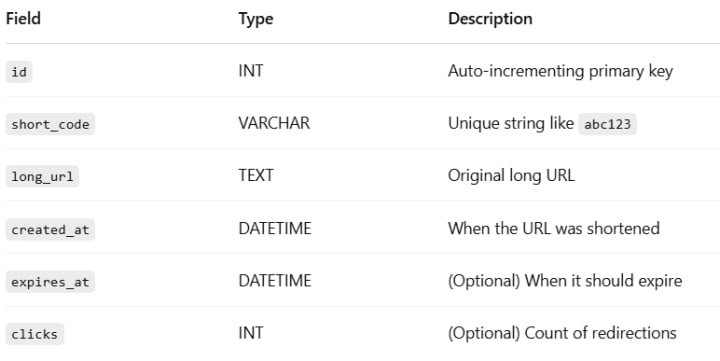
We need a place to store the mappings between long and short URLs.
Table: url_mappings
⚙️ Step 4: Workflow Breakdown
✂️ a. Shortening a URL
- User sends a POST request with a long URL
- Backend increments counter → converts to Base62
- Stores mapping in database
- Returns: https://short.ly/abc123
🔁 b. Redirecting a URL
- User visits https://short.ly/abc123
- Backend looks up abc123 in DB
- If found (and not expired), redirect to long URL
⚡ Step 5: Make It Fast with Caching
Redirection is read-heavy. You don’t want to hit the DB every time.
Use Redis or Memcached:
- Cache hot short codes like abc123 → original URL
- On miss: fetch from DB and populate cache
- On expiration: remove from both cache and DB
🌍 Step 6: Make It Scale
When traffic grows, your system must grow too.
Techniques:
- Sharding: Split DB into smaller parts
- Replication: Use read replicas for redirects, master DB for writes
- Load Balancing: Spread requests across multiple servers
- CDN: Use edge locations for faster redirect responses
- Rate Limiting: Stop bots from spamming millions of links
🎁 Bonus Features
1. Expiration Dates
- Add TTL to each short URL
- Delete or mark invalid after expiration
2. Custom Aliases
- Let users choose:
- short.ly/sreya-portfolio
- Check if alias already exists before saving.
3. Analytics
Track:
- Number of clicks
- Geo-location
- Browser/device type
Use tools like Kafka, Spark, or BigQuery for scalable analytics pipelines.
🏁 Wrapping It All Up
And that’s a wrap on URL shorteners! Here’s what you’ve learned:
- Generate Short Links Efficiently with Base62 encoding and a counter for fast, scalable links.
- Ensure Speed and Reliability by caching popular links and reducing database hits for quicker redirection.
- Scale for Growth through sharding, replication, and load balancing to handle millions of requests.
- Add Extra Features like custom aliases, expiration dates, and analytics to make your service stand out.
About the Creator
Sreya Satheesh
Senior Software Engineer | Student
https://github.com/sreya-satheesh
https://leetcode.com/u/sreya_satheesh/
Keep reading
More stories from Sreya Satheesh and writers in Education and other communities.
Capacity To Ship Packages Within D Days
You run a super busy delivery company. Your mission? Ship a bunch of packages within D days. There’s one catch: You can’t just use any truck. Each truck has a maximum weight capacity, and you need to figure out the smallest capacity that still gets the job done on time.
By Sreya Satheesh9 months ago in Education
How Early Hustle Jobs Build Lifelong Skills and Confidence
Early hustle jobs often begin as simple ways to earn extra money, but their long-term impact is far greater than most people recognize. Whether someone starts by babysitting, mowing lawns, working retail, or serving tables, these early experiences develop foundational skills that shape personal and professional success for decades.
By David Lipan4 days ago in Education
Career Growth Paths After Completing a Network Technician Program
Embarking on an Information Technology career can be very thrilling and fulfilling, especially when you choose a high-demand field that offers a clear path for career advancement. A computer network technician training gives a very good foundation for those who are new to the field of networking to learn and get acquainted with the very basics of networking, hardware, software, and troubleshooting. Getting through a computer network technician program would not only make you technically competent to enter the IT field but would also open multiple pathways for your career growth.
By Meaghan Howeabout 5 hours ago in Education



Comments