
Database Management Systems|Enhanced Entity Relationship and Object Modeling
6.0 Enhanced Entity Relationship and Object Modeling


6.1 Super Classes/ SubClasses
• Entity type represents
o Type of Entity
o Entity Set (collection of entities of that type that exist in the database)
• Entity type may have many subgroups
o Sub groups need to be represented explicitly (due to the significance to
the database)
• Each sub group is called a Sub Class
• Main entity type, which belongs the subgroups is called Super Class
• Member entity of sub class represents the same real world entity as some entity of the super class
• At the same time, that particular entity of sub class plays a distinct specific role, by which the specialty is identified
• Each member of sub class is a member of its super class
• Super Class – Sub Class relationship is called an IS-A relationship
Eg:

6.2 Type Inheritance
• Member of the sub class
o Inherits all the attributes and the relationships of the super class
o In addition, it has its own specific attributes and relationships
• Sub Class with these inherited and specific attributes and relationships is
considered as an individual entity type
6.3 Specialization/Generalization
6.3.1 Specialization
• Process of
o Defining a set of sub classes of an entity type
o Establish additional attributes with each sub class
o Establish additional specific relationships between each sub class and
other entity types
• Based on some distinguishing characteristics of the entities in the super class
• The specific attributes (those apply only to entities of a particular sub class) are called specific attributes or local attributes
• ⊂: class/subclass relationship
• EngType: specific or local attribute
• Manage: specific relationship to “Manager”
6.3.2 Generalization
• Process of
o Minimizing the differences between entities by identifying common
features.
o Generalizing them into a typical superclass
o Defining a generalized entity type from given entity types
• Suppress the differences among different entity types
• Functionally, the inverse of specialization
• Original entity types are special subclasses

• Identify common features
• Group them to form a superclass
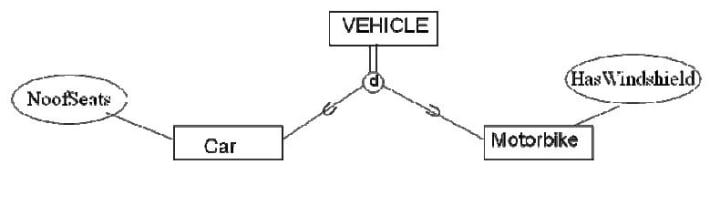
6.4 Characteristics and Constraints of Specialization and Generalization

6.4.1 Predicate-Defined Sub Classes
• Also called Condition-Defined sub class
• Determine the sub class to which an entity is belong to, by applying a
condition on the value of a given attribute of the super class
• Condition is called defining predicate
• Defining Predicate is the constraint which specifies the entity with which
value of the particular attribute should go the given sub-class
• Attribute –Defined Specialization
• All the sub classes have their specialization, depending on the conditions
formed on the same attribute, of the super class
• Such attribute is called defining attribute of the specialization
6.4.2 User-Defined Sub Classes
• Membership to the sub class is specified by the database users at the time of operation
• Membership is specified individually for each entity by the user
• No conditions are used to evaluate the entities automatically
6.4.3 Disjointness Constraint
• An entity can be a member of at most one sub class
• Attribute defined specialization implies the Disjointness, if defining attribute is a single valued
• In EER diagram, disjointness is denoted by a letter d in a circle
6.4.4 Overlapping Specialization
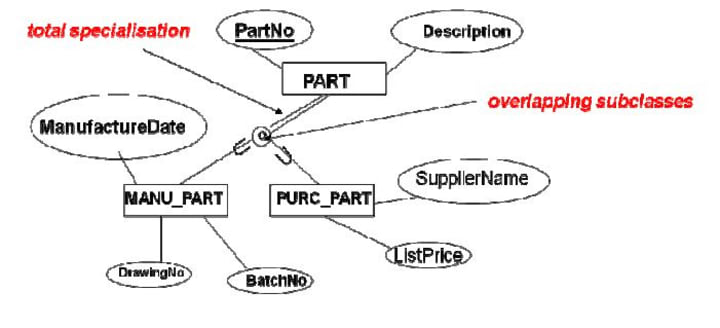
6.4.5 Completeness Constraint
• Partial Specialization
o Allows an entity not to belong to any sub class
o Denoted by a single line connecting the super class to the circle
6.4.6 Insertion and Deletion Rules
• Deleting an Entity from super class automatically deletes the entity from all the sub classes to which it belongs
• Inserting an entity in a super class implies that the entity is mandatorily inserted to the predicate-defined sub classes, if the entity satisfies the defining predicate
• Inserting an entity in a super class of total specialization implies that the entity is mandatorily inserted in at least one sub class
6.4.7 Union Types
• Considered with multiple inheritance
• Used to represent sub classes which inherit from more than one disjoint super classes
• The domain for sub class entity is the UNION of all its distinct super class entity types
• Such sub class is called a Union Type or a Category
• Super classes of the category may have different key attributes
• Total Category
o Holds union of all entities in its super class
o Represented by a double line connecting the category and the circle
• Partial Category
o Can hold a subset of union
o Represented by a single line connecting the category and the circle
6.4.8 Specialization Vs Categorization
• If the categorization is total, it may also be alternatively represented as Total Specialization
• Use Specialization if the two classes
o represent the same set of entities
o Share many attributes including the same key attribute
• Otherwise, categorization (Union Type) is more appropriate
6.4.9 Specialization Lattice
• Occurs when a sub class has more than one parent classes (multiple inheritance)
• If its parent class is also a subclass of another super class, the level 2 sub class inherits from both:
o Direct super class
o Predecessor super class
About the Creator
The Modern Real Estate Landscape: Key Trends Defining Today’s Market
The real estate market today is far from static, shaped by a combination of economic shifts, lifestyle changes, and technological innovation. Buyers, sellers, and investors face a dynamic environment that demands awareness of emerging patterns and adaptability in strategy. From shifting work habits to sustainability concerns, understanding these trends is essential for navigating the current market and making informed decisions.
By Michael O'Sullivan Hampton5 days ago in Education
Scaling Smart: How Consultants Support Business Growth and Efficiency
Business growth sounds exciting. More sales, more customers, and greater market visibility. But growth can also create stress. Costs may rise. Teams may struggle to keep up. Systems that once worked smoothly may start to break down. This is why many companies look for expert guidance. They want to understand how consultants support business growth and efficiency to deliver real, lasting results.
By Nicole Metza day ago in Education


Comments
There are no comments for this story
Be the first to respond and start the conversation.