
Crimson worm🐛
How’s God’s love similar to that of a crimson worm?
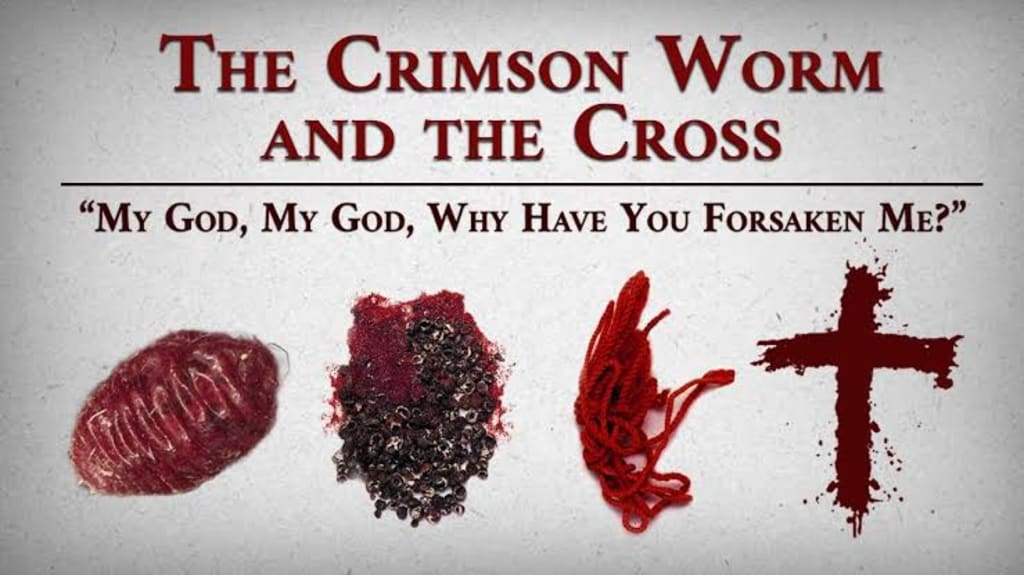
“For God so loved the world, that he gave his only begotten Son, that whosoever believeth in him should not perish, but have everlasting life.”(He died so we can have life.)
According to biblical references, the crimson worm is sometimes used as a symbol to represent God's love. The crimson worm is known for sacrificing itself to give birth to its offspring, and the red dye it produces is also used as a symbol of sacrifice and redemption. Similarly, God's love is often described as sacrificial and redemptive.
The Life Cycle of the Crimson Worm
The Crimson Worm (scientific name: coccus ilicis or kermes ilicis) looks more like a grub than a worm. In the lifecycle of this worm is where the remez is found. And it points to the work of Jesus on the cross.
When the female crimson worm is ready to lay her eggs, which happens only once in her life, she climbs up a tree or fence and attaches herself to it. With her body attached to the wooden tree, a hard crimson shell forms. It is a shell so hard and so secured to the wood that it can only be removed by tearing apart the body, which would kill the worm.
The female worm lays her eggs under her body, under the protective shell. When the larvae hatch, they remain under the mother’s protective shell so the baby worms can feed on the living body of the mother worm for three days. After three days, the mother worm dies, and her body excretes a crimson or scarlet dye that stains the wood to which she is attached and her baby worms. The baby worms remain crimson-colored for their entire lives. Thereby, they are identified as crimson worms.
On day four, the tail of the mother worm pulls up into her head, forming a heart-shaped body that is no longer crimson but has turned into a snow-white wax that looks like a patch of wool on the tree or fence. It then begins to flake off and drop to the ground looking like snow.
Isa 1:18 Come now, and let us reason together, saith the LORD: though your sins be as scarlet [shaniy – root word of tola’ath], they shall be as white as snow; though they be red like crimson [tola’ath], they shall be as wool.
The Body of the Tola’ath
In biblical times, the red dye excreted from the Crimson Worm was used in the High Priest’s robe and probably for red dye used on ram’s skins to create the covering of the Tabernacle in the wilderness (Ex 26:1, 28:5). Uses of this red dye continue today. While still red and attached to the tree, the worm’s body and shell are scraped off and used to make what is called “Royal Red Dye.” The waxy material is used to make high-quality shellac, used in the Middle East as a wood preserver. And the remains of the Crimson Worm are also used in medicines that help regulate the human heart.
What Does Psalm 22 Mean: “I am a Worm”
Was Jesus a “Crimson Worm” on the cross? In typology, yes!
Psa 22:6 But I am a worm, and no man; a reproach of men, and despised of the people.
Isa 1:18 … though your sins be as scarlet, they shall be as white as snow; though they be red like crimson, they shall be as wool.
Just as the mother worm attaches herself to the wood of a tree or fence, Jesus put himself on a wooden cross, a type of “tree.” And Jesus willingly allowed the nails to be driven into His hands (1 John 3:16). However, it wasn’t the nails that held Him on the cross. It was His desire to fulfill the purpose and plan of God the Father to redeem man from sin (Gal 1:4).
Just as the mother worm attaching herself to a tree is part of God’s design for the worm’s lifecycle, so also, it was God’s plan, His design, to send His Son to be attached to a tree, a wooden cross, to die (2 Tim 1:9, 1 Pet 1:20).
Just as the mother worm, when crushed, excretes a crimson, scarlet dye that both covers the baby worms and stains, or marks, them, Jesus was also bruised, or crushed, for our iniquities (Isa 53:5). His scourgings, and the nails that were driven into his hands and feet, brought forth His crimson, scarlet blood that both washes away our sins (Rev 1:5) and marks us as His own (Eph 2:13).
Finally, just as the baby worm is dependent on the mother worm for the crimson dye to give it life and to mark it, a repentant sinner must depend on the blood of Jesus for the forgiveness of sins, to receive new life, and to be marked as His own (Acts 4:12, 1 Pet 1:18-19).
A Little Red Worm
In expounding on Psalm 22:6 (“But I am a worm, and no man; a reproach of men, and despised of the people”), Charles Spurgeon wrote:
“There is a little red worm which seems to be nothing else but blood when it is crushed. It seems all gone except a blood-stain. And the Savior, in the deep humiliation of His spirit, compares Himself to that little red worm. How true it is that ‘He made Himself of no reputation’ for our sakes! He emptied Himself of all His Glory, and if there is any glory natural to manhood, He emptied Himself even of that! Not only the glories of His Godhead, but also the honors of His Manhood He laid aside that it might be seen that ‘though He was rich, yet for our sakes He became poor.’”
Jesus became poor. And in typology, having the sins of the world upon Himself, Jesus became like a worm, like a lowly crimson worm, hanging on a tree. (Job 25:6 and Isa 41:14 reveal the typology of sinful man as a worm.)
Nature Declares the Glory of God
Look around and see all the whispers of Jesus. From the beauty of God’s creation — the sun, the moon, the stars, the land, the seas, the animals, and especially mankind — everything testifies of our amazing God. In the spring, we see new life emerging, and in the summer, we feel the sun’s warmth. In the fall, the colors of God’s “paintbrush” are vivid, and in the winter, the world rests in a blanket of white. All this is the lifecycle of nature. And all is a gift from God.
“Come now, and let us reason together, saith the LORD: though your sins be as scarlet, they shall be as white as snow; though they be red like crimson, they shall be [white] as wool.” Isaiah 1:18
About the Creator
Keep reading
More stories from writers in Education and other communities.
Is transcription work suitable for stay-at-home mothers
For many stay-at-home mothers, the idea of earning an income sounds appealing—until reality steps in. Fixed schedules, long hours, childcare costs, and constant interruptions can make traditional jobs feel impossible. That’s where transcription work often enters the conversation. But is it actually a good fit, or just another work-from-home promise that doesn’t hold up in real life?
By Mahesh Kumar2 days ago in Education
The Path to Salvation
The late autumn evening air filled the monk's lungs, but it wasn't the season that chilled his bones. The heavy-handed presence of evil he had sensed upon entering the woods surrounding this mountain village had not bothered to conceal itself from him.
By Made in DNA7 days ago in Fiction



Comments (2)
The process of the female Crimson Worm laying her eggs and sacrificing herself for her offspring bears striking parallels to the story of Jesus' crucifixion. Just as the female worm attaches herself to a wooden surface and forms a protective shell, https://heardleunlimited.com/ Jesus was nailed to the wooden cross, enduring immense suffering and sacrifice.
Best playing place on this website https://solitaire-klondike.net play klondike solitaire free online game all time favorite game.