
Counting from 1 to 10: A Magical Journey for Kids
A fun start of journey for the little ones
Learning numbers is an exciting and essential milestone in a child's early development. Numbers 1 to 10 lay the groundwork for future counting, mathematical skills, and problem-solving abilities. Recognizing numbers, understanding their order, and connecting them to real-world objects helps children develop cognitive and analytical skills from a young age.
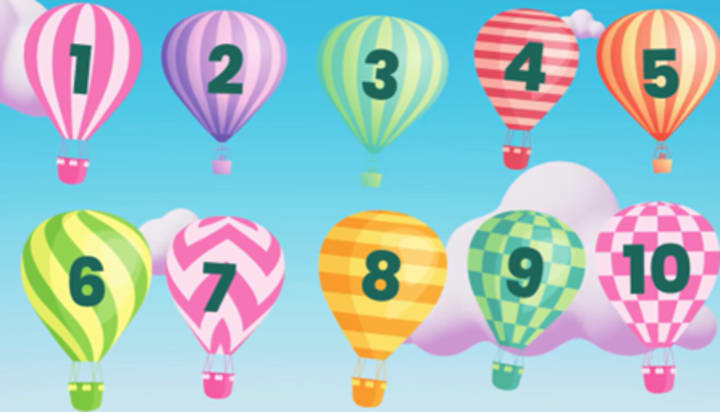
This fun and engaging journey introduces kids to each number, its spelling, and its significance, making learning an adventure full of discovery! Let’s explore the world of numbers together and see how they appear all around us.
Discovering the First Numbers
1 - The Beginning of Counting
We start with the number 1, written O-N-E. This number is the simplest and easiest to recognize because it represents a single object. Whether it’s one sun shining brightly, one balloon floating in the air, or one little puppy playing in the park, the number 1 is all around us!
Children often associate the number 1 with themselves—one child, one toy, or one story before bed. It helps them understand the concept of individuality and self-awareness in the learning process.
2 - The Power of Pairs
The number 2, written T-W-O, introduces the idea of pairs. Two things that are alike or come together make counting even more fun! Children love finding examples like:
- Two shoes on their feet
- Two hands to clap with
- Two little kittens playing together
The number 2 helps kids understand balance and relationships between objects in the world around them.
3 - A Small Trio
The number 3, spelled T-H-R-E-E, brings the concept of small groups. Some fun examples include:
- Three wheels on a tricycle
- Three scoops of ice cream
- Three little pigs from the famous story
By learning about the number 3, children begin recognizing patterns and forming connections between objects.
4 - A Balanced Quartet
Four, spelled F-O-U-R, is an important number in everyday life. We see it in:
- Four legs on a chair or table
- Four seasons in a year
- Four corners of a square
The number 4 introduces stability and balance, helping children see how things are structured and organized.
Exploring the Middle Numbers
5 - High Five!
The number 5, written F-I-V-E, is a special number for kids because they can count it on their fingers! It is also seen in:
- Five petals on many flowers
- Five fingers on one hand
- Five-pointed stars in the sky
The number 5 is easy to learn because it’s used daily in activities like high-fives, counting fingers, and spotting star shapes.
6 - The Sweet Six
The number 6, spelled S-I-X, is found in many places, such as:
- Six eggs in half a dozen
- Six legs on an insect
- Hexagons, which have six sides
The number 6 introduces kids to geometrical shapes and patterns, making learning more interactive.
7 - Lucky Number Seven
Seven, spelled S-E-V-E-N, is often considered a lucky number. It appears in many things, such as:
- Seven days in a week
- Seven colors in a rainbow
- Seven musical notes in a scale
The number 7 helps children understand the structure of time (weeks) and how colors and music relate to numbers.
Reaching Higher Numbers
8 - The Number of Mirth
Eight, spelled E-I-G-H-T, is often seen in fun and playful things like:
- Eight legs on a spider
- Eight arms of an octopus
- Eight slices of a pizza
The number 8 is unique because its shape (∞) resembles the symbol of infinity, introducing children to visual number connections.
9 - The Final Fling Before 10
Nine, spelled N-I-N-E, is just one step before 10! It is found in:
- Nine planets in the solar system (before Pluto’s reclassification)
- Nine balls in a playground game
- Nine apples in a basket
Nine helps children understand larger collections and grouping before reaching the milestone of 10.
10 - The Grand Finale!
Finally, we arrive at 10, spelled T-E-N! This number is a major milestone for young learners because:
- We count with 10 fingers
- A perfect score is often 10/10
- Birthday cakes have 10 candles when turning ten
The number 10 represents completeness and a full set, making it a fun and exciting number to celebrate.
Why Learning Numbers Matters
Counting isn’t just about memorizing numbers—it helps children:
✅ Develop logical thinking and problem-solving skills
✅ Recognize patterns and relationships between objects
✅ Improve memory and cognitive development
✅ Build confidence in everyday math activities
By introducing numbers in a fun and engaging way, kids develop a strong mathematical foundation that helps them in school and everyday life.
Making Counting Fun for Kids
Learning numbers should be an adventure! Here are some fun ways to engage children in counting from 1 to 10:
🎲 Use Playful Activities – Count toys, fruits, or steps while walking
🎨 Get Creative – Draw numbers or make flashcards with colorful pictures
📖 Read Counting Books – Explore stories with numbers
🎶 Sing Number Songs – Songs like "One, Two, Buckle My Shoe" make numbers memorable
🧩 Try Puzzles and Games – Number games enhance problem-solving skills
Making counting an interactive experience helps children enjoy numbers while learning effortlessly.
Numbers: The Building Blocks of Learning
Counting from 1 to 10 is more than just learning numbers—it’s a magical journey of discovery! Numbers are everywhere, from our fingers to the stars, making them an essential part of life.
Encourage children to explore, count, and have fun while learning numbers. By fostering curiosity and enthusiasm, we set them on the path to a lifelong love of learning and mathematics.
Ready to embark on this exciting counting adventure? Watch this fun video to see how numbers come to life!
🌟 Follow Cutie Bee for more amazing content! 🌟
About the Creator
Keep reading
More stories from BrandSoft Solutions and writers in Education and other communities.
Exploring the World of Professions: Inspiring Young Minds
Every child dreams of growing up to become something extraordinary. Some imagine saving lives, while others dream of building cities, exploring the skies, or creating delicious meals. Professions play a crucial role in shaping our world, and each career path brings a unique contribution to society.
By BrandSoft Solutions11 months ago in Education
Prevention First: How Proactive Medical Care Builds Stronger Communities
Preventive medical care plays a critical role in shaping healthier communities. When people receive care before illness develops, they avoid many severe conditions. This approach improves quality of life and reduces strain on healthcare systems. Moreover, prevention supports long-term wellness rather than short-term treatment. Communities that prioritize preventive care experience lower rates of chronic disease. As a result, individuals remain active and productive. Preventive care, therefore, serves as the foundation for sustainable public health.
By St. John's Community Health8 days ago in Education
Starting Strong: Learning the Basics of Investment Management
Investment management involves managing money set aside to grow over time. It is about deciding how and where to put money so that it earns more in the future. This process includes choosing among options such as stocks, bonds, or real estate. It also involves planning how long to hold these investments and how to react when markets change. For beginners, learning about investment management is the first step toward gaining control over their financial future.
By Winston Feng6 days ago in Education
One Hard Thing
Stop me if you’ve heard this one before: You have the number, you know your schedule- you’ve even picked out the perfect day and time to make this appointment. Shoot, you’ve even picked out alternative days and times just in case their schedules can’t accommodate you!
By Taylor Rigsbya day ago in Motivation



Comments
There are no comments for this story
Be the first to respond and start the conversation.