
Could Wormholes Exist Naturally in the Universe? Exploring Physics, Possibilities, and Evidence
Wormholes are among the most intriguing ideas in modern physics. Often imagined as cosmic tunnels that connect distant regions of space—or even different universes—wormholes promise shortcuts across the vastness of the cosmos. While they are a staple of science fiction, physicists have taken wormholes seriously for decades. This leads to a fundamental and fascinating question: Could wormholes exist naturally in the universe, without being artificially created or stabilized by advanced civilizations? The answer lies at the intersection of general relativity, quantum physics, cosmology, and observational astronomy. In this article, we explore whether natural wormholes are allowed by physics, how they might form, what would keep them stable, and whether there is any evidence that they actually exist.

What Is a Wormhole, Scientifically Speaking?
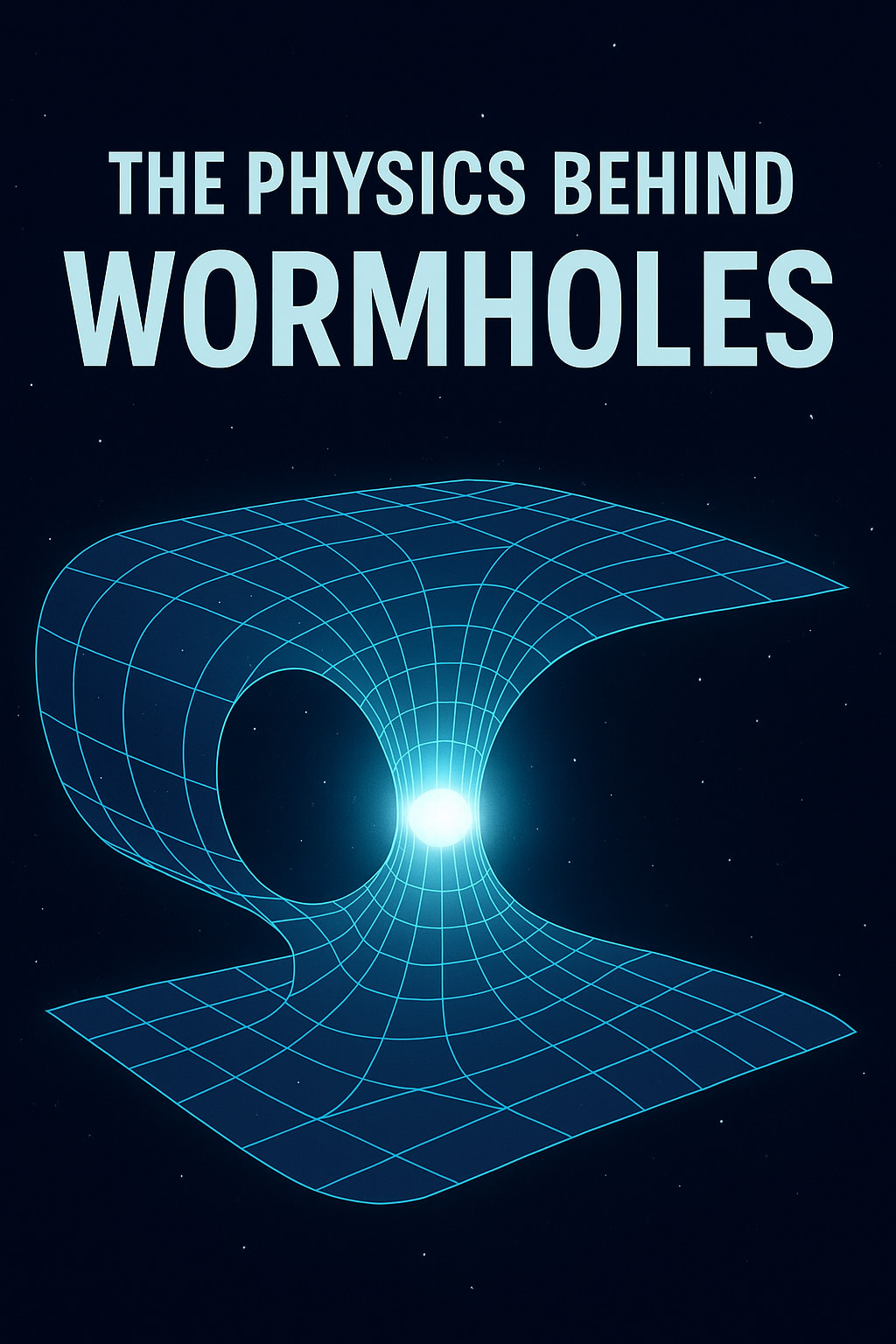
In physics, a wormhole is a solution to Einstein’s equations of general relativity that connects two separate regions of spacetime through a curved tunnel-like structure.
A wormhole consists of:
• Two “mouths” (entry and exit points)
• A “throat” connecting them
• A non-trivial spacetime geometry
Wormholes are not objects in space—they are structures of space itself.
________________________________________
Are Wormholes Allowed by the Laws of Physics?
Yes. Wormholes are mathematically allowed by Einstein’s theory of general relativity.
Einstein’s equations:
• Do not forbid wormholes
• Allow many exotic spacetime geometries
• Permit solutions where spacetime connects distant regions
The real challenge is not whether wormholes are mathematically possible, but whether nature actually creates and sustains them.
________________________________________
Natural Formation Mechanisms: How Could Wormholes Arise?
1. The Early Universe and Extreme Conditions
The early universe was:
• Extremely hot
• Extremely dense
• Dominated by quantum fluctuations
Under such conditions:
• Spacetime itself may have fluctuated wildly
• Tiny wormholes could have formed spontaneously
• Some may have expanded or stabilized briefly
This idea fits with models of quantum gravity, where spacetime is not smooth but dynamic at very small scales.
________________________________________
2. Quantum Foam and Microscopic Wormholes
Physicist John Wheeler proposed that spacetime at the smallest scales is a turbulent “quantum foam.”
In this picture:
• Tiny wormholes constantly appear and disappear
• They exist at Planck length scales
• They are extremely short-lived
These wormholes would be:
• Natural
• Ubiquitous
• Undetectable directly
They would not allow travel, but they suggest wormholes are a natural feature of spacetime itself.
________________________________________
3. Black Holes and Wormhole Connections
Some solutions of general relativity suggest that:
• Black holes may be connected to other regions of spacetime
• These connections resemble non-traversable wormholes
• Known as Einstein–Rosen bridges
While these wormholes collapse too quickly to be crossed, they indicate that wormhole-like structures naturally arise from gravity under extreme conditions.
________________________________________
4. Cosmic Strings and Topological Defects
Cosmic strings are hypothetical:
• Ultra-thin, ultra-dense objects
• Left over from early universe phase transitions
If they exist:
• Intersections or loops of cosmic strings could distort spacetime
• Potentially forming wormhole-like geometries
This remains speculative, but mathematically consistent.
________________________________________
The Biggest Obstacle: Stability
Even if wormholes form naturally, the key question is:
Can they stay open?
Gravitational Collapse
• Ordinary matter causes wormholes to collapse
• Gravity pinches the throat shut almost instantly
Exotic Matter Requirement
To keep a wormhole open, physics requires negative energy density, often called exotic matter.
While strange-sounding:
• Quantum physics allows negative energy in small amounts
• Observed in effects like the Casimir effect
However:
• Known quantum effects are extremely weak
• Large, stable wormholes would require enormous quantities
________________________________________
Could Nature Produce Exotic Matter?
Possibilities include:
• Quantum vacuum fluctuations
• Dark energy (speculative connection)
• Unknown fields in the early universe
So far:
• No confirmed natural source of large-scale exotic matter exists
• But physics does not rule it out entirely
________________________________________
Traversable vs Non-Traversable Wormholes
Non-Traversable Wormholes
• Likely to exist naturally
• Appear briefly
• Collapse almost instantly
• Cannot transmit matter or information
Traversable Wormholes
• Require exotic matter
• Must be stable
• Could allow travel or signals
Natural traversable wormholes are much less likely, but not mathematically forbidden.
________________________________________
Observational Evidence: Have We Seen Wormholes?
Direct Evidence
• None so far
• No confirmed wormhole detection
Indirect Searches
Scientists look for:
• Unusual gravitational lensing patterns
• Anomalous motion of stars
• Distortions inconsistent with black holes
Some proposed wormhole candidates have later been explained as:
• Black holes
• Dense star clusters
• Data limitations
At present, wormholes remain unobserved.
________________________________________
Could Wormholes Be Mistaken for Black Holes?
Possibly.
Some wormhole models:
• Mimic black hole gravitational effects
• Lack event horizons
• Produce subtle differences in light behavior
Future telescopes and gravitational-wave detectors may be able to distinguish them.
________________________________________
Wormholes and the Laws of Causality
If traversable wormholes exist naturally, they raise serious concerns:
• Faster-than-light travel
• Time travel paradoxes
• Violations of causality
Some physicists believe:
• Unknown physical laws prevent these outcomes
• Nature enforces “chronology protection”
• Wormholes collapse before causing paradoxes
This may explain why natural traversable wormholes are rare or nonexistent.
________________________________________
The Role of Quantum Gravity
A full theory of quantum gravity may reveal that:
• Wormholes are fundamental spacetime features
• Or that they are forbidden beyond mathematics
• Or that they exist only at microscopic scales
Until quantum gravity is experimentally confirmed, the question remains open.
________________________________________
Scientific Consensus Today
Most physicists agree that:
• Wormholes are mathematically allowed
• Tiny, short-lived wormholes may exist naturally
• Large, stable, traversable wormholes are unlikely
• No evidence yet confirms their existence
Wormholes remain a legitimate area of theoretical research—not fantasy, but not confirmed reality.
________________________________________
Why This Question Matters
Studying natural wormholes helps physicists:
• Test general relativity
• Understand spacetime topology
• Explore quantum gravity
• Investigate information flow in the universe
Even if wormholes never exist physically, they deepen our understanding of cosmic laws.
________________________________________
Common Misconceptions
❌ Wormholes are pure science fiction
✔ They arise from real equations
❌ Wormholes violate physics
✔ They obey known laws under extreme conditions
❌ Wormholes must be large and usable
✔ Most would be microscopic and unstable
________________________________________
Final Conclusion
So, could wormholes exist naturally in the universe?
Yes—at least in principle.
Physics allows:
• Microscopic, short-lived wormholes
• Non-traversable spacetime connections
• Possible early-universe formation
However:
• Stable, human-traversable wormholes remain speculative
• Exotic matter requirements are severe
• No observational evidence currently exists
Wormholes sit at the boundary between what physics permits and what nature chooses to realize—making them one of the most profound and exciting questions in modern science
About the Creator
Keep reading
More stories from shahkar jalal and writers in Education and other communities.
Are Wormholes Mathematically Allowed by Physics? Exploring the Equations Behind Cosmic Shortcuts
What Is a Wormhole? A wormhole is a hypothetical structure that connects two separate regions of spacetime through a tunnel-like geometry. Instead of traveling the long way through space, a wormhole could provide a shortcut by bending spacetime itself.
By shahkar jalal2 months ago in Education
Problem-Solving Skills for Better Decision Making
Making good choices is a skill. Some people think strong decisions come from luck or natural talent. In truth, they come from practice and clear thinking. This is where powerful problem-solving skills for better decision-making play an important role.
By Andrew Lakeabout 14 hours ago in Education
Why Environmental Compliance Is Becoming a Business Priority for Companies in Dubai
Dubai continues to grow at a remarkable pace. Industrial zones expand, construction projects reshape the skyline, and logistics networks move goods through ports and airports every day. This growth creates strong economic opportunities, but it also increases environmental pressure across the city.
By Umar Quality Jounal4 days ago in Education



Comments
There are no comments for this story
Be the first to respond and start the conversation.