
Could Dark Matter Interact With Itself?
Exploring One of the Biggest Mysteries in Modern Physics Dark matter is one of the most fascinating and mysterious components of our universe. Although it makes up nearly 85% of all matter, it cannot be seen, touched, or detected directly with ordinary instruments. Scientists know dark matter exists because of its gravitational effects on galaxies, stars, and cosmic structures — yet its true nature remains unknown. One of the most important questions in modern astrophysics is: Could dark matter interact with itself? This idea, known as self-interacting dark matter (SIDM), may hold the key to solving several long‑standing cosmic puzzles. In this article, we will explore what dark matter is, why scientists suspect self‑interaction, what evidence supports the idea, and how it could reshape our understanding of the universe.

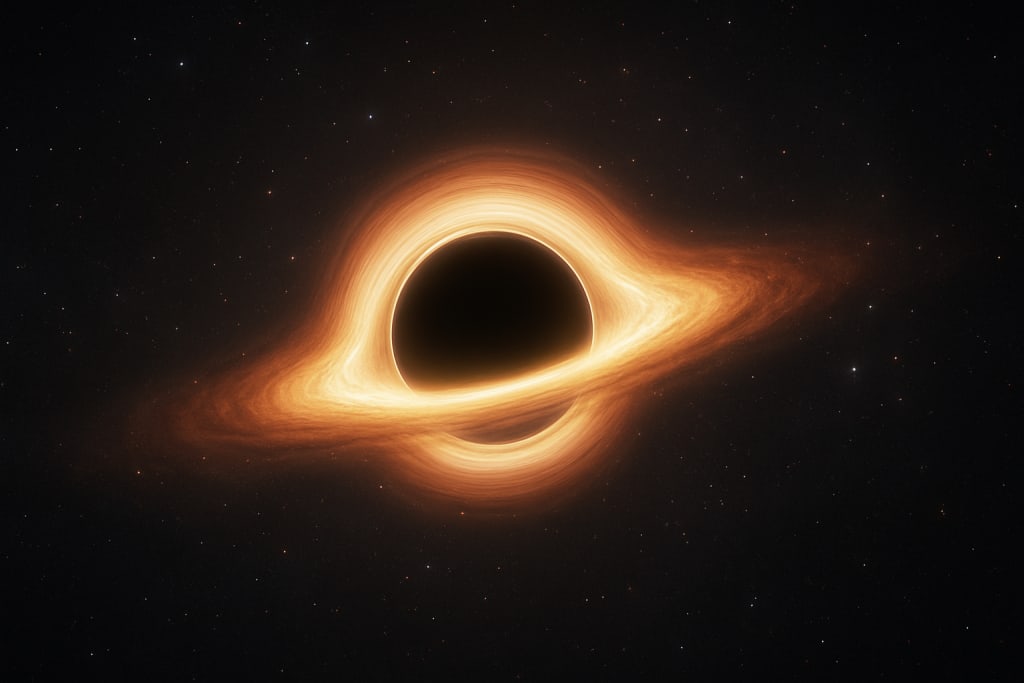
What Is Dark Matter?
Dark matter is a form of matter that does not emit, absorb, or reflect light. Because it is invisible, astronomers cannot observe it directly through telescopes. Its presence is inferred from its gravitational influence on visible matter.
Key evidence for dark matter includes:
• Galaxy rotation curves — stars orbit galaxies faster than visible mass alone can explain
• Gravitational lensing — light bends around invisible mass
• Cosmic microwave background measurements
• Large scale structure of the universe
Without dark matter, galaxies would not have formed as they did, and the universe would look drastically different.
________________________________________
The Traditional View: Collisionless Dark Matter
For decades, the leading theory assumed that dark matter interacts only through:
• Gravity
• Possibly the weak nuclear force
This model is called Cold Dark Matter (CDM). It treats dark matter particles as:
• Slow moving ("cold")
• Massive
• Essentially collisionless
CDM has been remarkably successful at explaining the universe on large scales — such as galaxy clusters and cosmic filaments.
However, when scientists examine smaller cosmic structures, problems begin to appear.
________________________________________
The Small Scale Problems in Cosmology
Several observations conflict with predictions made by collisionless dark matter models.
1. The Core–Cusp Problem
Simulations predict that dark matter density should sharply increase toward the centers of galaxies, forming a cusp.
Observations instead show flat density cores, especially in dwarf galaxies.
2. The Missing Satellites Problem
Models predict thousands of small satellite galaxies around galaxies like the Milky Way.
In reality, only dozens are observed.
3. The Too Big to Fail Problem
Some predicted massive dark matter halos should contain visible galaxies — but they do not.
These discrepancies suggest that something important may be missing from standard dark matter models.
________________________________________
Introducing Self Interacting Dark Matter (SIDM)
Self interacting dark matter proposes that dark matter particles can:
• Collide with each other
• Exchange energy
• Scatter elastically
These interactions are stronger than gravity but far weaker than electromagnetic forces, which explains why they are difficult to detect.
In SIDM models, dark matter behaves somewhat like a very thin gas rather than a completely collisionless substance.
________________________________________
How Self Interaction Could Solve Cosmic Puzzles
Self interactions can naturally explain many observed galactic features.
Flattening Galactic Cores
When dark matter particles collide:
• Energy redistributes
• Dense cusps soften
• Central regions become smoother
This produces the flat cores astronomers observe.
Reducing Satellite Galaxies
Self interaction can suppress the formation of very small halos, helping explain why fewer dwarf galaxies exist than predicted.
Explaining Galaxy Diversity
Galaxies with similar masses often have very different internal structures.
SIDM allows this diversity to emerge naturally due to:
• Different interaction rates
• Environmental conditions
• Baryonic feedback effects
________________________________________
Observational Evidence Supporting Self Interaction
While dark matter cannot be observed directly, astrophysical observations provide indirect clues.
1. Galaxy Cluster Collisions
The famous Bullet Cluster initially supported collisionless dark matter because most mass passed through the collision.
However, later studies found:
• Small offsets between galaxies and dark matter
• Possible evidence of limited self interaction
These findings allow self interaction — as long as it is not too strong.
2. Dwarf Galaxies
Dwarf galaxies are dominated almost entirely by dark matter, making them ideal testing grounds.
Their observed properties strongly favor models that include some level of dark matter self interaction.
3. Gravitational Lensing Measurements
Precise lensing maps reveal smoother inner mass distributions than CDM predicts, again hinting at self scattering.
________________________________________
How Strong Could Dark Matter Self Interactions Be?
Physicists describe interaction strength using the cross section to mass ratio.
Current observational limits suggest:
• About 0.1 to 1 cm²/g
This is:
• Strong enough to affect galaxies
• Weak enough to preserve large scale cosmic structure
This delicate balance makes SIDM a highly attractive theory.
________________________________________
What Could Mediate Dark Matter Interactions?
If dark matter interacts with itself, a new force must exist.
Possible candidates include:
Dark Photons
• Analogous to ordinary photons
• Act only within the dark sector
Scalar Particles
• Similar to the Higgs field
• Modify particle masses and interactions
Dark Forces
• Entirely new fundamental forces
• Do not couple strongly to ordinary matter
These hypothetical particles form part of what scientists call the dark sector.
________________________________________
The Dark Sector: A Hidden Universe
Some theories suggest dark matter is not a single particle but part of a complex system including:
• Dark atoms
• Dark radiation
• Dark chemistry n In such models, dark matter may interact with itself far more richly than previously imagined — possibly even forming dark stars or dark galaxies.
Although speculative, these ideas are consistent with current experimental limits.
________________________________________
Experimental Searches for Self Interacting Dark Matter
Scientists are testing SIDM through multiple approaches.
Particle Accelerators
Experiments like the Large Hadron Collider search for signs of dark-sector particles.
Direct Detection Experiments
Facilities such as:
• LUX-ZEPLIN
• XENONnT
• PandaX
attempt to observe rare dark matter interactions.
Astrophysical Surveys
Upcoming observatories will dramatically improve measurements:
• Vera Rubin Observatory
• Euclid Space Telescope
• James Webb Space Telescope
These instruments will provide unprecedented data on galaxy formation and dark matter distribution.
________________________________________
Does Self Interacting Dark Matter Replace Cold Dark Matter?
Not necessarily.
SIDM is best viewed as an extension of cold dark matter, not a rejection of it.
On large cosmic scales:
• SIDM behaves almost identically to CDM
On small scales:
• Self interactions become important
This hybrid behavior allows SIDM to preserve CDM’s successes while fixing its weaknesses.
________________________________________
Challenges and Open Questions
Despite its promise, SIDM still faces challenges:
• What is the exact particle mass?
• What mediates the interaction?
• Why does the interaction strength fall within such a narrow range?
• How does SIDM connect to the Standard Model?
These questions remain active areas of research.
________________________________________
Why This Question Matters
Understanding whether dark matter interacts with itself could:
• Reveal new fundamental forces
• Expand the Standard Model of particle physics
• Explain galaxy formation
• Clarify the evolution of the universe
It may represent the first glimpse into a hidden realm of physics beyond what we currently know.
________________________________________
Conclusion
So — could dark matter interact with itself?
Based on growing observational evidence and advanced simulations, the answer is increasingly:
Yes, it might.
Self interacting dark matter offers elegant solutions to long standing cosmological problems while remaining consistent with large scale observations. Although definitive proof has not yet been found, SIDM stands as one of the most promising directions in modern astrophysics.
As new telescopes come online and experiments grow more sensitive, humanity may soon uncover whether the invisible matter shaping our universe is truly silent — or quietly interacting in the dark.
________________________________________
Dark matter interaction, self interacting dark matter, dark matter physics, dark sector, galaxy formation, astrophysics education, cosmic structure, universe mysteries
________________________________________
Educational Note: This article is written for learning and awareness purposes, using current theoretical and observational research in cosmology and particle physics.
About the Creator
Keep reading
More stories from shahkar jalal and writers in Education and other communities.
Life in the Ranks: The Overlooked Struggles of Military Service
Military life is often admired from a distance. The uniform, the discipline, and the mission all project a powerful image of strength. Yet, behind this image are real people facing real challenges. The structured lifestyle and constant state of readiness can be mentally and emotionally exhausting. Service members don’t just serve during deployments—they live a demanding reality every day, regardless of where they are stationed.
By Trish Schnabelabout 16 hours ago in Education


Comments
There are no comments for this story
Be the first to respond and start the conversation.