
Could Black Holes Hide Wormholes Inside? Exploring One of Physics’ Boldest Ideas
Black holes are among the most extreme and mysterious objects in the universe. Wormholes, on the other hand, are hypothetical shortcuts through spacetime—bridges connecting distant regions of the cosmos. When these two concepts intersect, they give rise to one of the most intriguing questions in modern theoretical physics: Could black holes hide wormholes inside them? This idea sits at the frontier of science, blending general relativity, quantum mechanics, and cosmology. While no observational evidence currently supports the existence of wormholes, theoretical physics allows fascinating possibilities. Some models suggest that what we call a black hole might conceal a wormhole-like structure beyond its event horizon. In this article, we explore whether black holes could hide wormholes, what current physics says, and why the idea remains both controversial and compelling.

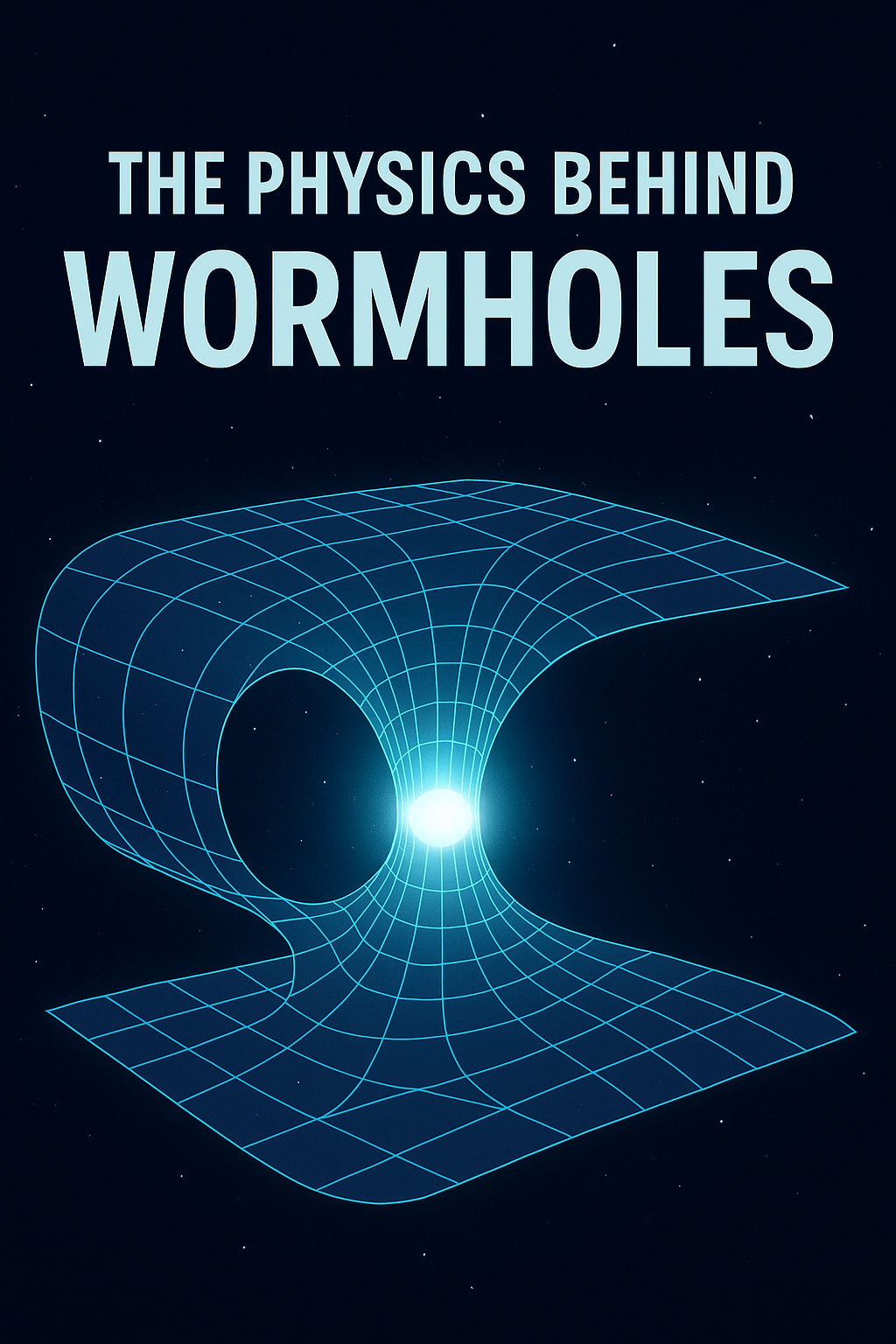
Understanding Black Holes
A black hole forms when a massive object collapses under its own gravity, compressing matter into an incredibly small region known as a singularity.
Key features of a black hole:
• Event horizon: the point of no return
• Singularity: a region of extreme density
• Strong spacetime curvature
Once something crosses the event horizon, it cannot communicate with the outside universe—making the interior largely unobservable.
________________________________________
What Is a Wormhole?
A wormhole is a theoretical tunnel connecting two separate points in spacetime. In mathematics, wormholes appear as valid solutions to Einstein’s equations.
Important properties:
• They connect distant regions or universes
• They can be non-traversable or traversable
• Traversable wormholes require exotic matter
The question is whether a black hole’s interior could naturally form such a structure.
________________________________________
The Einstein–Rosen Bridge Connection
The first link between black holes and wormholes came in 1935, when Einstein and Rosen discovered that the equations describing a black hole also imply a structure now called an Einstein–Rosen bridge.
This bridge:
• Connects two black holes
• Resembles a wormhole
• Is not traversable
• Collapses instantly
Thus, mathematically, black holes already contain something that looks like a wormhole—but not one that can be used.
________________________________________
What Lies Beyond the Event Horizon?
Inside a black hole:
• Time and space exchange roles
• All paths lead toward the singularity
• Classical physics breaks down
Because we cannot observe inside black holes directly, theoretical models vary widely. Some predict:
• A true singularity
• A quantum-corrected core
• A bounce into another spacetime region
This uncertainty leaves room for wormhole-like possibilities.
________________________________________
Could a Black Hole Contain a Wormhole?
Some theoretical models propose:
• The singularity is replaced by a wormhole throat
• The black hole interior connects to another universe
• The event horizon hides the entrance
In these models:
• Falling into a black hole does not end at a singularity
• Instead, spacetime continues through a tunnel
This would mean black holes are gateways—not dead ends.
________________________________________
The Role of Quantum Gravity
General relativity predicts singularities, but physicists believe singularities signal incomplete physics.
Quantum gravity theories suggest:
• Singularities may be smoothed out
• Extreme density triggers new spacetime structures
• Wormholes could emerge at Planck scales
Approaches like:
• Loop quantum gravity
• String theory
• Holographic models
often replace singularities with more complex geometry.
________________________________________
Black Holes as One-Way Wormholes
Even if wormholes exist inside black holes:
• They may be one-way only
• Nothing can return through the event horizon
• Information flow is constrained
This preserves causality while allowing hidden internal structure.
Such wormholes would be fundamentally different from science-fiction portals.
________________________________________
The ER = EPR Hypothesis
One of the most exciting ideas linking black holes and wormholes is the ER = EPR conjecture, proposed in 2013.
It suggests:
• Quantum entanglement (EPR) and wormholes (ER) are related
• Entangled black holes may be connected by microscopic wormholes
• Spacetime geometry emerges from quantum entanglement
In this view:
• Wormholes are everywhere
• They are non-traversable
• They exist at the quantum level
This supports the idea that black holes may hide wormhole structures inside.
________________________________________
Why We Cannot Detect These Wormholes
Even if black holes hide wormholes:
• The event horizon blocks all signals
• No observational evidence escapes
• Effects outside remain identical to ordinary black holes
From the outside:
• A black hole with a wormhole looks like a normal black hole
• No distinguishing signature is known
This makes experimental confirmation extremely difficult.
________________________________________
Could Such Wormholes Be Traversable?
Current physics strongly suggests:
• Wormholes inside black holes are not traversable
• Tidal forces are extreme
• Exotic matter is absent
• Collapse is inevitable
Any traveler entering would:
• Be crushed by gravity
• Lose causal contact with the universe
• Never exit in a controlled way
So even if wormholes exist, they are not usable.
________________________________________
Do Black Holes Lead to Other Universes?
Some cosmological models propose:
• Each black hole spawns a new universe
• The Big Bang could be the interior of a black hole
• Wormholes act as cosmic reproductive mechanisms
These ideas remain speculative but mathematically intriguing.
________________________________________
Objections and Skepticism
Many physicists remain cautious:
• No empirical evidence supports wormholes
• Quantum gravity remains incomplete
• Exotic matter requirements are severe
• Simpler explanations are preferred
Most scientists view black hole wormholes as interesting but unproven.
________________________________________
Why This Question Matters
Exploring whether black holes hide wormholes helps physicists:
• Test general relativity
• Understand spacetime topology
• Investigate quantum gravity
• Address the information paradox
Even if wormholes do not exist, the research advances physics.
________________________________________
Scientific Consensus Today
Most physicists agree:
• Black holes may not contain classical singularities
• Exotic internal structures are possible
• Wormholes are mathematically allowed
• Traversable wormholes are unlikely
• Observational proof is absent
Thus:
Black holes could hide wormhole-like structures—but not usable portals.
________________________________________
Final Conclusion
So, could black holes hide wormholes inside?
According to modern theoretical physics:
• Yes, it is mathematically possible
• Quantum gravity may replace singularities with wormholes
• Such wormholes would be hidden behind the event horizon
• They would be non-traversable and unobservable
Black holes may not be cosmic dead ends after all—but whether they secretly connect regions of spacetime remains one of the deepest unanswered questions in science.
For now, black holes remain silent, guarding whatever strange geometry lies beyond their horizons.
About the Creator
Keep reading
More stories from shahkar jalal and writers in Education and other communities.
Are wormholes stable or self-destructing?
What Is a Wormhole? A Quick Scientific Overview In Einstein’s theory of general relativity, gravity arises from the curvature of spacetime. Wormholes are solutions to Einstein’s equations that connect two distant regions of spacetime through a tunnel-like geometry.
By shahkar jalal2 months ago in Education
7 Online Skills That Can Change Your Financial Future in 2026
7 Online Skills That Can Change Your Financial Future In today’s digital world, one skill can completely transform your life. Just a decade ago, making money online sounded unrealistic to many people. Today, thousands of people are building careers, businesses, and even financial freedom using only their laptops and internet connections. The truth is simple: the internet has created opportunities that never existed before. But the biggest mistake most people make is waiting for the “perfect moment” to start learning. The reality is that learning just one valuable online skill can open doors to income streams you never imagined. Here are seven powerful online skills that can truly change your financial future. 1. Content Writing Content writing is one of the easiest online skills to start with. Every website, blog, and online business needs high-quality content to attract readers and customers. If you can write helpful, interesting, or informative articles, you already have the foundation for this skill. Content writers earn money by writing: Blog posts Website content Product descriptions News articles Platforms like freelance marketplaces, blogging websites, and digital publications are always looking for good writers. With practice, many writers turn this skill into a full-time career. 2. Graphic Design In the online world, visuals matter. Businesses need logos, social media graphics, advertisements, and brand designs to attract attention. Graphic design allows creative people to turn their imagination into income. Even beginners can start by learning simple tools and gradually improving their skills. Graphic designers can work with: Small businesses Online brands Content creators Marketing agencies A single well-designed logo or brand package can sometimes earn more than weeks of traditional work. 3. Video Editing Video is the most powerful form of content on the internet today. From social media platforms to online courses, videos dominate the digital world. But most creators don’t have the time or skill to edit their own videos. This is where video editors come in. If you learn how to cut clips, add music, create smooth transitions, and improve video quality, you can become extremely valuable. Video editors are needed by: YouTubers Businesses Online educators Social media influencers The demand for video editing continues to grow every year. 4. Social Media Management Millions of businesses rely on social media to reach customers. But many business owners don’t know how to grow their pages, create content, or engage with their audience. Social media managers help brands: Plan content Post regularly Respond to followers Grow their audience With the right strategy, social media managers can manage multiple accounts and earn steady monthly income. This skill combines creativity with marketing knowledge, making it highly valuable. 5. Digital Marketing Digital marketing is one of the most powerful online skills you can learn. It involves promoting products, services, or brands through online channels such as search engines, social media, and email. Digital marketers help businesses get: More website visitors More customers More sales Companies are willing to pay well for people who can increase their revenue. Learning digital marketing can open doors to freelance work, remote jobs, or even your own online business. 6. Web Development Every business needs a website. But building a professional website requires technical skills. Web developers create and maintain websites using coding languages and development tools. Although this skill takes more time to learn than others on this list, it is also one of the highest-paying online skills. Many web developers work remotely and build websites for clients all around the world. Once you gain experience, the opportunities become endless. 7. AI Content Creation Artificial intelligence is rapidly changing the online world. Many creators and businesses now use AI tools to produce content faster and more efficiently. AI content creators use technology to generate: Articles Images Videos Marketing content People who understand how to use AI tools effectively have a huge advantage in the modern digital economy. Instead of replacing creativity, AI often amplifies it. Those who learn how to combine creativity with technology will be ahead of the curve. Final Thoughts The internet has made it possible for anyone, anywhere in the world, to build valuable skills and create new income opportunities. But knowledge alone is not enough. The real difference comes from taking action. Pick one skill from this list and start learning today. Practice consistently. Improve a little every day. Over time, that single skill could become the foundation of a completely different financial future. Because sometimes, all it takes is one skill to change everything.
By Baseer Shaheen 6 days ago in Education




Comments
There are no comments for this story
Be the first to respond and start the conversation.