


Basic Steps in Starting a Building Project
When there is a plan to develop a new building, it is very necessary to have an idea about the start and the end of the building project. The flowchart below shows the construction flow from the start to the end of a building project.
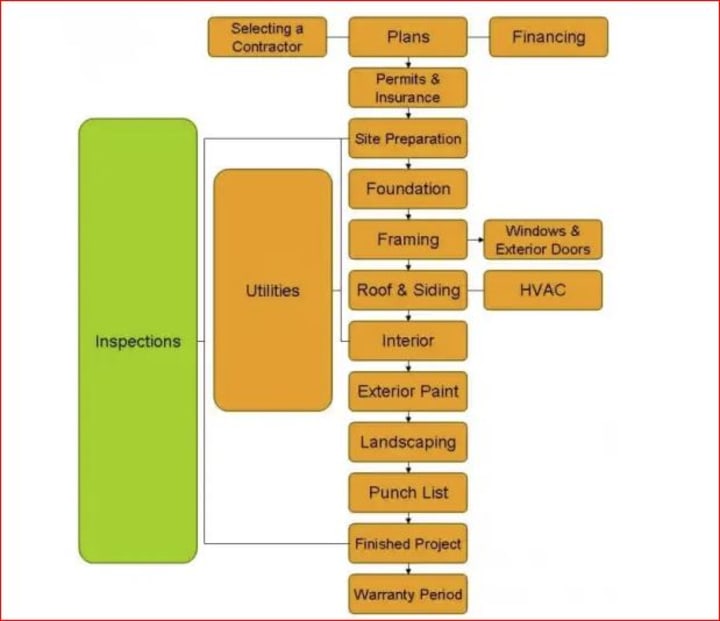
Fig.1.Construction Flow in Building Construction( Image Courtesy: Quantumci)
There may be variations as every project is unique and follows different design and construction processes. In general, the basic steps involved in a building project are briefly explained.
- Planning
- Permits
- Preparation of Construction Site
- Foundation Construction
- Superstructure Construction
- Punch Lists
- Building Warranty Period
1. Planning
The planning in building construction involves three major steps:
Developing the Building Plan
Analyzing the Finance
Selecting the Construction Team
Once the site where the building project is indented to construct is chosen, the expertise of engineers and architects is taken to develop the site and the building plan. Sometimes, an appropriate site is selected after the building layout is prepared.
The building plan is developed based on the owner’s requirements and budget. Once the plan is in hand, the finance and total cost is estimated. The structural design details and the material estimates are prepared which help to derive project cost estimates. The cost calculated include:
- The material cost
- The construction cost
- The labor cost
- Miscellaneous cost
Construction Cost Estimates Based on the estimated cost, either a bidding process is performed or the project to handover over to a known contractor. The contractor and the owner must agree to a contract based on which the project is implemented. The contract mentions the completion period and necessary guides, and exclusions to remove claims. Read More: Types of Drawings used in Building Construction
2. Permits and Insurance in Building Construction
Before starting a building construction, the owner must make sure that one has the necessary permits taken to start the construction. Permits and insurance are obtained from different sources in cities and states. construction work conducted without permits results in project delay or project demolition or huge fines. Possessing insurance for the required parties helps to save the owner and the contractor.
3. Site Preparation
From here, the actual construction process starts. Based on the site and building plan, necessary excavations, leveling, and filling can be undergone to prepare the site. The necessary excavation for utilities, power, water and sanitation lines, and temporary storage facilities are prepared. Mostly the works needed to set up the utilities are prepared.
This is followed by an inspection from government officials. Read More: Steps in Preparing Site for Construction Projects -Soil Report, and Excavation Inspections are performed at different stages on structural, building codes, the utilities, HVAC, electrical works, etc. After the completion of the whole project, a final inspection is performed.
4. Foundation / Substructure Construction
Building structures are generally constructed on concrete foundations. Based on the soil type and water table level of the area, the foundation chosen can vary. If necessary, soil testing is performed to check the bearing capacity. Shallow foundations are required for low-rise buildings.
For high-rise buildings, a pile foundation is employed. Once the foundation is selected, the soil is excavated to construct the foundation. It is performed based on the foundation layout. Formworks are placed in the foundation trenches and reinforcement is placed based on the foundation detailing design prepared in the planning stage.
The reinforcement works performed by the contractor are periodically checked by the engineer in charge. Read More: Construction of Foundation - Depth, Width, Layout, and Excavation The concrete mix of the required proportion is poured into formwork and is cured to form the finished foundation.
5. Superstructure Construction
The superstructure is constructed once the substructure is complete. Generally, a framed structure is developed which is later finished with masonry walls. Adequate windows and exterior doors are placed based on the building plan. Other works coming under this section are
Construction of roofs or siding
Installation of heating, ventilation, and air conditioning
Providing adequate electric and water lines connection line.
Provide insulation works as required to protect from lightning
Provision of waterproofing to the walls.
Plastering and finishing the walls and surfaces
Flooring works
Exterior and Interior Painting
6. Punch List
Once the project is complete, the contractor inspects the whole work one by one and makes a punch list. Those structural units or areas that were not constructed properly or are below the quality level are listed in the punch list. This is later corrected by the contractor in charge.
7. Warranty Period
Once the project is complete and handover to the owner, the contractor specifies a warranty period. Within this period, any defects found in the building constructed must be fixed and replaced by the contractor in charge. The warranty for materials and appliances is obtained from manufacturers and suppliers.
About the Creator
Keep reading
More stories from Shri Valsan and writers in Education and other communities.
DS SOLID WORKS
DS SOLID MODELING Solid modeling (or solid modeling) is a consistent set of principles for mathematical and computer modeling of three-dimensional shapes (solids). Solid modeling is distinguished from related areas of geometric modeling and computer graphics, such as 3D modeling, by its emphasis on physical fidelity. Together, the principles of geometric and solid modeling form the foundation of 3D-computer-aided design and in general support the creation, exchange, visualization, animation, interrogation, and annotation of digital models of physical objects.
By Shri Valsan3 years ago in Education
How AI Is Impacting the Jobs of Website Designers and Developers
Artificial Intelligence (AI) is transforming industries across the globe, and the world of website design and development is no exception. From streamlining workflows and enhancing creativity to automating repetitive tasks and reshaping professional roles, AI’s influence is broad and deep. In this article, we explore how AI is impacting website designers and developers — the opportunities it presents, the challenges it introduces, and how professionals can adapt to thrive in an AI-augmented landscape.
By Rajiv Menon5 days ago in Education
Kiranmala: The tale of Princess Who conquered Magic Mountain
Long ago, in a land far away, the queen was panicked, her grasp on reality seemingly slipping. She had given birth to two boys and one girl. But to her horror, before even meeting their father, each child vanished, something else taking their place. She faced accusations of witchcraft and demon sorcery. And though the king loved her, he was easily swayed. He soon grew doubtful and banished his wife, who left the kingdom in anguish. Little did they know, the queen’s jealous sisters were the ones to replace the newborns
By Munesh Yadavabout 24 hours ago in Education
Center Stage with Paul Stewart
*** I'm keen to republish the interviews I did for my series with Vocal creators. It's been a few years and I thought it might be nice to revisit these wonderful conversations. I'll be releasing them one at a time for a few weeks/months.
By Heather Hubler5 days ago in Interview



Comments (2)
I liked this post when I was looking for I want to tell you something From interior design services to exterior remodeling, professionals in the field provide expert guidance and innovative solutions to transform houses into stunning and functional spaces. With a focus on sustainability and energy efficiency home renovation cologne https://www.tschidaconstruction.com/ not only enhances the aesthetic appeal of residential properties but also contributes to making them more eco-friendly.
Thanks!