
"Collaborating for a Better Future: The G20 Summit on Global Challenges and Opportunities."
G20 Summit
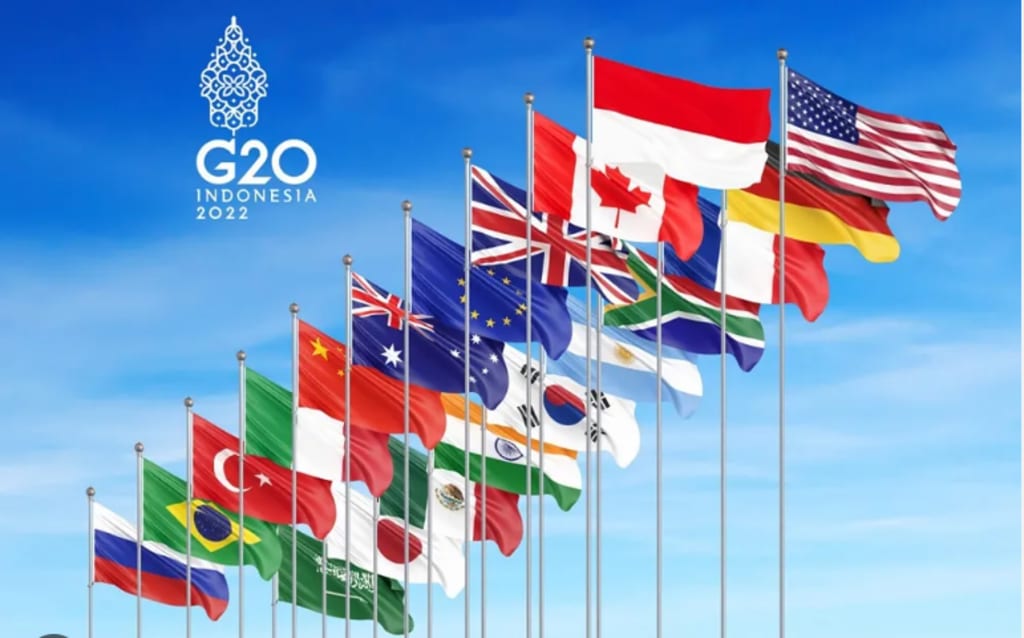
G20 Summit ,
The G20 summit is a meeting of leaders from the world's 20 largest economies. The G20 was established in 1999 to bring together leaders from both developed and developing countries to address global economic issues and promote international financial stability. The G20 summit is held annually and provides an opportunity for leaders to discuss important economic and financial matters and to coordinate their efforts to address global challenges. The G20 countries represent 85% of global GDP and two-thirds of the world's population. The G20 summit is an important forum for setting the direction of the global economy and for promoting international cooperation on economic and financial issues.
Countries in G20- The G20 is made up of the following 20 countries:
Argentina, Australia, Brazil, Canada, China, European Union, France, Germany, India, Indonesia, Italy, Japan, Mexico, Russia, Saudi Arabia, South Africa, South Korea, Turkey, United Kingdom, United States of America
These countries represent the largest economies in the world and represent 85% of global GDP and two-thirds of the world's population. The G20 provides an opportunity for leaders from these countries to work together on global economic and financial issues, promote international cooperation, and set the direction of the global economy.
Some of the common topics that are discussed at the G20 summit include:
1. Global economic growth and job creation: Leaders discuss ways to promote sustainable economic growth, create jobs, and reduce inequality.
This can involve implementing economic reforms, investing in infrastructure and education, and promoting inclusive growth. The G20 leaders also work towards ensuring that the benefits of economic growth are shared by all, including disadvantaged and marginalized communities. This can involve addressing issues such as income inequality, poverty, and unemployment, and promoting access to quality education and job training.
2. Financial stability: Discussions center on measures to enhance financial stability and prevent future financial crises.
During the G20 summit, leaders discuss measures to enhance financial stability, such as strengthening the financial regulatory framework, promoting transparency and accountability in the financial sector, and reducing systemic risks. They also discuss ways to improve the resilience of the financial sector and prevent the buildup of imbalances and systemic risks. In addition, the G20 leaders address the challenges posed by new financial technologies and digital currencies, and explore ways to ensure that these technologies are used in a safe and stable manner.
3. Sustainable development: Leaders address the challenges of sustainable development, including poverty reduction, gender equality, and environmental protection.
Leaders discuss ways to address the challenges of sustainable development, such as poverty reduction, gender equality, and environmental protection. This can involve implementing policies and programs to improve access to quality education and health care, support sustainable agriculture and rural development, and reduce greenhouse gas emissions. The G20 leaders also work to promote inclusive growth, which involves ensuring that the benefits of economic growth are shared by all, including women, young people, and marginalized communities.
4. Climate change: The G20 leaders discuss ways to address the challenges of climate change and promote clean and sustainable growth.
Climate change is another critical issue that is discussed at the G20 summit. The G20 leaders recognize the need for global action to address the challenges of climate change and promote clean and sustainable growth. To reduce greenhouse gas emissions, increase the use of renewable energy, and promote energy efficiency. They also explore ways to finance the transition to a low-carbon economy, including the development of new financial instruments and investment opportunities.In addition, the G20 leaders work to support the implementation of the Paris Agreement on climate change, which aims to limit global temperature rise to well below 2 degrees Celsius and pursue efforts to limit the temperature increase to 1.5 degrees Celsius.
5. Global trade: Discussions focus on ways to promote free and fair trade and address challenges to the global trading system.
To promote free and fair trade and address challenges to the global trading system, such as rising protectionism and the negative impacts of globalization on some communities. This can involve supporting the rules-based multilateral trading system, strengthening trade-related institutions, and reducing trade-distorting policies.
6. Health and pandemics: The G20 leaders discuss measures to improve global health, including responses to pandemics like COVID-19.
The G20 leaders, representing the largest economies in the world, have a crucial role to play in improving global health and responding to pandemics like COVID-19. During their discussions, they can exchange best practices and coordinate efforts to ensure a coordinated and effective response to health emergencies.
Some measures that the G20 leaders could consider include:
1. Increased funding for global health organizations such as the World Health Organization (WHO) and the Global Fund to Fight AIDS, Tuberculosis and Malaria.
2. Investment in research and development of new medical treatments and vaccines, including support for equitable access to new medicines.
3. Improving healthcare infrastructure and systems in developing countries to make them better equipped to respond to pandemics.
In conclusion, the G20 leaders have an important role to play in improving global health and responding to pandemics like COVID-19.
7. Digital transformation: Discussions center on ways to promote digital transformation and ensure the benefits of technology are shared by all.
The G20 leaders have an important role to play in promoting digital transformation and ensuring that the benefits of technology are shared by all. During their discussions, they can exchange best practices and coordinate efforts to ensure a coordinated and effective approach to digital transformation.
Some of the measures that the G20 leaders could consider include:
1. Bridging the digital divide by providing access to technology and digital infrastructure to people in rural and underserved areas.
2. Supporting the development of new technologies, such as artificial intelligence and the Internet of Things, to drive innovation and growth.
3. Encouraging the development of a digital economy, including the growth of e-commerce and digital entrepreneurship, to create new job opportunities.
4. Promoting digital literacy and education, including training programs for workers to acquire the necessary skills for the digital economy.
5. Ensuring the protection of personal data and privacy, and promoting cybersecurity to prevent the abuse of technology.
In conclusion, the G20 leaders have a crucial role to play in promoting digital transformation and ensuring that the benefits of technology are shared by all. By taking coordinated and effective measures, they can help to drive innovation, growth and job creation while ensuring that the technology is used in a responsible and sustainable way.
These are some of the common topics that are discussed at the G20 summit, and the specific issues addressed may vary from year to year depending on the current global economic and financial situation.
About the Creator
Deepak kanna
Content Writer
Keep reading
More stories from Deepak kanna and writers in Education and other communities.
"Converging better Ideas: Future Chartered Accountant"
Chartered Accountancy (CA): The Chartered Accountancy (CA) course is a professional finance and accounting certification offered by several countries, including India, Australia, Canada, and South Africa. The course aims to provide students with a comprehensive understanding of finance, accounting, tax, and auditing principles.
By Deepak kanna3 years ago in Education
The Power of Service Beyond the Uniform in Everyday Life
Service reaches far beyond the moments spent in uniform, shaping lives long after formal duties end. Veterans, first responders, and public servants carry lessons that extend into workplaces, families, and communities. Their values of discipline, compassion, teamwork, and integrity influence how they interact with others and how they continue serving in new ways. As they go about their everyday lives, their actions show that service is not defined by a role but by a mindset. Because of that mindset, countless communities benefit from their leadership and steady presence.
By Eric Schnabela day ago in Education
Importance of Technology in Learning Islamic Education
Islamic education has always been rooted in knowledge, reflection, and understanding. From handwritten manuscripts to traditional madrasa systems, learning has continuously evolved with time. Today, technology is shaping a new chapter in how Islamic education is taught, accessed, and understood. Rather than replacing traditional learning, technology enhances it, making Islamic knowledge more accessible, structured, and engaging for learners of all ages.
By Arslan Shahbaza day ago in Education



Comments
There are no comments for this story
Be the first to respond and start the conversation.