
Chinese Feng Shui vs. Western Feng Shui: Key Differences
Part 1


Feng Shui is practiced worldwide in two prominent forms: Chinese Feng Shui and Western Feng Shui. While the latter evolved from the Chinese tradition, these two approaches are fundamentally different. Western Feng Shui lacks the true theoretical foundation of authentic Feng Shui. Instead, it is based on misunderstanding and misapplications of some essential principles of Chinese Feng Shui. Although it uses the name “Feng Shui” and borrows some terminology, it is disconnected from authentic Feng Shui. Essentially, Western Feng Shui is a Western cultural adaptation based on some terms from Chinese Feng Shui.
Here are some examples to illustrate the differences:
1. Misinterpretation of Feng Shui as Furniture Arrangement
Western Feng Shui often defines Feng Shui as the Chinese art of arranging furniture. For example, some Feng Shui books describe it as “the ancient art of furniture arrangement and energy flow in the home...” However, this definition is inaccurate. None of the classic Chinese Feng Shui texts or schools focus on furniture arrangement, as Feng Shui’s essence is not about furniture placement.
In simple terms, Feng Shui is the knowledge Chinese people use to understand their fate (命, ming) and improve their destiny (运,yun). The methods for doing so involve harmonizing the energy (qi) within a person’s body with the energy in their surrounding environment and the cycles of time. Furniture arrangement is a modern addition to align traditional Feng Shui techniques with contemporary living. However, such adjustments must be guided by careful Feng Shui analysis. Without a systematic evaluation of both the external surrounding and the interior environment, achieving proper furniture placement is impossible.
2. Misinterpretation of Qi as Merely Moving Air
Some Western Feng Shui books emphasize the indoor flow of "qi," but the “qi” they refer to is not the same as the qi in Feng Shui; it is merely seen as moving air. In Chinese Feng Shui, however, qi is defined in a much more complex way, encompassing three primary types: temporal qi, spatial qi, and human body qi.
For example, from a temporal perspective, this year (2024) is the Year of the Dragon. 'Dragon' is one of the well-known twelve Chinese zodiacs, but in reality, the twelve zodiacs are folk terms for twelve types of the Earth energy. The Earth energy associated with 'Dragon' has the academic name "Chen" (辰). People born this year have a particular Earth energy flowing through their body’s meridian system.
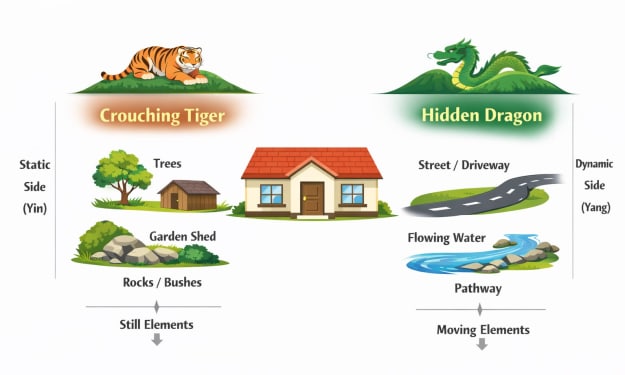
From a spatial perspective, the 360-degree circle within a residence can be divided into 24 directions, each with distinct qi characteristics. Beyond the interior qi field, the most influential Feng Shui elements are found in the surrounding environment, including streets, buildings, traffic, mountains, and water flow.
The ultimate goal of Feng Shui is to harmonize the spatial and temporal energies in our living environment with the energy within our bodies. Therefore, understanding our personal energy characteristics is essential knowledge in Feng Shui. Personal qi flows through the body's meridians; it not only gives life but also carries information about a person’s fate. Each individual’s internal qi nature is set from birth, much like DNA. In Feng Shui, there are 518,400 basic human qi types.
All these qi factors must be analyzed before making any Feng Shui adjustments, including furniture arrangements. It’s not as simple as the furniture tips presented in some online videos or books. This is the core difference between Chinese and Western Feng Shui.
In the next lecture, I’ll share some authentic Chinese Feng Shui tips with you.
About the Creator
Lidong Yu
I am a Chinese Feng Shui consultant and educator, raised and trained in China. My work draws on classical Feng Shui traditions to help people better understand the relationship between themselves, their environments, and time through Qi.
Exploring FSC 5999: Miscellaneous Electrical and Electronic Components in Aerospace and Avionics
When I first started studying aircraft systems, I realized that aviation engineering is as much about the parts you don’t see as the ones you do. Beyond major systems like engines and flight controls, there exists a broad yet vital collection of miscellaneous electrical and electronic components — categorized under FSC 5999 — that quietly support mission-critical functions throughout an aircraft.
By Beckett Dowhan5 days ago in Education



Comments
There are no comments for this story
Be the first to respond and start the conversation.