

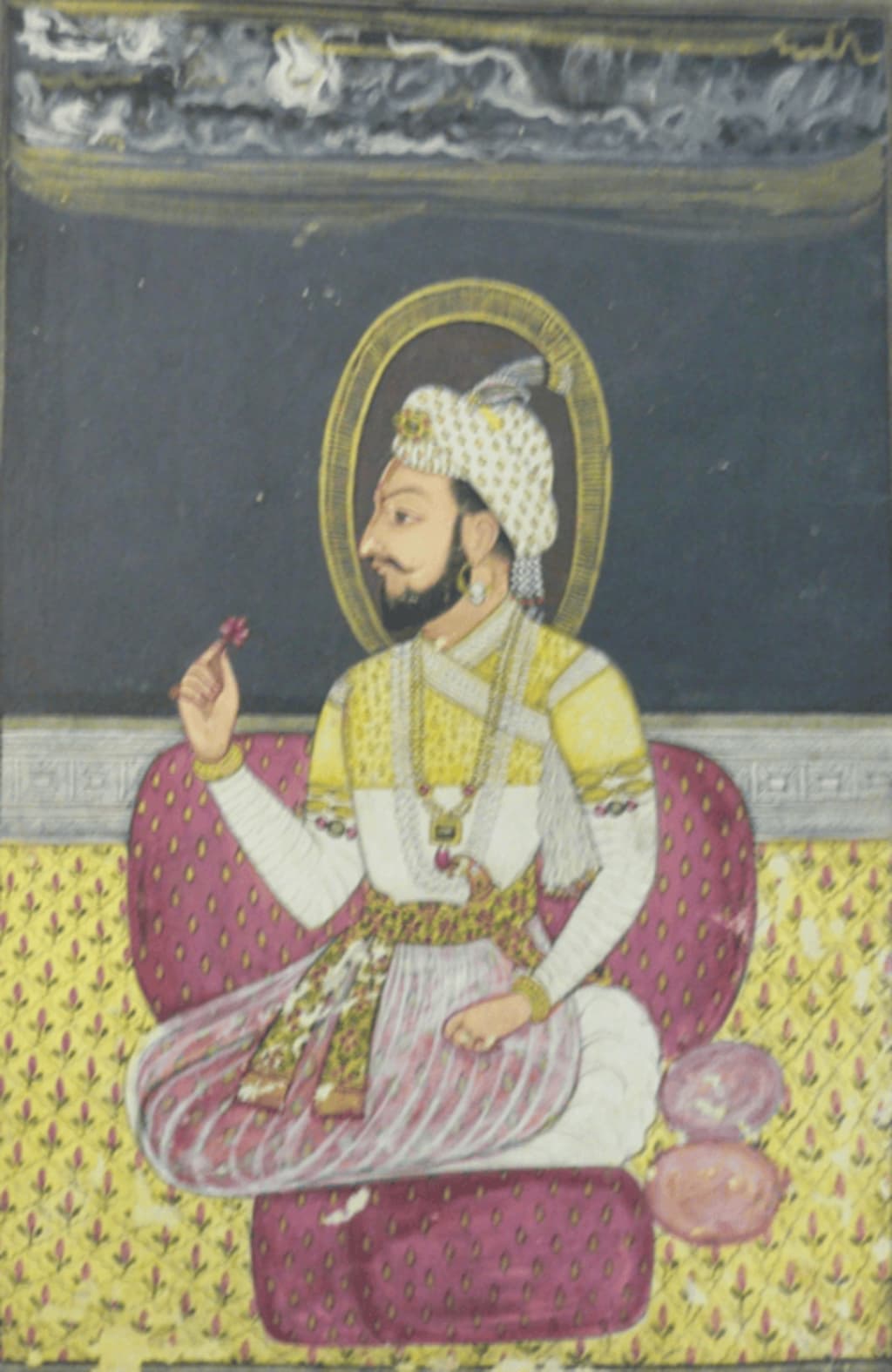
Chhatrapati Sambhaji Maharaj was born on 14 May 1657 at Fort Purandar. Being a prince, he was exposed to battlefield campaigns and political maneuvers from an early age.
Maharani Saibai, Sambhaji Maharaj's mother, passed away when the Maharaj was a young child. After that, a woman named Dharau from Kapurhol village near Pune became his wet nurse. Sambhaji Maharaj was taken care of by his grandmother, Rajmata Jijabai.
Putlabai, his stepmother, also adored him greatly. But Sambhaji Maharaj's stepmother, Soyarabai[2], treated him like a child and tried to get in the way of his political career. Many historical documents say that Sambhaji Maharaj was very handsome and brave. Additionally, he was an extremely shrewd politician and a scholar of numerous languages. He had fully grasped the political nuances. Shivaji Maharaj brought him with him on his trip to Agra in the hope that learning about the events and politics of the Mughal court would help him in the future. At that time, Sambhaji Raje was 9 years old. After Shivaji Maharaj escaped from prison, Sambhaji Raje should not suffer the rush to Swarajya and therefore it was necessary to keep him in a safe place for some time. Therefore, Shivaji Maharaj kept him in the house of Moropant Peshwa's brother-in-law in Mathura. Shivaji Maharaj spread the rumor that Sambhaji Raje had died in order to prevent the Mughal soldiers from following him. Some time after he reached Maharashtra, Sambhaji Maharaj safely reached Swarajya.
Sambhaji Raje had mastered the nuances of politics and battlefield strategy by the time Shivaji Maharaj was crowned in 1674 AD. He won over the representatives who came to Raigad for the coronation with his humble demeanor. Twelve days after Shivaji Maharaj was crowned, Jijau passed away. After that, Sambhaji Raje received no more attention from anyone. On the battlefield and in Swarajya's politics, Shivaji Maharaj was involved. In Shivaji Maharaj's court, young Sambhaji Raje frequently disagreed with more experienced officials. The illustrious Annaji Dutt's administration was strongly opposed by Sambhaji Maharaj. Since Shivaji Maharaj was an experienced and skilled administrator, he frequently ignored Annaji's corrupt administration. But Sambhaji Maharaj found it difficult to accept that. Sambhaji Maharaj was opposed by Annaji Datto and other seasoned dignitaries. Only at Annaji Datto's direction did dignitaries in the court begin to treat Sambhaji Maharaj with contempt. They were unable to accompany Shivaji Maharaj on the campaign to South India because of their opposition. Also, the Ashtapradhan Mandal refused to follow Sambhaji Maharaj's orders in Shivaji Maharaj's absence. As a result, Shivaji Maharaj was forced to send Sambhaji Maharaj to serve as Shringarpur's Subedar in Konkan.
Aurangzeb attacked the Marathas in 1682. Aurangzeb's army was five times larger than the Maratha army, while Aurangzeb's empire was at least 15 times larger than Sambhaji Maharaj's Swarajya. At that time, Aurangzeb's army was among the most powerful armies in the world. Still, the Marathas fought bravely under the leadership of Sambhaji Maharaj. A striking example of the Maratha strong will and tenacity is the battle of Ramshej Fort near Nashik. Aurangzeb's chieftains expected that the fort would surrender within a few hours. But the Marathas put up such a stubborn resistance that they had to fight for six and a half years to conquer the fort. Sambhaji Maharaj taught such a lesson to the enemies, the Portuguese of Goa, the Siddi of Janjira, and the Chikkadeva Rai of Mysore, that they did not dare to help Aurangzeb against Sambhaji Maharaj. Also, none of them could turn against them. Under the leadership of Sambhaji Maharaj, the Marathas fought all the enemies single-handedly.[
In 1687-88 AD, there was a major famine in Maharashtra. Due to this, the situation became difficult.
About the Creator
Keep reading
More stories from Suresh Patil and writers in Education and other communities.
Rabindranath Tagore: A Day to day existence Woven in Words and Tunes
Rabindranath Tagore: A Day to day existence Woven in Words and Tunes In the core of nineteenth century Bengal, in the midst of the lively embroidery of Indian culture, a star was conceived, bound to enlighten the world with his splendor. Rabindranath Tagore, the most youthful child of Debendranath Tagore, a logician and strict reformer, acquired a tradition of scholarly and imaginative enthusiasm. His experience growing up was saturated with writing, music, and reasoning, supporting his natural inventiveness.
By Suresh Patilabout a year ago in Education
How Problem-Solving Shapes the Success of Modern Entrepreneurs
Entrepreneurship today is defined by constant change and relentless challenges. Business leaders are no longer operating in stable, predictable environments; instead, they face shifting markets, evolving customer expectations, and rapid technological advancements. In this environment, problem-solving has become the cornerstone of entrepreneurial success. The ability to identify issues, analyze them critically, and create practical solutions separates thriving ventures from those that struggle to survive. Entrepreneurs who develop strong problem-solving skills are better equipped to innovate, make strategic decisions, and guide their businesses toward sustainable growth.
By Greg Warnockabout 9 hours ago in Education
Genomic Breakthroughs, Life-Changing Impact
Scientific discovery has always played a vital role in advancing human health, but few fields have transformed medicine as dramatically as genomics. By exploring the structure and function of genes, scientists have gained powerful insights into how diseases develop, how individuals respond to treatments, and how health risks can be predicted before symptoms appear. These genomic breakthroughs are not only advancing science but also changing lives around the world. From personalized medicine to improved disease prevention, the impact of genomics is reshaping healthcare, offering hope, understanding, and better outcomes for countless people.
By Mark Bouzyka day ago in Education
Why Didn't Anyone Tell Us
Men, move along. This is not for you. This is for the women. I was forty-five when I began menopause. It is pretty young for that to be going on in a woman’s life, but I had undiagnosed PCOS, my entire life. Thank you to all the gynecologists I had seen my entire life. That in itself should encourage women to keep seeking second opinions, especially when you are not getting correct answers or any at all.
By Alexandra Grant2 days ago in Humans


Comments
There are no comments for this story
Be the first to respond and start the conversation.