
Chalk Dust and Empty Promises
A Village Girl's Fight for Education in Pakistan
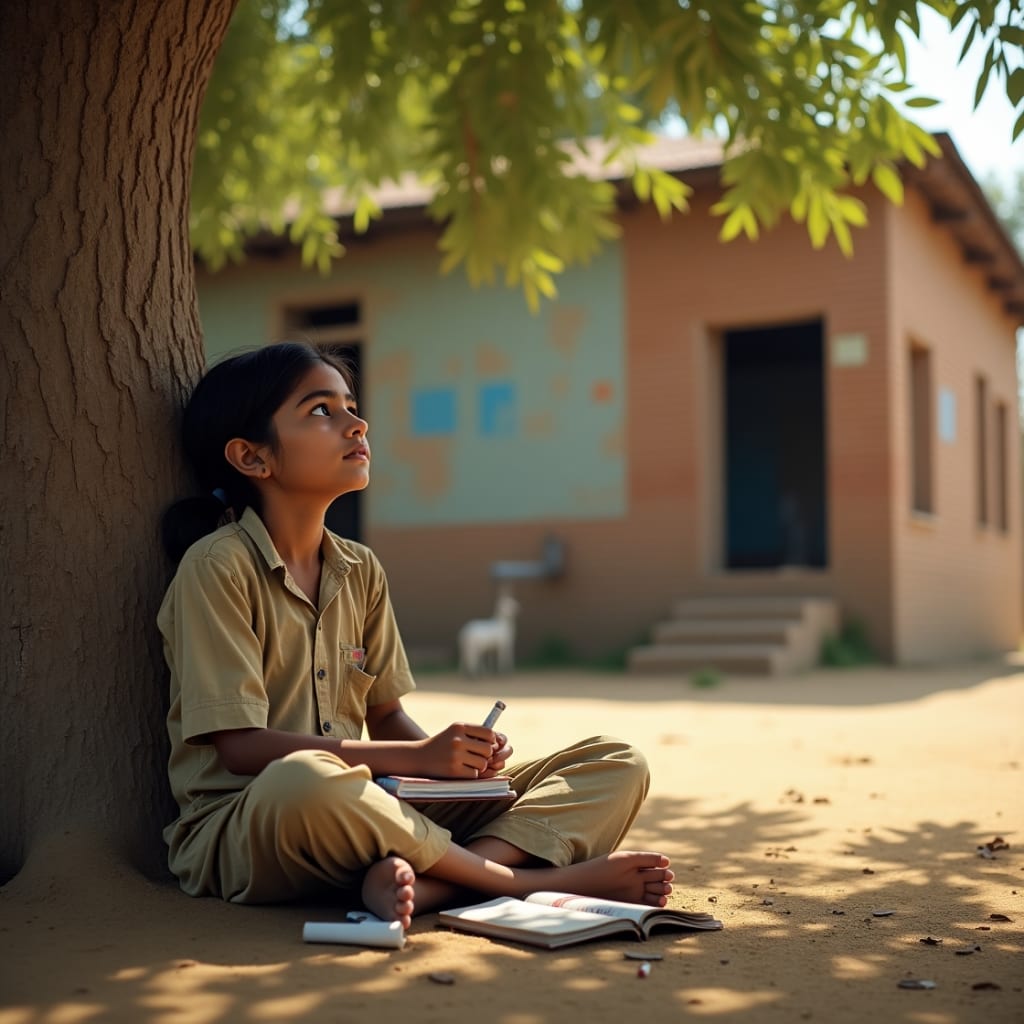
When twelve-year-old Zainab ran barefoot through the dusty paths of her remote Pakistani village, she carried more than a satchel of torn books. She carried hope. A fragile, flickering hope that one day, education would unlock a door her family never had the chance to open.
But that door was heavy—rusted shut by poverty, apathy, and decades of broken promises.
Zainab’s village lies in the outskirts of Bahawalpur, where the sun burns hotter than ambition, and water is scarcer than opportunity. In a place where the loudest sound is the silence of empty classrooms, her desire to learn made her unusual. Girls here are taught to cook before they can spell, expected to marry before they understand what dreams mean.
There is a building that passes for a school, built with donor money that never quite made it to the blackboard. It has no windows, no electricity, and often, no teacher. A faded sign reads “Government Girls Primary School” but the children call it “ghost school.” On most days, the teacher is absent—busy with other government duties, or simply uninterested. The headmaster, a cousin of a local politician, draws a full salary each month. He’s never once visited the premises.
Zainab, however, goes anyway. With only a half-broken slate and chalk, she draws letters on the ground. She once saw a picture of a university in Lahore on a torn newspaper and whispered to herself, “Someday.”
But that “someday” feels impossibly far.
The National Crisis That No One Hears
Zainab's story isn't rare. In fact, it's painfully common. Pakistan has over 22 million children out of school, the second-highest number in the world. Public education is in crisis—underfunded, mismanaged, and entangled in politics. According to UNESCO, nearly 44% of girls in rural areas don’t complete primary education. Infrastructure is crumbling, learning outcomes are dismal, and corruption eats away at the system like termites in a wooden desk.
What’s even more heartbreaking is the illusion of progress. Government officials boast about new school buildings or digitized attendance systems. But what use is a biometric machine if there are no teachers to check in? What use are textbooks if they arrive six months after the school year has started?
Millions of children like Zainab are being robbed of a future—slowly, silently.
One Candle, One Light
One day, an NGO volunteer named Sameer visited Zainab’s village as part of a community outreach program. He noticed her writing English letters in the dirt with a twig. When he asked where she learned it, she said, “From the backside of food wrappers.” That moment changed him.
Sameer petitioned for solar-powered learning kits and started weekend lessons under a neem tree. Soon, six girls joined. Then ten. He called it the “Tree of Learning.” The government still didn’t notice. But something shifted in the village.
Fathers who once said, “Girls don’t need school,” saw their daughters reading medicine labels, helping their siblings with homework, even explaining weather reports from the radio. It wasn’t magic. It was education.
A Nation’s Future in Jeopardy
Zainab is one girl. But she represents the soul of a country with immense untapped potential. Pakistan is a young nation—over 60% of the population is under 25. Yet without quality education, that demographic edge becomes a ticking time bomb.
The tragedy of poor education is not just academic. It fuels cycles of poverty, extremism, and inequality. It handicaps healthcare, crushes entrepreneurship, and weakens democracy. When you silence a child’s question, you silence a future scientist, teacher, artist, or leader.
The government must go beyond cosmetic reforms. Teacher training, accountability, community involvement, and curriculum overhaul aren’t luxuries—they’re necessities. Private schools have filled the gap, but they remain inaccessible to the rural poor. Education must be a right, not a privilege.
Epilogue: Still She Writes
Today, Zainab is 14. She now teaches three younger girls under that same neem tree. The school building still sits idle, but her voice echoes louder than ever.
She writes on lined paper now—gifted by Sameer—and dreams of becoming a teacher.
“If I can help one girl not stop dreaming, maybe we can open that door together,” she says with a shy smile.
In her small hands, she holds something stronger than chalk or books.
She holds the future.
About the Creator
Keep reading
More stories from Habibullah and writers in Education and other communities.
How AI Is Impacting the Jobs of Website Designers and Developers
Artificial Intelligence (AI) is transforming industries across the globe, and the world of website design and development is no exception. From streamlining workflows and enhancing creativity to automating repetitive tasks and reshaping professional roles, AI’s influence is broad and deep. In this article, we explore how AI is impacting website designers and developers — the opportunities it presents, the challenges it introduces, and how professionals can adapt to thrive in an AI-augmented landscape.
By Rajiv Menona day ago in Education
Kiranmala: the legend of the princess who considered magic mountain
Long ago, in a land far away, the queen was panicked, her grasp on reality seemingly slipping. She had given birth to two boys and one girl. But to her horror, before even meeting their father, each child vanished, something else taking their place. She faced accusations of witchcraft and demon sorcery. And though the king loved her, he was easily swayed. He soon grew doubtful and banished his wife, who left the kingdom in anguish. Little did they know, the queen’s jealous sisters were the ones to replace the newborns
By Munesh Yadavabout 2 hours ago in Education


Comments
There are no comments for this story
Be the first to respond and start the conversation.