
Celestron Origin Telescope - Everything You Need to Know
Celestron Origin is an Intelligent Telescope similar to a small home observatory. This telescope will change the stargazing forever.


Celestron Started the year 2024 with a bang. They announced “Celestron Origin,” a new and one of the coolest telescopes ever so far. The telescope not only looks awesome but also is a combination of various technologies developed by the Celestron.
The telescope is designed keeping the demand in mind, and at the same time, they also tried to counter the competition. Whenever anyone gets interested in astronomy, they usually want to go towards astrophotography and click on those awesome-looking photos you see in your Instagram feed. Looks like the Celestron Origin will be the first choice of those people. Nowadays, AI is combined with almost everything; it was just a time when telescope manufacturers used AI in telescopes.
Details of Celestron Origin.
The Origin isn’t your grandpa’s telescope. The Origin is an all-in-one home observatory, sleek and compact, that blurs the lines between stargazing and astrophotography, making the universe’s wonders accessible to everyone.
The Celestron Origin uses RASA and StarSense technologies developed by the Celestron.
What is RASA?
The RASA is the Rowe-Ackermann Schmidt astrograph. It was designed by Dave Rowe and Mark Ackermann and is a revolutionary optical design that has transformed the world of astrophotography. Unlike traditional telescopes, which often have long focal lengths and slow apertures, the RASA boasts a unique combination of a fast f/2.2 focal ratio and a wide field of view. This means it can gather light much more efficiently, allowing you to capture stunning images of faint deep-sky objects in a fraction of the time it would take with other telescopes.
The RASA is relatively small and lightweight, making it easy to transport and set up. The RASA is designed for both experienced and beginner astrophotographers. Its simple design and intuitive operation make it a joy to use.
The RASA is a versatile telescope that is well-suited for a wide range of astrophotographers, from beginners to experienced amateurs. If you are looking to capture stunning images of deep-sky objects without the need for complex equipment or long exposure times, then the RASA is a perfect choice for you.
StarSense
It uses StarSense, so this telescope has no more alignment headaches. Forget the tedious manual setup! Celestron’s Starsense technology takes the wheel. Simply point the origin towards the sky, and its built-in brain finds its bearings, aligning itself with celestial precision. Let the tech handle the nitty-gritty while you settle in for your cosmic show.
The Origin app
Your smartphone is your cosmic control panel. The dedicated Origin App is your window to the universe. Imagine a planetarium at your fingertips, guiding you through constellations and hidden gems. With a tap, choose objects from curated lists or explore freely. The Origin captures stunning images, processed and stacked using AI algorithms, all in real-time on your phone. Share your cosmic conquests with the world; you’re a citizen scientist now.
The Origin does not have an eyepiece where you line up to see the object during Astro Gathering. Now Celestron Origin will give a live feed on the TV or phone so that all your friends and family can enjoy and observe the night sky together.
Origin is a portable system that doesn’t require external WiFi networks, so you can easily take it to remote, dark skies in any car. The optical tube, mount, and tripod are all easily assembled and disassembled without tools. Each component weighs less than 16 lb. Optional carrying cases are also available.
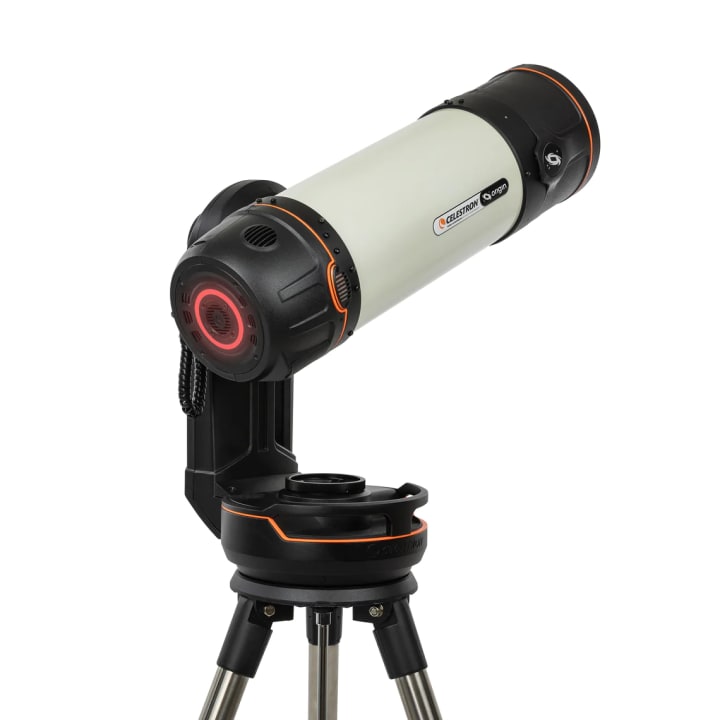
Celestron Origin Optical tube.
The optical tube is a RASA design. It has an aperture of 152 mm or around 6 inches. Its focal length is 335 mm, and its focal ratio is f/2.2. The optics are covered with Celestron’s Starbright XLT coatings. The weight of the optical tube is 10.6 lbs or around 4.8kg.
About the Creator
Alien Tech
TheAlienTech.com is focused on astronomy, stargazing, and space technology.
We will be also discussing the future of humanity.
Keep reading
More stories from Alien Tech and writers in Education and other communities.
Celestron NexStar 8SE - Full Review
The Celestron Nexstar 8SE is one of the best-selling and most popular telescopes. This telescope is the top model from Celestron’s iconic orange tube-designed SE series telescopes. The telescope is loaded with many features and provides the best stargazing experience for beginners and advanced astronomers. This telescope is known for its superb optics and exceptional performance. So in this article, we will cover almost everything about this telescope. So by the end of this article, you’ll have all the information you need to decide whether this telescope is the right choice for you.
By Alien Tech2 years ago in Education
What is Affiliate Marketing: A Beginner's Step-by-Step Guide
Affiliate marketing is a performance-based online business model that generates over $12 billion annually in the U.S. alone and continues to grow as e-commerce expands. At its core, affiliate marketing allows individuals to earn commissions by promoting products or services created by other companies. Affiliates share unique tracking links through websites, blogs, social media, email lists, or videos, and earn a percentage of each sale or action completed through those links. Because affiliates don’t handle product creation, inventory, payment processing, or customer support, it’s one of the most accessible ways to monetize an online presence.
By Mohammad Sufyaan6 days ago in Education



Comments
There are no comments for this story
Be the first to respond and start the conversation.