
Can We Cool the Earth by Dimming the Sun?
Inside the UK’s Bold Geoengineering Experiments

What if we could press a planetary “pause” button on global warming?As climate anxiety grips communities worldwide and the effects of global heating accelerate, a bold question is being asked in science labs across the UK: Can we reflect sunlight back into space to cool the Earth—safely, temporarily, and deliberately?
This is not science fiction. It’s called geoengineering, and in 2025, it’s moving from the realm of theory into real-world experimentation.
What Is Geoengineering—and Why Is the UK Leading It Now?
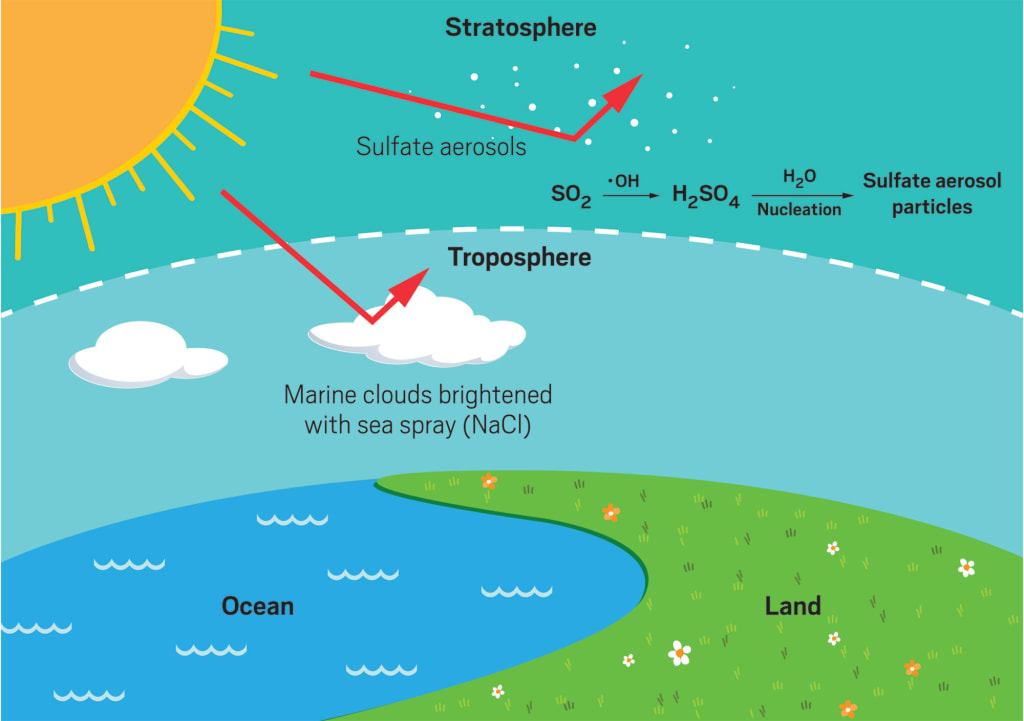
Geoengineering—also known as climate engineering—refers to large-scale, deliberate intervention in Earth’s climate system to counteract global warming. One of the most discussed forms is Solar Radiation Management (SRM), where the goal is to reflect a small percentage of sunlight back into space to cool the planet.
In the UK, scientists are actively exploring several SRM techniques, including:
Stratospheric Aerosol Injection – Releasing tiny reflective particles (like sulfur dioxide) high into the stratosphere to mimic the cooling effects of volcanic eruptions.
Marine Cloud Brightening – Spraying seawater droplets into clouds to make them whiter and more reflective.
Cirrus Cloud Thinning – Reducing high-altitude clouds that trap heat, allowing more infrared radiation to escape.
These aren’t hypothetical anymore. With rising global temperatures and emissions still climbing, researchers are urgently looking for tools that could buy us time—without replacing the need for long-term decarbonization.
The UK’s £50 Million Bet on Climate Intervention
In late 2024, the UK’s government-backed Advanced Research and Invention Agency (ARIA) committed a staggering £50 million to fund outdoor experiments in geoengineering. This was followed in early 2025 by another £11 million from the Natural Environment Research Council (NERC), creating a coordinated national push into what was once considered a fringe field.
Under strict environmental oversight, these small-scale tests will explore the feasibility and side effects of SRM methods in real-world conditions. The UK's initiative is among the most significant globally, especially at a time when the U.S. is retreating from such research under shifting political leadership.
These aren’t full-scale applications but tightly controlled scientific studies. Still, they mark the first time such climate interventions are being tested in the open air in the UK.
Support vs. Backlash: A Nation Divided
Not everyone is comfortable with the idea of deliberately manipulating the Earth’s climate.
Supporters of the research argue that we’re entering uncharted climate territory and need every option on the table. They emphasize that SRM could act as a “climate shock absorber,” softening the blow while emissions cuts and carbon capture strategies scale up.
On the other hand, critics warn that messing with the atmosphere could backfire. Potential risks include shifts in rainfall patterns, regional droughts, and unknown ecological consequences. There’s also the moral hazard concern: If geoengineering appears to be a quick fix, will governments slow down efforts to reduce emissions?
These tensions raise a broader question: who gets to control the global thermostat? And what if one nation’s “solution” causes problems for others?
Why This Matters Now More Than Ever
Climate tipping points—such as the collapse of ice sheets or the Amazon rainforest—are closer than previously thought. Scientists increasingly believe that even if we stopped emitting carbon tomorrow, the warming already baked into the system could cause irreversible damage.
That’s why many experts argue that we need to understand geoengineering, whether or not we ever deploy it. By conducting safe, transparent, and ethical experiments now, we can build the knowledge base needed to make informed decisions later.
Furthermore, by taking a leadership role, the UK can help ensure that future discussions around these powerful tools are grounded in science, not panic or politics.
The Path Forward: Research, Regulation, and Responsibility
The UK's experiments are a first step—not toward deployment, but toward understanding. The scientists behind these efforts are clear: this is not a substitute for cutting emissions. Rather, it’s an emergency option if warming spirals out of control.
For geoengineering to be part of the climate toolkit, it must be studied with humility, caution, and global cooperation. Any future use will demand international governance, public transparency, and rigorous risk assessment.
Final Words: A Planet in Our Hands
Geoengineering may be one of the most controversial climate strategies ever proposed—but ignoring it won’t make it go away. As the UK leads the charge in cautious, science-led exploration, we all have a role in shaping how these powerful tools are used—or not used.
Thank you for reading this in-depth look into one of the most fascinating and debated areas of modern climate science. Whether you support it or question it, staying informed is the first step toward making the right choices for our planet’s future.
If you’re curious to learn more, come take a walk with me through this fascinating journey!
About the Creator
Natik Ahsan
Welcome to a world of wonder, curiosity, and nature's quiet magic.
Here, I explore stories that open minds, spark thought, and invite gentle conversation.
Thank you for being here—your presence means everything.
Keep reading
More stories from Natik Ahsan and writers in Education and other communities.
Is Seedless Fruit Safe? Unpacking the Biotech Controversy
Seedless fruits, a wonder of agricultural biotechnology, offer a hassle-free option for fruit lovers without losing nutrition. Using techniques like parthenocarpy and genetic modification, they make eating easier while helping shape modern diets and tackle global food challenges.
By Natik Ahsan9 months ago in Education
Rewiring Wellness: How Neuroscience Is Redefining the Mind-Body Connection in Therapy
In recent years, neuroscience has reshaped the understanding of how emotional and physical processes interact, offering therapists new insight into healing. The mind-body connection, once viewed as more philosophical than scientific, now has clear biological explanations. Studies show that thoughts, emotions, and physical sensations are deeply intertwined, influencing everything from stress responses to overall wellbeing. This knowledge is transforming modern therapeutic practices by providing clinicians with evidence-based tools that support integrated healing.
By Debra Bailey PHDa day ago in Education
Was Alexander the great really that great?
Order, order! Who do we have on the stand today? Alexander... the Great, eh? Well, what’s so great about him? Your honor, the better question is, what's not great about him? He was the King of Macedon and considered a living demigod by Egyptians and Greeks alike. He conquered Persia when it was one of Earth's largest empires. And he was a thoughtful student of Aristotle, creative enough to untie the impossibly tight Gordian knot by cutting it in half. The Gordian knot is a myth— just like the countless other stories invented to enhance Alexander’s legend!
By Munesh Yadava day ago in Education
Center Stage with Paul Stewart
*** I'm keen to republish the interviews I did for my series with Vocal creators. It's been a few years and I thought it might be nice to revisit these wonderful conversations. I'll be releasing them one at a time for a few weeks/months.
By Heather Hubler5 days ago in Interview




Comments
There are no comments for this story
Be the first to respond and start the conversation.