
Can Time Exist Without Matter? Exploring One of Physics’ Deepest Questions
Time shapes everything we experience. We measure motion with it, remember the past through it, and anticipate the future because of it. But a profound question lies beneath our everyday assumptions: Can time exist without matter? If the universe were completely empty—no particles, no radiation, no energy—would time still pass? Or does time require matter to exist at all? This question sits at the crossroads of physics, cosmology, and philosophy. Modern science offers surprising insights, but no simple answers.

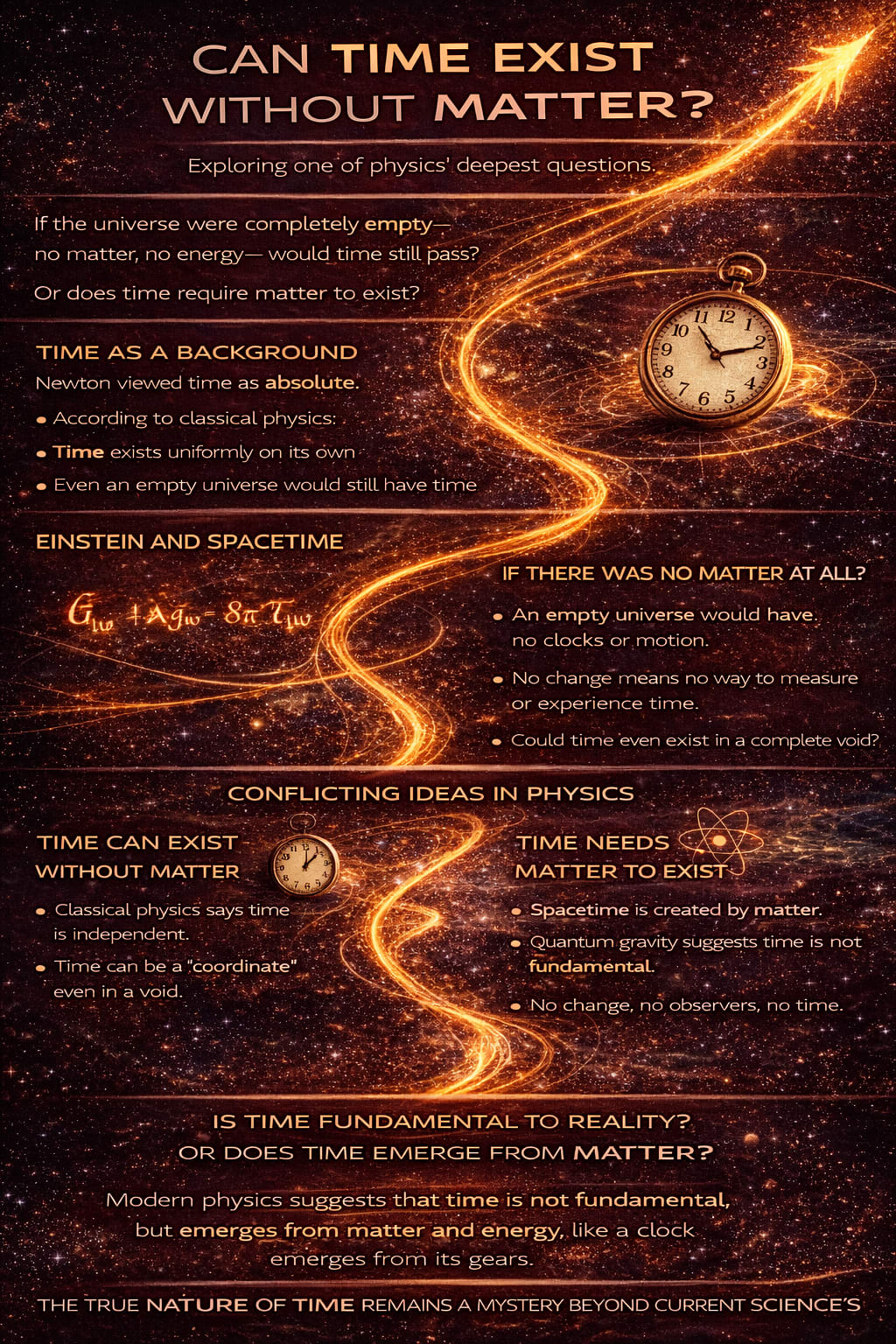
Why This Question Matters
Understanding whether time can exist without matter affects:
• The origin of the universe
• The nature of spacetime
• Quantum gravity theories
• Whether time is fundamental or emergent
At its core, this question asks whether time is something real on its own, or something that arises from physical processes.
________________________________________
The Classical View: Time Exists Independently
For centuries, physicists believed time was absolute.
Newton’s Concept of Time
• Time flows uniformly
• It exists independently of matter
• Even an empty universe would still have time
In this classical view, time is a cosmic background—always ticking, whether anything happens or not.
________________________________________
Einstein Changed the Nature of Time
Albert Einstein revolutionized physics with relativity.
Key Insight
Time is not separate from space—it is part of spacetime.
Spacetime is shaped by:
• Matter
• Energy
• Motion
This immediately complicates the idea of time existing without matter.
________________________________________
Spacetime Depends on Matter and Energy
Einstein’s field equations show:
• Matter tells spacetime how to curve
• Curved spacetime tells matter how to move
If spacetime includes time, and spacetime is shaped by matter, then the question arises:
Can time exist if there is nothing to shape spacetime?
________________________________________
An Empty Universe in General Relativity
General relativity allows solutions where:
• Matter density is zero
• Spacetime still exists
However, even “empty” space is not truly empty.
________________________________________
Vacuum Is Not Nothing
In modern physics:
• Empty space contains quantum fields
• Vacuum fluctuations occur constantly
• Energy exists even without particles
So when we ask “without matter,” we must ask:
Without matter, energy, or fields—or absolutely nothing?
________________________________________
Can Time Exist Without Events?
Time is often defined operationally:
• Time is measured by change
• Without change, time cannot be measured
If nothing happens, does time still exist?
This leads to a crucial distinction:
• Time as a coordinate
• Time as a physical process
________________________________________
Time as a Coordinate
In physics equations:
• Time can exist as a variable
• Even if nothing changes
• Equations still include time
This suggests time can exist mathematically without matter.
________________________________________
Time as Experience or Process
But physically:
• Time is known through change
• No matter → no clocks
• No processes → no duration
Without matter, time may exist but be meaningless.
________________________________________
Does Time Require Clocks?
A clock requires:
• Matter
• Motion
• Energy transitions
Without clocks, time cannot be observed.
This raises the philosophical question:
If time exists but cannot be measured, does it meaningfully exist?
________________________________________
The Relational View of Time
Some physicists and philosophers argue:
• Time does not exist independently
• Time is a relationship between events
• No events → no time
This is called relational time.
________________________________________
Julian Barbour and Timeless Physics
Physicist Julian Barbour argues:
• Time is not fundamental
• The universe is a collection of “nows”
• Change creates the illusion of time
In this view, time cannot exist without matter.
________________________________________
Quantum Gravity and the Disappearance of Time
In attempts to unify quantum mechanics and relativity:
• Some equations eliminate time entirely
• The universe evolves without time
• Time emerges only at large scales
This strongly suggests time may require matter and complexity.
________________________________________
Emergent Time Theory
According to emergent theories:
• Time arises from interactions
• It is not a basic ingredient of reality
• Without matter, time does not exist
This is similar to temperature:
• Temperature does not exist without particles
• It emerges from motion
Time may work the same way.
________________________________________
The Big Bang and the Birth of Time
Cosmology suggests:
• Time began with the universe
• Matter, energy, space, and time emerged together
If true, time cannot exist without matter—because they were born together.
________________________________________
Before the Big Bang: Was There Time?
Most physicists agree:
• “Before time” may be meaningless
• Time itself began at the Big Bang
• Without matter, there was no time
This supports the idea that time depends on physical reality.
________________________________________
Could Time Exist in an Empty Universe?
Let’s consider a hypothetical universe:
• No matter
• No radiation
• No fields
• No energy
What remains?
Possibilities:
1. Time still exists but nothing changes
2. Time exists mathematically but not physically
3. Time does not exist at all
Physics cannot yet answer definitively.
________________________________________
Entropy and the Arrow of Time
Time as we experience it has direction.
That direction comes from entropy.
• Entropy requires matter
• No matter → no entropy
• No entropy → no arrow of time
Without matter, time would have no direction.
________________________________________
Does Timelessness Mean Nonexistence?
Even if time exists without matter:
• It would not flow
• It would have no direction
• It would be indistinguishable from nonexistence
In practical terms, such time would be irrelevant.
________________________________________
Time Without Matter vs Time Without Energy
Even removing matter:
• Energy fields may remain
• Quantum fluctuations persist
Truly removing everything may not be physically possible.
________________________________________
Is Absolute Nothing Possible?
Physics suggests:
• True nothingness may be impossible
• Laws of physics still apply
• Fields and probabilities exist
If laws exist, time may exist as part of them.
________________________________________
Does Time Depend on Laws of Physics?
If physical laws exist:
• They include time evolution
• Time may be encoded in structure
This suggests time may exist even without matter—but only abstractly.
________________________________________
Human Perception vs Cosmic Reality
Humans experience time through:
• Change
• Memory
• Motion
Without matter:
• No observers
• No experiences
• No meaning
Time may exist but never be experienced.
________________________________________
Major Scientific Views Summarized
Time Can Exist Without Matter
✔ Supported by classical physics
✔ Time as a coordinate
✔ Mathematical existence
Time Cannot Exist Without Matter
✔ Supported by relativity and quantum gravity
✔ Time emerges from interactions
✔ No change → no time
________________________________________
Which View Does Modern Physics Favor?
Modern physics increasingly favors:
• Time as emergent
• Time dependent on matter and energy
• Time not fundamental
This suggests time cannot meaningfully exist without matter.
________________________________________
Why This Question Remains Open
We lack:
• A complete theory of quantum gravity
• Direct access to timeless states
• Experimental tests beyond the universe
Until then, the question remains unresolved.
________________________________________
The Most Honest Scientific Answer
From current knowledge:
Time may exist mathematically without matter, but it likely cannot exist physically or meaningfully without matter and energy.
Time without matter would have:
• No flow
• No direction
• No observability
________________________________________
Conclusion: Can Time Exist Without Matter?
The answer depends on what we mean by “exist.”
• As a mathematical concept: Possibly yes
• As a physical process: Likely no
• As an experienced reality: Definitely no
Modern physics increasingly suggests that time and matter are deeply intertwined. Without matter, time loses meaning, direction, and reality as we understand it.
Time may not be the stage on which the universe plays—but a feature that emerges only when something exists to change.
About the Creator
Keep reading
More stories from shahkar jalal and writers in Education and other communities.
Real Estate vs. Stock Market Investing: Which Path Builds More Wealth?
Real estate vs. stock market investing is a common debate for anyone who wants to grow wealth. Many people ask which option is safer, which earns more money, and which fits their lifestyle. The truth is that both choices can build wealth over time. However, they work in very different ways. You need to understand the strengths and risks of each before you decide.
By Manny Khoshbin7 days ago in Education
The Reality of doing it all before graduation
Many kids hear from their parents that they should try to live life to the fullest and do as much as they can before it’s too late. None of them is wrong in that regard, but putting it into practice is a little harder than it sounds.
By Aydn Young7 days ago in Education
Who is your "Person"?
It's important to recognize that you cannot go through life as easily on your own. My name is Elizabeth and I'm a survivor of child abuse and horrific trauma. Healing from trauma is not a quick fix and recognizing that it will take time, is part of the struggle.
By Elizabeth Woods3 days ago in Psyche


Comments
There are no comments for this story
Be the first to respond and start the conversation.