
Can the Universe Exist Without Matter?
Introduction When we think about the universe, we usually imagine stars, planets, galaxies, and vast clouds of cosmic dust. Matter seems essential to everything we observe. But this leads to a profound scientific question: Can the universe exist without matter at all? In other words, if all particles vanished—no atoms, no stars, no radiation—would the universe itself still exist? Or is matter required for space and time to exist in the first place? This question lies at the intersection of cosmology, quantum physics, and philosophy. Modern science provides surprising answers that challenge our everyday intuition. In this article, we explore what matter truly is, how it relates to space and time, and whether the universe could exist—even empty—without a single particle inside it.

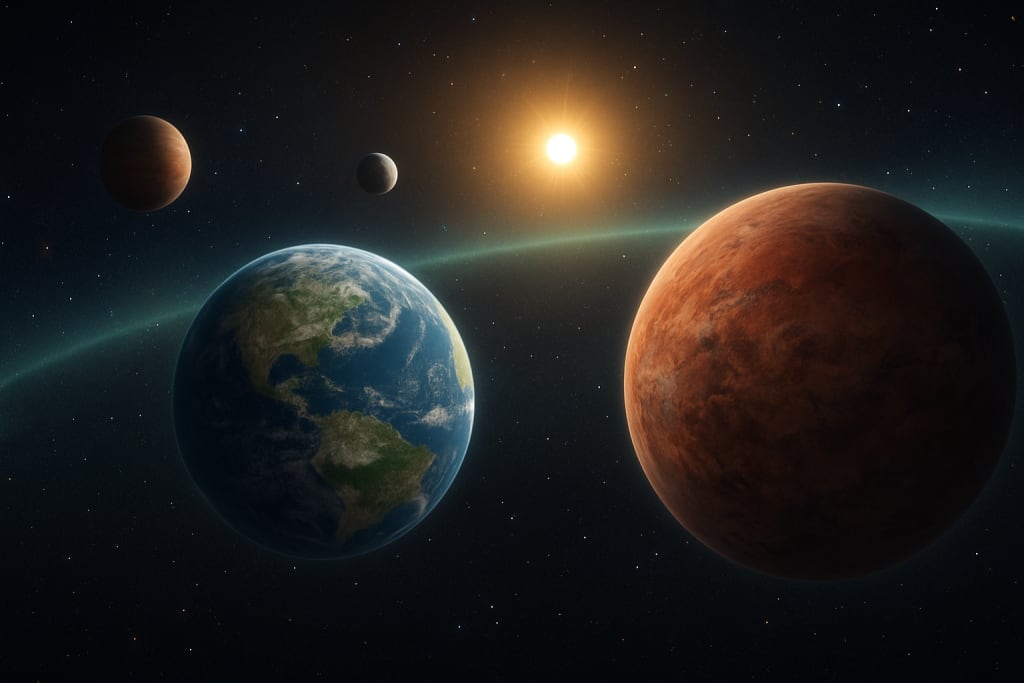
What Is Matter?
Matter is anything that has:
• Mass
• Volume
• Physical structure
Atoms, molecules, planets, stars, and living beings are all forms of matter.
Matter is composed of elementary particles such as:
• Quarks
• Electrons
• Neutrinos
These particles interact through fundamental forces.
But matter is only one component of the universe.
________________________________________
What Else Exists Besides Matter?
Modern physics tells us the universe contains more than matter alone.
The universe is made of approximately:
• 5% ordinary matter
• 27% dark matter
• 68% dark energy
In addition, the universe contains:
• Space
• Time
• Energy
• Physical fields
This already suggests that matter is not the primary ingredient of existence.
________________________________________
Is Space Independent of Matter?
According to classical physics, space was once thought to be a passive stage where matter moves.
Einstein changed this view completely.
In general relativity:
• Space and time form spacetime
• Matter tells spacetime how to curve
• Spacetime tells matter how to move
But importantly:
Spacetime can exist even where no matter is present.
Empty space is still something—not nothing.
________________________________________
What Is a Vacuum?
A vacuum is often described as “empty space,” but in physics, it is never truly empty.
Even in a perfect vacuum:
• Quantum fields still exist
• Energy fluctuates
• Virtual particles appear and vanish
This is known as quantum vacuum energy.
So even without matter, the universe would not be absolutely nothing.
________________________________________
Can Space Exist Without Matter?
Yes.
Solutions to Einstein’s equations allow for spacetime with:
• No matter
• No radiation
• No particles
Such solutions are called vacuum solutions.
Examples include:
• Empty expanding universes
• Gravitational waves traveling through space
• Black hole spacetimes far from matter
This shows that space and time do not require matter to exist.
________________________________________
Would Gravity Exist Without Matter?
Gravity is produced by energy and mass, but spacetime itself can still exist without sources.
Even without matter:
• Spacetime geometry remains
• Gravitational waves can propagate
• Expansion may continue
Gravity becomes inactive but spacetime does not vanish.
________________________________________
Can the Universe Exist Without Energy?
Here the answer becomes more complex.
Quantum physics shows that even “empty” space contains energy.
The vacuum has:
• Zero-point energy
• Quantum fluctuations
Removing all energy entirely may not be physically possible.
The universe cannot reach a state of perfect nothingness.
________________________________________
Dark Energy and Empty Space
Dark energy appears to be an intrinsic property of space itself.
This means:
• The emptier space becomes
• The more dominant dark energy becomes
If matter disappeared completely, dark energy would still cause space to expand.
This suggests that:
The universe does not require matter to continue existing.
________________________________________
Could Matter Disappear Completely?
In the far future, theoretical predictions suggest:
• Stars will burn out
• Black holes will evaporate
• Particles may decay
Over unimaginable timescales, matter could approach zero.
Yet space would continue expanding.
________________________________________
A Universe of Only Space and Time
If all matter vanished, the universe would consist of:
• Expanding spacetime
• Quantum fields
• Vacuum energy
No stars. No atoms. No light.
But still—a universe.
________________________________________
Does the Universe Need Observers?
Some philosophical interpretations suggest reality requires observers.
Physics does not support this idea.
The universe existed for nearly:
• 9 billion years before Earth formed
• 13.8 billion years before humans appeared
Existence does not depend on observation.
________________________________________
Quantum Fields Exist Without Particles
Particles are excitations of quantum fields.
Even without particles:
• Fields still exist
• Laws still operate
• Space retains structure
Matter is not fundamental—fields are.
________________________________________
Could There Be a Universe With No Matter Ever?
Theoretical models allow universes where:
• Matter never forms
• Only radiation or vacuum energy exists
• Structure never develops
Such universes would be empty, dark, and lifeless—but still real.
________________________________________
The Early Universe and Matter Creation
At the Big Bang:
• Energy dominated
• Matter formed later
• Particles emerged from energy
This confirms that matter is not required at the beginning.
Matter is a consequence of cosmic evolution, not its foundation.
________________________________________
Why Matter Exists at All
One of the greatest mysteries in physics is why matter exists instead of nothing.
Tiny asymmetries between matter and antimatter allowed matter to survive.
Without that imbalance, the universe would be almost empty today.
________________________________________
What Would an Empty Universe Look Like?
An observer—if one existed—would see:
• Complete darkness
• No temperature variations
• No structures
• Endless expanding space
Time would continue, but nothing would happen.
________________________________________
Does “Nothing” Truly Exist?
Physics strongly suggests that true nothingness does not exist.
Even when matter is removed:
• Space remains
• Fields remain
• Energy fluctuations remain
Absolute nothing may be impossible.
________________________________________
Educational Importance
This topic helps students understand:
• The difference between matter and space
• The role of quantum fields
• Why vacuum is not empty
• How modern cosmology defines existence
It demonstrates how scientific definitions differ from everyday language.
________________________________________
What Scientists Agree On
There is strong agreement that:
• Space can exist without matter
• Vacuum is not nothing
• Matter is not fundamental
• The universe is mostly non-matter
These conclusions are supported by observation and theory.
________________________________________
What Scientists Still Don’t Know
Open questions include:
• Why vacuum energy exists
• Why matter formed at all
• Whether spacetime is fundamental
• Whether true nothingness is possible
These questions remain active areas of research.
________________________________________
Final Answer: Can the Universe Exist Without Matter?
Based on modern physics:
Yes — the universe can exist without matter.
Space, time, quantum fields, and vacuum energy do not depend on atoms or particles.
Matter is not the foundation of existence—it is a temporary structure within a much deeper framework.
Even if all matter vanished, the universe would still exist as an expanding fabric of spacetime filled with quantum energy.
________________________________________
Conclusion
Our everyday experience makes matter feel essential. But modern physics reveals a far stranger truth.
The universe is not built from matter alone.
It is built from:
• Space and time
• Energy and fields
• Fundamental physical laws
Matter is simply one phase in the universe’s long history.
Long after the last star fades and the final particle decays, the universe may remain—silent, empty, and expanding—yet still very much real.
This realization reshapes our understanding of existence itself and reminds us that reality is far deeper than what we can touch or see.
________________________________________
can the universe exist without matter, universe without matter explained, vacuum energy cosmology, quantum vacuum space, does empty space exist, astrophysics education, cosmology for students, nature of reality science
About the Creator
Keep reading
More stories from shahkar jalal and writers in Education and other communities.
Life in the Ranks: The Overlooked Struggles of Military Service
Military life is often admired from a distance. The uniform, the discipline, and the mission all project a powerful image of strength. Yet, behind this image are real people facing real challenges. The structured lifestyle and constant state of readiness can be mentally and emotionally exhausting. Service members don’t just serve during deployments—they live a demanding reality every day, regardless of where they are stationed.
By Trish Schnabel3 days ago in Education
Instructions Included Challenge Winners
For the Instructions Included challenge, we asked writers to tell a story through instructions and to trust the form to carry what could not be said outright. Across the top entries, that trust paid off in many different ways.
By Vocal Curation Teamabout 15 hours ago in Resources



Comments
There are no comments for this story
Be the first to respond and start the conversation.