
Can pak lauunch a nuclear attack on india | india - pakistan kashmir conflict
Nuclear Deterrence and the India-Pakistan Kashmir Conflict: Assessing Risks and Realities
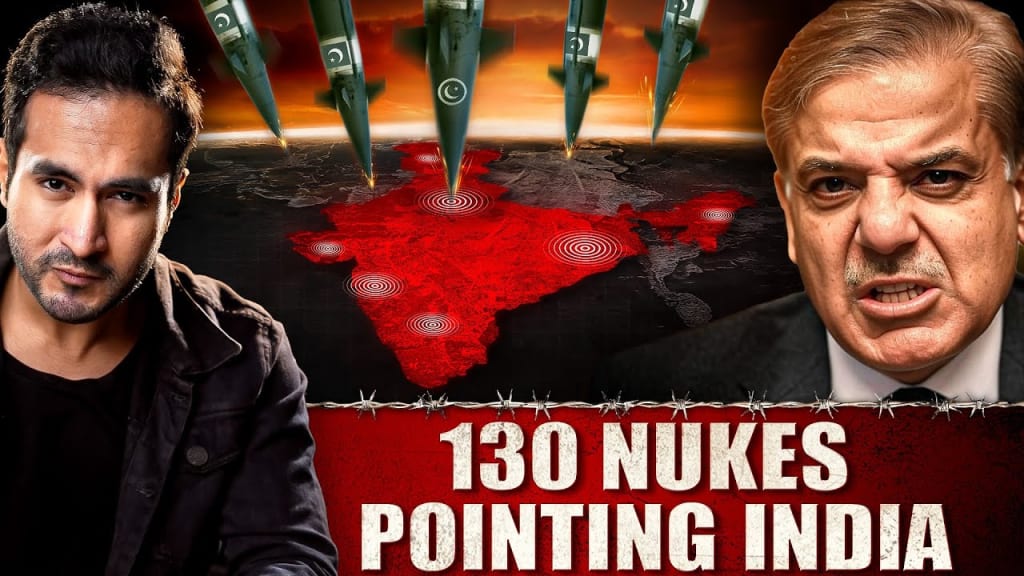
Title: Nuclear Deterrence and the India-Pakistan Kashmir Conflict: Assessing Risks and Realities**
The India-Pakistan conflict over Kashmir, one of the world’s most protracted territorial disputes, has simmered for over seven decades. Since their independence in 1947, the two nuclear-armed neighbors have fought four wars, engaged in countless skirmishes, and maintained a volatile ceasefire along the Line of Control (LoC) in Kashmir. Central to contemporary geopolitical analysis is the question: **Could Pakistan launch a nuclear attack on India amid escalating tensions over Kashmir?** This article examines the historical context, nuclear doctrines, crisis dynamics, and geopolitical constraints to evaluate the plausibility of such a scenario.
---
### **Historical Context: The Roots of the Kashmir Dispute**
The Kashmir conflict originated in the partition of British India, when the princely state’s Hindu ruler acceded to India despite its Muslim-majority population. Pakistan contested the decision, leading to the first Indo-Pak war (1947–48) and the region’s division into Indian-administered Jammu and Kashmir (J&K) and Pakistan-administered Azad Kashmir and Gilgit-Baltistan. Subsequent wars in 1965, 1971, and 1999 (Kargil) deepened mutual distrust.
India’s revocation of J&K’s autonomy under Article 370 in August 2019, followed by Pakistan’s diplomatic downgrade and renewed support for Kashmiri separatists, reignited tensions. Cross-border shelling, militant infiltration, and accusations of state-sponsored terrorism (e.g., the 2019 Pulwama attack) have kept the region on a knife’s edge.
---
### **Nuclear Capabilities and Doctrines**
Both nations possess significant nuclear arsenals. According to the Stockholm International Peace Research Institute (SIPRI), **India holds approximately 160 warheads**, while **Pakistan has 165**, with both expanding their stockpiles. Their delivery systems include ballistic missiles (e.g., India’s Agni-V and Pakistan’s Shaheen-III), cruise missiles, and aircraft.
#### **India’s No-First-Use (NFU) Policy**
India’s nuclear doctrine, established in 2003, emphasizes **retaliation-only** strikes, vowing never to use nuclear weapons first. However, it reserves the right to retaliate massively against any nuclear attack on its territory or forces. Recent ambiguity, including defense minister remarks in 2019 about potential NFU revisions, has raised questions about India’s commitment to restraint.
#### **Pakistan’s First-Use Posture**
Pakistan, by contrast, rejects NFU, citing India’s conventional military superiority. Its **“full-spectrum deterrence”** strategy includes tactical nuclear weapons (TNWs) like the Nasr missile, designed to counter India’s “Cold Start” doctrine—a rapid mobilization strategy for limited conventional warfare. Islamabad argues TNWs deter Indian aggression without triggering all-out nuclear war. Critics, however, warn that decentralizing command over TNWs increases escalation risks.
---
### **Escalation Dynamics: Triggers and Thresholds**
The risk of nuclear use hinges on perceived existential threats. For Pakistan, three scenarios could theoretically justify a nuclear response:
1. **Collapse of Conventional Defenses**: If India’s military advances threaten Pakistan’s territorial integrity (e.g., capturing major cities).
2. **Economic or Political Strangulation**: A scenario where India’s actions cripple Pakistan’s state functionality.
3. **Decapitation Strike**: An attempt to eliminate Pakistan’s nuclear command.
However, several factors mitigate these risks:
#### **Mutual Assured Destruction (MAD)**
Both nations understand that nuclear use would invite catastrophic retaliation. Even a “limited” strike could kill millions, devastate ecosystems, and trigger global condemnation. India’s second-strike capability, including submarine-launched missiles (e.g., K-4), ensures survivability, reinforcing MAD.
#### **International Deterrence**
Global powers, including the U.S., China, and Russia, have vested interests in preventing nuclear conflict. China, Pakistan’s ally, has historically mediated crises (e.g., 2019 Balakot standoff), while the U.S. leverages aid and diplomacy to restrain Pakistan. The UN and financial institutions (IMF) also exert economic pressure.
#### **Domestic Constraints**
Pakistan’s military, which controls nuclear assets, prioritizes regime survival. Despite anti-India rhetoric, provoking a nuclear war would undermine its political and economic interests. Similarly, India’s leadership recognizes that conflict would derail its economic ambitions.
---
### **Crisis Precedents: Lessons from the Brink**
Past confrontations illustrate how nuclear deterrence has contained conflicts:
- **1999 Kargil War**: Pakistan’s infiltration nearly triggered Indian counterstrikes across the LoC. U.S. intervention forced Pakistani withdrawal, showcasing third-party mediation’s role.
- **2001–2002 Parliament Attack Crisis**: Mobilization of 1 million troops ended without war, as neither side could justify escalation.
- **2019 Balakot Airstrikes**: India’s retaliatory strike after Pulwama led to Pakistan’s capture of an Indian pilot, but both sides de-escalated swiftly, aware of nuclear risks.
These examples underscore that while brinkmanship occurs, mutual vulnerability enforces caution.
---
### **The Kashmir Factor: Catalyst or Red Herring?**
Kashmir remains symbolic for both nations, but its linkage to nuclear war is overstated. India frames it as a bilateral issue or internal matter, while Pakistan ties it to self-determination. However, neither side views Kashmir as worth annihilation. Even in its 2019 posture, Pakistan limited responses to diplomatic and irregular warfare (e.g., supporting proxy groups), avoiding overt military escalation.
---
### **Human and Economic Consequences**
A nuclear exchange would have apocalyptic regional implications. Studies estimate that even 100 Hiroshima-sized warheads could kill 20–30 million immediately, with radiation, famine, and global cooling causing further devastation. Economically, South Asia’s GDP growth—critical for both nations—would collapse, displacing 100+ million people.
---
### **Pathways to De-escalation**
Sustainable peace requires addressing Kashmir’s political status and reducing militarization. Potential measures include:
- **Reviving Dialogue**: Resuming composite talks on Kashmir, trade, and Siachen.
- **Strengthening CBMs**: Expanding ceasefire agreements, hotlines, and notification protocols.
- **International Mediation**: Involving neutral actors like the UAE, which facilitated backchannel talks in 2021.
- **Counterterrorism Cooperation**: Joint efforts to dismantle groups like Lashkar-e-Taiba.
---
### **Conclusion: Capability vs. Intent**
Pakistan *can* technically launch a nuclear attack, but the probability remains negligible due to MAD, institutional pragmatism, and global pressures. Nuclear weapons serve as political tools rather than battlefield options, deterring war but failing to resolve underlying disputes. The Kashmir conflict will persist as a flashpoint, yet rational actors on both sides recognize that nuclear war offers no winners—only losers. The challenge lies in transforming deterrence stability into lasting diplomatic progress, ensuring that the unthinkable remains confined to theory.
About the Creator
Reader insights
Outstanding
Excellent work. Looking forward to reading more!
Top insight
Heartfelt and relatable
The story invoked strong personal emotions
Keep reading
More stories from writers in Education and other communities.



Comments
There are no comments for this story
Be the first to respond and start the conversation.