
Can Black Holes Create New Universes? Exploring the Idea of Cosmic Birth Through Collapse
Black holes are often seen as the ultimate cosmic endings—regions where matter collapses, time warps, and nothing escapes. But some of the most fascinating ideas in modern physics suggest a far more creative role for these mysterious objects. Instead of being just cosmic graveyards, could black holes actually create new universes? This bold idea sits at the intersection of cosmology, general relativity, and quantum gravity. While still speculative, it offers intriguing possibilities about the origin of our universe and the nature of reality itself. In this article, we explore the scientific reasoning behind the idea that black holes might give birth to new universes, what theories support it, and what evidence—if any—exists.

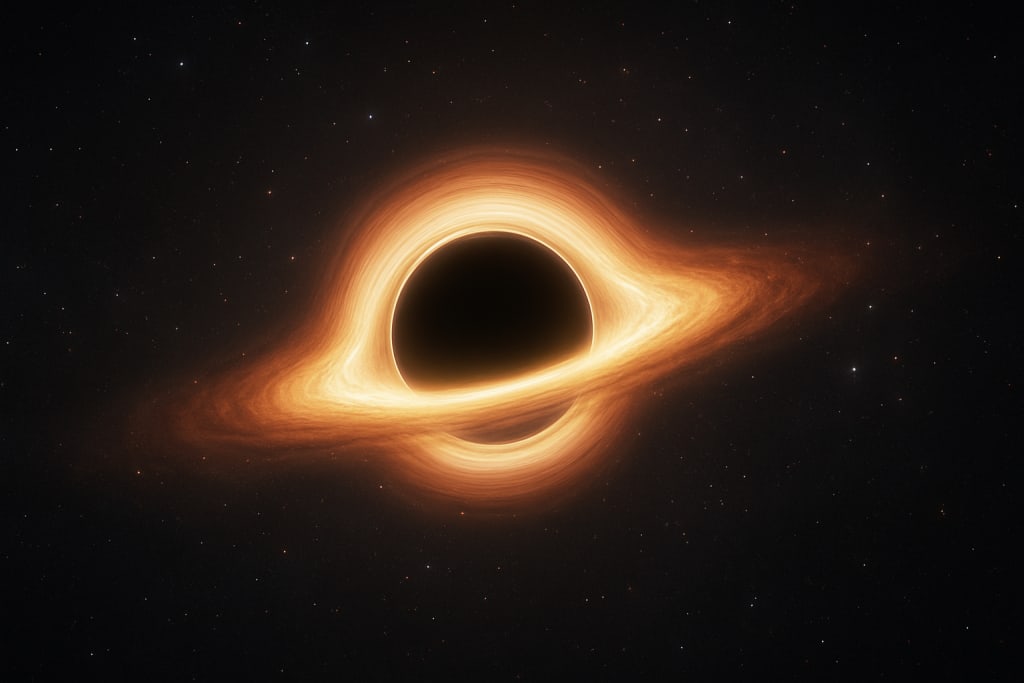
Black Holes: Endpoints or Beginnings?
Traditionally, black holes are described as:
• End states of massive stars
• Regions where gravity overwhelms all forces
• Objects that trap matter, energy, and light
At the heart of a black hole lies a singularity, where classical physics breaks down. But many physicists believe that singularities are not real physical objects—rather, they indicate the limits of current theories.
If singularities are resolved by quantum gravity, the interior of a black hole might not be an end—but a beginning.
________________________________________
The Big Bang and Black Hole Similarities
Interestingly, the Big Bang shares features with black holes:
• Extreme density
• Strong spacetime curvature
• Breakdown of known physics
The Big Bang is not an explosion in space but an expansion of space itself—just as a black hole is a collapse of space. This symmetry has led some physicists to ask:
Could the Big Bang have occurred inside a black hole?
________________________________________
The Black Hole Universe Hypothesis
One idea suggests that:
• Our universe exists inside a black hole formed in another universe
• The event horizon of that black hole corresponds to the observable boundary of our universe
• What appears as a singularity in one universe becomes a Big Bang in another
This is known as the black hole universe hypothesis.
________________________________________
Replacing the Singularity with a Bounce
Classical general relativity predicts singularities. However, quantum gravity theories suggest:
• Infinite densities are unphysical
• Quantum effects prevent total collapse
• A collapsing region rebounds or “bounces”
This bounce could create:
• A new expanding spacetime
• A separate universe with its own laws of physics
• A new arrow of time
________________________________________
Loop Quantum Gravity and Black Hole Bounces
In loop quantum gravity, spacetime is quantized.
Predictions include:
• Singularities replaced by quantum bridges
• Black holes transitioning into white holes
• Matter re-emerging into new regions of spacetime
In this view:
• A black hole collapse becomes a Big Bang-like expansion
• The interior evolves into a new universe
________________________________________
White Holes as Cosmic Births
A white hole is the time-reverse of a black hole:
• Matter can exit but not enter
• Acts as a source rather than a sink
Some theories suggest:
• Every black hole in our universe may correspond to a white hole in another universe
• The white hole appears as a Big Bang in the new universe
No white holes have been observed—but their existence is not forbidden by physics.
________________________________________
Cosmological Natural Selection
Physicist Lee Smolin proposed the idea of cosmological natural selection:
• Each black hole creates a new universe
• Physical constants vary slightly in each universe
• Universes that produce more black holes create more offspring
Over time:
• Universes evolve to favor black hole production
• Our universe may be fine-tuned for this reason
This offers a potential explanation for why physical constants appear finely balanced.
________________________________________
Do Physical Laws Carry Over?
If black holes create new universes:
• Physical constants may be inherited
• Slight variations could occur
• New universes may differ from their parent
This could explain:
• The diversity of possible universes
• Why our universe allows complex structures
• The apparent fine-tuning of constants
________________________________________
Event Horizons as Cosmic Boundaries
In this scenario:
• The event horizon isolates parent and child universes
• Information cannot pass backward
• Each universe evolves independently
From the inside:
• The new universe experiences its own Big Bang
• There is no knowledge of the parent universe
________________________________________
What Happens to Matter Falling In?
Matter falling into a black hole:
• Is crushed to extreme density
• May contribute to the energy of the new universe
• Becomes part of the initial conditions of cosmic expansion
To us, this matter is lost. To the new universe, it may be creation fuel.
________________________________________
Does This Violate Known Physics?
This idea:
• Does not contradict general relativity outright
• Requires quantum gravity for full explanation
• Avoids infinite singularities
• Preserves conservation laws globally
However, it remains theoretical.
________________________________________
The Information Paradox Revisited
If black holes create new universes:
• Information is not destroyed
• It passes into the child universe
• From our perspective, it is lost
• From a global perspective, it is conserved
This offers a possible solution to the black hole information paradox.
________________________________________
Why We Cannot Observe Baby Universes
Even if black holes create universes:
• No signals can cross the event horizon
• Observers cannot survive the interior
• No direct evidence can return
This makes the hypothesis extremely difficult to test.
________________________________________
What Does Observational Evidence Say?
So far:
• Black holes behave as predicted by general relativity
• No anomalies indicate universe creation
• Cosmological observations match Big Bang models
There is no direct evidence for black hole universe creation.
________________________________________
Are There Alternative Explanations?
Yes. The Big Bang could:
• Be a unique event
• Result from quantum fluctuations
• Arise from a prior contracting universe
Black holes creating universes is only one of many possibilities.
________________________________________
Why Physicists Take the Idea Seriously
Despite lack of evidence, the idea is explored because it:
• Resolves singularities
• Explains fine-tuning
• Links black holes to cosmology
• Encourages progress in quantum gravity
Speculative ideas often drive breakthroughs.
________________________________________
Key Points Summary
• Black holes contain extreme conditions
• Singularities likely require quantum gravity
• Some theories replace singularities with bounces
• Black holes could create expanding universes
• Each universe would be causally disconnected
• No observational proof currently exists
________________________________________
Conclusion: Can Black Holes Create New Universes?
The scientifically honest answer is:
Possibly—but there is no direct evidence yet.
Modern theoretical physics allows the possibility that black holes are not just cosmic endpoints but cosmic seeds, giving rise to new universes beyond our own. If true, this would mean our universe may itself be the interior of a black hole formed elsewhere.
While this idea remains speculative, it highlights a profound truth: the universe may be far more interconnected and creative than we imagine.
Until we develop a complete theory of quantum gravity, the idea that black holes create new universes remains one of the most fascinating—and humbling—possibilities in modern science.
About the Creator
Keep reading
More stories from shahkar jalal and writers in Education and other communities.
Why Do Black Holes Evaporate? Understanding Hawking Radiation
Black holes are not truly black. They slowly evaporate. This phenomenon, now known as Hawking radiation, reveals a deep connection between gravity, quantum mechanics, and thermodynamics. But why do black holes evaporate? Where does this radiation come from? And what does it mean for the fate of black holes and the universe itself?
By shahkar jalal23 days ago in Education
Kiranmala: the legend of the princess who considered magic mountain
Long ago, in a land far away, the queen was panicked, her grasp on reality seemingly slipping. She had given birth to two boys and one girl. But to her horror, before even meeting their father, each child vanished, something else taking their place. She faced accusations of witchcraft and demon sorcery. And though the king loved her, he was easily swayed. He soon grew doubtful and banished his wife, who left the kingdom in anguish. Little did they know, the queen’s jealous sisters were the ones to replace the newborns
By Munesh Yadav2 days ago in Education
The Human Guide Behind Technical Excellence
Mentorship of skilled technicians plays a decisive role in shaping strong careers and reliable work standards. Technical skill alone does not make a technician capable. Real growth comes from shared experience, steady guidance, and trust built over time. In many industries, mentorship fills the gap between classroom learning and real job demands. It helps technicians move from basic ability to confident performance. This article explores how mentorship supports learning, builds skills, and strengthens the future workforce.
By Michael Gastinel2 days ago in Education


Comments
There are no comments for this story
Be the first to respond and start the conversation.