
Can Astronomy Coexist with Mystery? Exploring Science, Wonder, and the Unknown Universe
Can astronomy coexist with mystery? At first glance, science appears to eliminate mystery. Telescopes peer deeper into space, equations describe cosmic motion, and data replaces myth with measurable fact. Yet paradoxically, the more astronomy reveals about the universe, the more profound its unanswered questions become. Rather than destroying mystery, astronomy often deepens it. Every discovery opens new layers of uncertainty about space, time, dark matter, black holes, and the ultimate fate of the cosmos.

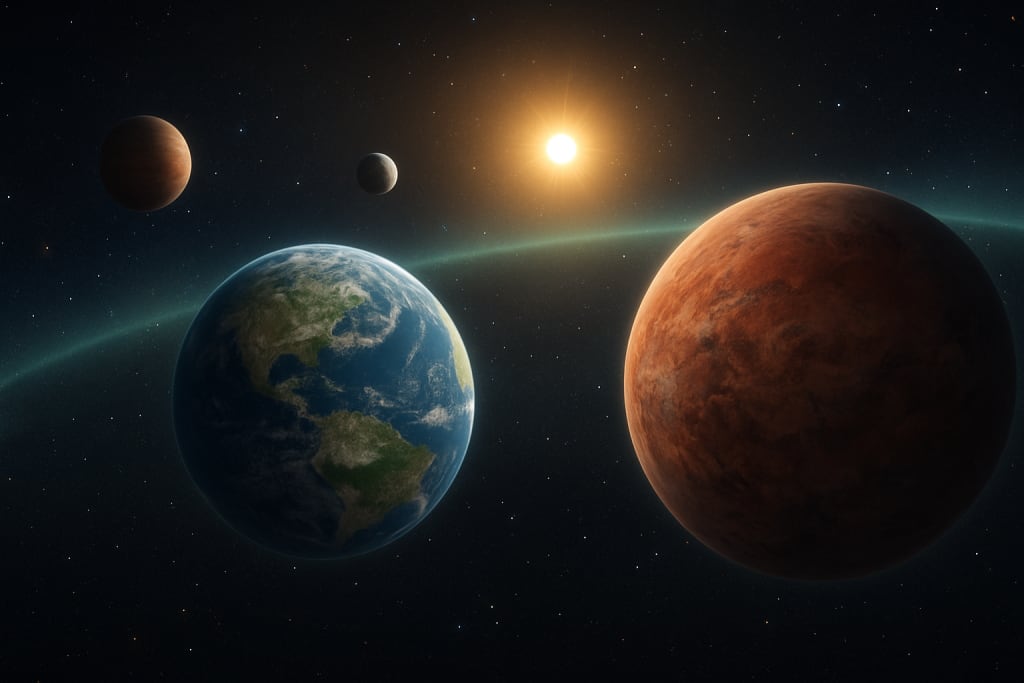
The Birth of Astronomy: From Myth to Measurement
For thousands of years, the night sky inspired stories. Ancient civilizations interpreted stars as gods, omens, or cosmic guardians. The heavens were mysterious, sacred, and unreachable.
Then came observational science.
When Galileo Galilei turned his telescope skyward in the 17th century, he observed moons orbiting Jupiter and mountains on the Moon. These discoveries challenged established beliefs and marked a turning point in human understanding.
Later, Isaac Newton demonstrated that gravity governs both falling apples and orbiting planets. Suddenly, celestial motion was not divine choreography but mathematical law.
It might seem that mystery was fading.
But something unexpected happened.
As explanations grew more precise, the universe became even stranger.
________________________________________
Every Answer Creates New Questions
Astronomy has never closed the book on cosmic inquiry. Instead, each breakthrough expands the horizon.
Consider these milestones:
• The discovery that galaxies exist beyond our own.
• The realization that the universe is expanding.
• The detection of black holes.
• The identification of exoplanets orbiting distant stars.
Each solved puzzle generated deeper questions.
When Edwin Hubble confirmed that galaxies are moving away from us, it led to the idea of the Big Bang. But that introduced new mysteries: What caused it? What existed before it? Why did it happen at all?
Astronomy does not eliminate mystery—it transforms it.
________________________________________
The Dark Universe: A Realm of the Unknown
Perhaps the strongest evidence that astronomy coexists with mystery is the discovery of dark matter and dark energy.
Modern observations show that:
• About 5% of the universe consists of ordinary matter.
• Roughly 27% is dark matter.
• Approximately 68% is dark energy.
In other words, 95% of the universe is fundamentally unknown.
Dark matter cannot be seen, only inferred from its gravitational effects. Dark energy appears to drive the accelerating expansion of space, but its nature remains elusive.
Advanced observatories like the James Webb Space Telescope provide unprecedented data about distant galaxies and early cosmic history. Yet even with cutting-edge instruments, the core components of the universe remain mysterious.
Astronomy shines light into darkness—but darkness still dominates the cosmic landscape.
________________________________________
Black Holes: Where Physics Meets Paradox
Black holes were once theoretical predictions. Today, we have images of one captured by the Event Horizon Telescope collaboration.
Yet black holes remain deeply mysterious.
Inside them, gravity becomes so extreme that our current physical theories break down. Quantum mechanics and general relativity—two pillars of modern physics—conflict at singularities.
What happens to information that falls into a black hole? Does it disappear? Is it preserved?
These questions remain unresolved.
Astronomy gives us observational evidence, but theoretical mysteries persist.
________________________________________
The Cosmic Horizon: Limits of Observation
Even with powerful telescopes, astronomy faces fundamental limits.
We can observe only the “observable universe”—the region from which light has had time to reach us since the Big Bang.
Beyond that cosmic horizon lies unknown territory.
There may be regions of space forever inaccessible to us.
This limitation ensures that astronomy will always coexist with mystery. Some answers may be permanently out of reach—not because of technological failure, but because of the structure of spacetime itself.
________________________________________
The Search for Extraterrestrial Life
Few questions capture public imagination like: Are we alone?
Astronomy has identified thousands of exoplanets. Some lie within the “habitable zone” of their stars, where liquid water could exist.
Missions continue to search for atmospheric biosignatures—chemical signs of life.
Yet we have no confirmed detection of extraterrestrial life.
The universe is vast, ancient, and filled with billions of galaxies. Statistically, life elsewhere seems plausible.
But until evidence emerges, mystery remains.
Astronomy narrows the possibilities, but it does not eliminate uncertainty.
________________________________________
Mystery as a Driving Force
Far from hindering science, mystery fuels it.
Unanswered questions motivate research funding, technological innovation, and international collaboration.
Without mystery:
• There would be no search for dark matter particles.
• No missions to study cosmic microwave background radiation.
• No efforts to unify quantum mechanics with gravity.
Mystery is not the enemy of astronomy—it is its engine.
________________________________________
The Psychological Role of Wonder
Astronomy uniquely combines scientific precision with emotional awe.
Looking at images of distant galaxies or nebulae often evokes a sense of vastness and humility.
Studies suggest that experiences of awe can:
• Expand perspective.
• Increase curiosity.
• Promote cooperative thinking.
Mystery deepens this emotional impact.
If the universe were fully explained and predictable, much of its existential power might fade.
The coexistence of knowledge and mystery preserves both intellectual engagement and emotional resonance.
________________________________________
Science vs. Superstition: A Critical Balance
It is important to distinguish between scientific mystery and superstition.
Astronomy replaces unsupported myths with evidence-based explanations.
But acknowledging mystery does not mean abandoning reason.
Scientific mystery means:
• Questions remain open.
• Hypotheses require testing.
• Evidence guides conclusions.
Astronomy thrives on disciplined curiosity—not blind belief.
Mystery within science is structured and investigable.
________________________________________
The Possibility of a Final Theory
Some physicists seek a “Theory of Everything” that would unify all fundamental forces.
If discovered, would mystery disappear?
Unlikely.
Even with complete physical laws, questions about complexity, consciousness, ethics, and meaning would remain.
Just as knowing grammar does not exhaust literature, knowing fundamental physics may not exhaust cosmic inquiry.
Astronomy could achieve deeper understanding while preserving philosophical wonder.
________________________________________
Human Finitude in an Expanding Cosmos
Human beings are finite.
The universe spans billions of years and trillions of stars.
This scale difference ensures that full comprehension may always exceed our grasp.
Astronomy allows us to map patterns and predict phenomena, but total knowledge may remain beyond reach.
Rather than diminishing astronomy, this limitation gives it enduring purpose.
________________________________________
The Harmony Between Knowledge and Mystery
The relationship between astronomy and mystery is not adversarial.
It is symbiotic.
Knowledge sharpens mystery.
Mystery guides knowledge.
When we discover a new exoplanet, we ask about its atmosphere.
When we measure cosmic expansion, we ask about dark energy.
When we detect gravitational waves, we ask about black hole mergers.
Astronomy does not eliminate the unknown—it organizes it.
Mystery becomes refined rather than erased.
________________________________________
A Universe That Invites Inquiry
Perhaps the most remarkable aspect of astronomy is that the universe is understandable at all.
Physical laws are consistent.
Mathematics describes cosmic motion.
Light carries information across billions of years.
Yet the universe is not fully transparent.
It invites investigation without surrendering all its secrets.
This balance creates a dynamic relationship between observer and cosmos.
________________________________________
Conclusion: Coexistence as Cosmic Necessity
So, can astronomy coexist with mystery?
Not only can it—it must.
Mystery sustains exploration.
Exploration generates discovery.
Discovery reveals deeper mystery.
From dark matter to black holes, from cosmic origins to extraterrestrial life, unanswered questions remain central to astronomical research.
The universe is not a closed book waiting to be finished.
It is an open frontier—expanding both physically and intellectually.
Astronomy provides clarity, precision, and predictive power.
Mystery provides depth, motivation, and wonder.
Together, they form a continuous dialogue between humanity and the cosmos.
As long as telescopes turn skyward and minds remain curious, astronomy and mystery will coexist—not as rivals, but as partners in understanding reality.
And perhaps that coexistence is what keeps the universe endlessly compelling.
About the Creator
Keep reading
More stories from shahkar jalal and writers in Education and other communities.
Is the Universe Endless in Questions? Exploring the Infinite Depth of Cosmic Mystery
The History of Expanding Questions Throughout history, humans have looked to the sky and asked questions. Ancient astronomers mapped stars and planets to track seasons. Later, revolutionary thinkers like Galileo Galilei and Johannes Kepler transformed celestial observation into mathematical science.
By shahkar jalalabout 7 hours ago in Education
Iron Peptides Domain Transition
We are reaching out to our valued customers, research professionals, and the broader scientific community to announce a significant change in our online presence. Our previous domain, ironpeptides.com, has been suspended, and we have successfully transitioned all operations to our new domain:
By Hazel Jackson4 days ago in Education




Comments
There are no comments for this story
Be the first to respond and start the conversation.