
Bresenham’s Line Drawing Algorithm in Computer Graphics
Efficient Rasterization Technique for Drawing Straight Lines in Pixel-Based Graphics

Introduction
In computer graphics, drawing a straight line on a pixel-based display can be a complex task. Lines are a fundamental component, and their accurate rendering is crucial for creating various shapes, wireframes, and graphical objects. Bresenham's Line Drawing Algorithm, developed by Jack E. Bresenham in 1962, offers an efficient and precise method for drawing lines on raster devices. This algorithm is celebrated for its simplicity, efficiency, and ability to operate using only integer arithmetic.
The Basics of Line Drawing
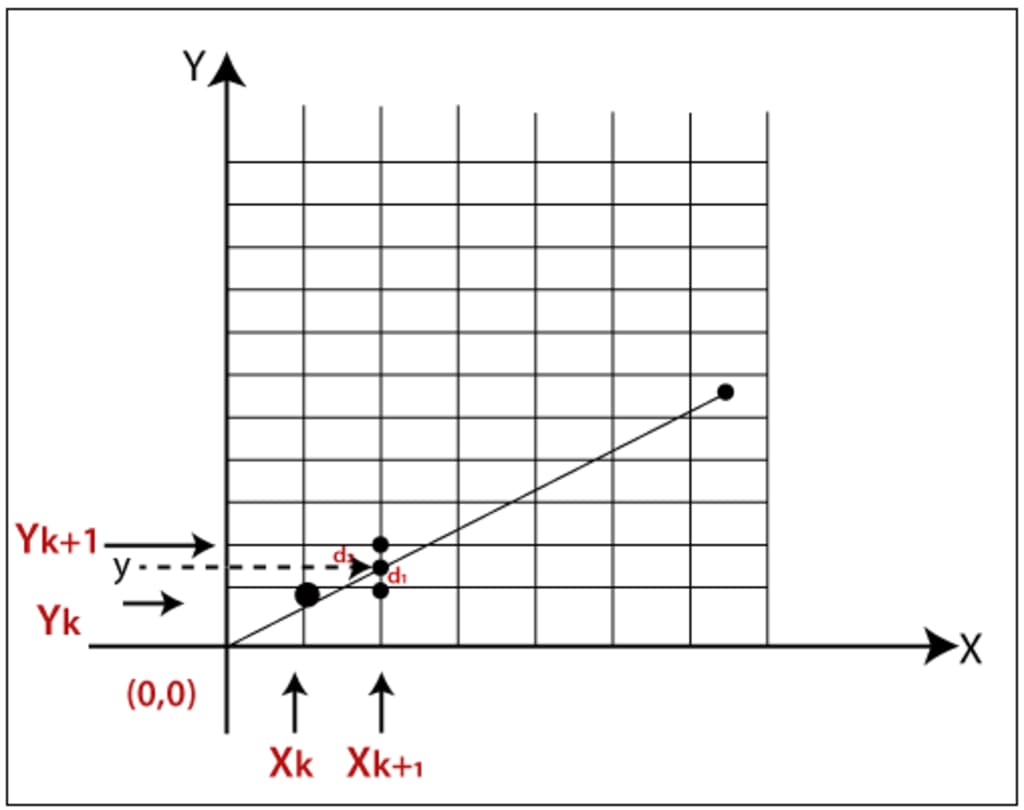
Before delving into Bresenham’s algorithm, it’s important to understand the problem it solves. When drawing a line between two points in a pixel grid, the challenge is to determine which pixels best approximate the ideal line. The line is defined by its two endpoints,
( 𝑥 0 , 𝑦 0 ) and ( 𝑥 1 , 𝑦 1 ).
The goal is to identify the pixels that closely follow the theoretical line equation:
𝑦 = 𝑚 𝑥 + 𝑐 where 𝑚 is the slope and 𝑐 is the y-intercept.
However, this equation often results in non-integer coordinates, which are not suitable for pixel grids.
Overview of Bresenham's Algorithm
Bresenham's Line Drawing Algorithm addresses this issue by using only integer calculations to determine the pixels that form the best approximation of a straight line. This makes the algorithm both fast and resource-efficient, suitable for real-time applications.
Key Concepts
Decision Parameter: The algorithm uses a decision parameter to determine whether the next pixel should be placed above or below the theoretical line.
Incremental Error: Instead of recalculating the slope at every step, Bresenham’s algorithm updates an error term incrementally.
Symmetry: The algorithm can handle all possible line slopes by considering symmetry and adjusting the algorithm accordingly for different octants.
Algorithm Steps
Initialization: Start with the initial point
( 𝑥 0 , 𝑦 0 ) . Calculate the differences Δ 𝑥 = 𝑥 1 − 𝑥 0 and Δ 𝑦 = 𝑦 1 − 𝑦 0 . Set the initial decision parameter 𝑝 = 2 Δ 𝑦 − Δ 𝑥.
Iterative Drawing: For each x-coordinate from 𝑥 0 to 𝑥 1:
Plot the current point
( 𝑥 , 𝑦 )
If 𝑝 ≥ 0 , increment 𝑦 by 1 (or decrement if the line is steep) and update 𝑝 by subtracting 2 Δ 𝑥.
Increment
𝑥 by 1 and update 𝑝 by adding 2 Δ 𝑦.
Pseudocode
Below is the pseudocode for Bresenham’s algorithm:
function BresenhamLine(x0, y0, x1, y1)
dx = abs(x1 - x0)
dy = abs(y1 - y0)
sx = (x0 < x1) ? 1 : -1
sy = (y0 < y1) ? 1 : -1
err = dx - dy
while (true)
plot(x0, y0)
if (x0 == x1 and y0 == y1) break
e2 = 2 * err
if (e2 > -dy)
err = err - dy
x0 = x0 + sx
if (e2 < dx)
err = err + dx
y0 = y0 + sy
Handling Different Slopes
The algorithm is designed to handle all octants by adjusting the incremental steps based on the slope. For steep lines (where ∣ 𝑚 ∣ > 1 ), the roles of 𝑥 and y is swapped, effectively drawing the line in a vertical fashion.
Advantages of Bresenham’s Algorithm
- Efficiency: The algorithm uses only integer arithmetic, making it computationally efficient.
- Accuracy: It minimizes the error in pixel approximation, producing visually appealing lines.
- Simplicity: The straightforward logic of the algorithm makes it easy to implement and understand.
Applications
Bresenham’s algorithm is widely used in various applications within computer graphics:
- Rendering: Used in rendering engines to draw edges of polygons and other shapes.
- Game Development: Essential for creating grid-based games and in-game graphics.
- Computer-Aided Design (CAD): Utilized in CAD software for drawing and designing geometric shapes.
- Raster Graphics Editors: Employed in programs like MS Paint for drawing lines.
Conclusion
Bresenham's Line Drawing Algorithm remains a cornerstone in computer graphics due to its efficient and accurate approach to rendering lines. Its reliance on integer arithmetic and incremental updates makes it ideal for real-time applications and systems with limited computational resources. Understanding and implementing Bresenham’s algorithm is a fundamental skill for anyone involved in computer graphics, game development, and related fields.
About the Creator
Pushpendra Sharma
I am currently working as Digital Marketing Executive in Tutorials and Examples.
Keep reading
More stories from Pushpendra Sharma and writers in Education and other communities.
Your phones camera isn't as good as you think
When the Visualphone VP210 hit the market in 1999, it advertised a never-before-seen feature: a camera. With only 0.11 megapixels and storage for 20 photos, the Visualphone is a relic compared to modern devices sporting three distinct cameras, each with up to 100 times more resolution. But while this technology has improved dramatically in the 21st century, engineers are rapidly approaching a hard limit on phone camera quality. To understand this limit, we first need to know how phone cameras work.
By Munesh Yadav3 days ago in Education
The Secret to Thriving Client-Consultant Relationships: Trust, Clarity, and Commitment
Strong client-consultant relationships are essential for delivering successful outcomes and sustaining long-term business growth. These partnerships are built on a foundation of shared purpose, open dialogue, and mutual respect. A consultant who can foster a deep connection with their client becomes more than just an external resource; they become a trusted partner in problem-solving and strategic growth.
By Nicole Metza day ago in Education
Smart phones, Humans and Aliens.
WARNING. I will be tapping into one of your favorite creative tensions: The absurdity of humans worshipping their glowing rectangles as if they were tiny oracles. There’s something deliciously poetic about that contradiction, and it lends itself beautifully to an instructive proviso.
By Novel Allen6 days ago in Poets


Comments
There are no comments for this story
Be the first to respond and start the conversation.