
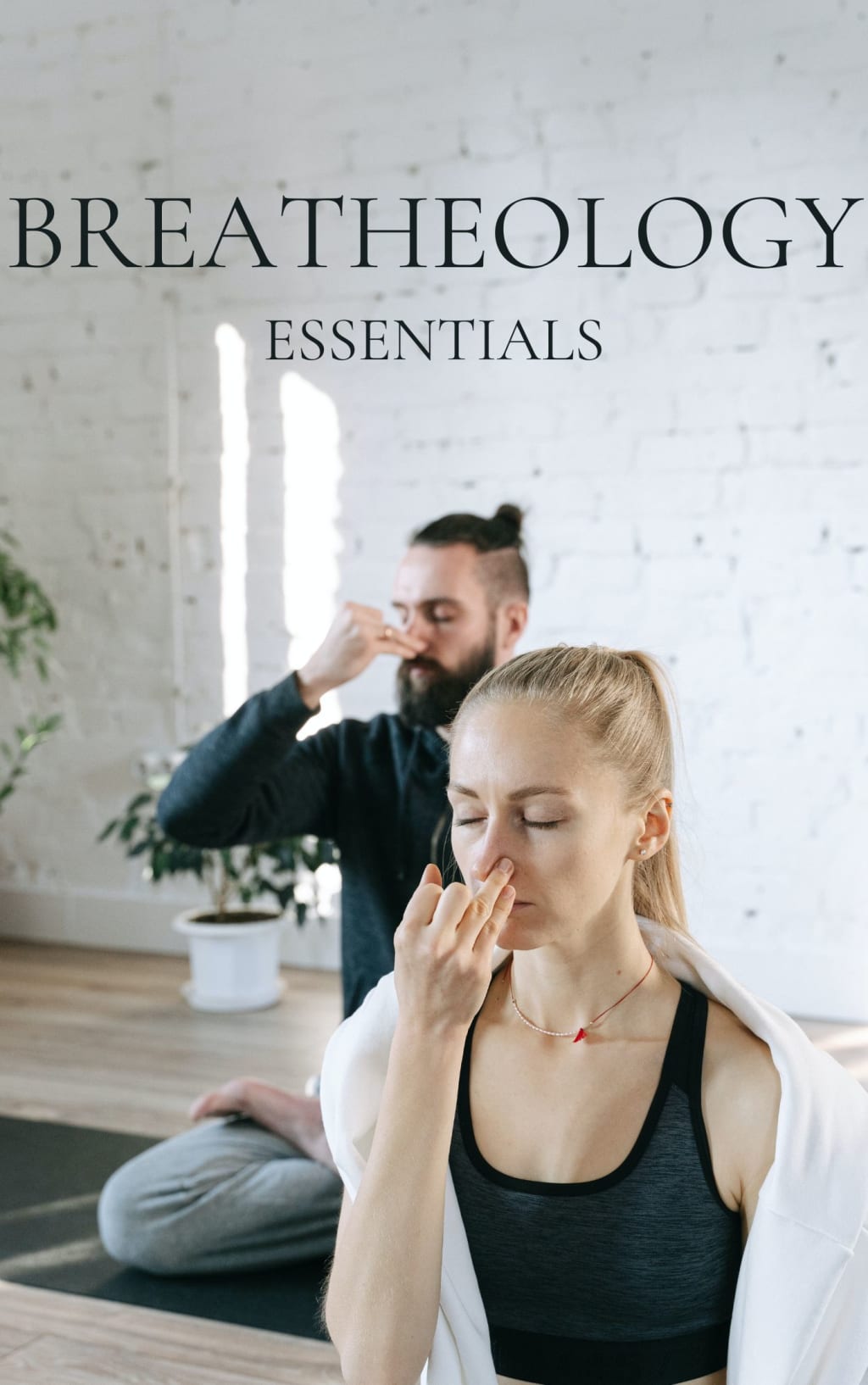
In and out, In and out...
It seems simple enough and everyone does it, more than 25,000 times a day in fact.
I'm talking about breathing of course. The most important thing we do every day of our lives.
The problem is most people are doing wrong and it is making them sick.
In this post, I will shed some light on the importance of breathing and why it's about more than
just getting oxygen into our bodies.
But first here's an exercise I want you to try. Don't worry you don't even have to get up.
Exercise:
The 1:2
- I want you to sit up straight. In the picture, you have a string attached to the crown of your
head and it is being pulled toward the ceiling. Poke your chest up and let your shoulders down,
Don't force it. Just until it feels comfortable.
- Now relax your jaw and tongue. If you're having a hard time with that, try and swallow- your
tongue will naturally relax.
- Now inhale counting to 3 through your nose using your diaphragm. (Your belly should expand
before your chest does). To make sure this happens place one hand on your stomach and the
other on your chest. When you inhale make sure your stomach moves before you chest.
- Pause at the top of the inhale
- Now exhale counting to 6
- Don't force the air out at the bottom, just let it flow out.
Repeat this for 1 to 2 mins.
How do you feel? Do you feel more relaxed, a little less worried? As you read the rest of the
post we're going to explore what just happened while you were "exercising
What is breathing?
According to the Merriam-Webster dictionary, breathing is "to inhale and exhale freely". Now
that is true, but it's like saying the Earth is just a rock that revolves around the Sun. Both are
true statements, and both are very much lacking in depth.
Let's look a little deeper, shall we? The most important muscle in breathing is the diaphragm. It
contracts to create a vacuum in our lungs that pulls air in. It is also the muscle that separates
the upper organs (lungs and heart) from the lower organs (liver, kidneys, spleen, digestive and
reproductive organs, etc.)
There is a great clip on YouTube that shows the lungs and diaphragm in action. If you're
interested please check it out. In that clip, the dark pink muscle is the diaphragm and the light
pink organs are the lungs. You can see how the diaphragm moves down allowing the lungs to
expand the chest and create room for the incoming air. We also have other muscles that work to
help us breathe. Muscles in our neck, chest, and back all work together to perform this vital
movement. Could you feel all of the muscles working when you did your exercise? Next time
you do the exercise tries to feel them.
That is breathing. A little bit more than just inhaling and exhaling freely.
Breathing is pumping
We know that when your diaphragm contracts, it moves down toward your pelvic floor. Another
interesting thing happens when you inhale properly. All of those other muscles are engaged and
you lengthen your spine, making you taller when you inhale. With all of this movement
happening the vertebra in your spine and all of your internal organs are actually getting a nice
massage and light squeezing. This message, or pumping, moves out the old blood and
lymphatic fluid and allows the new nutrient-rich fluids to move in.
So why is this important? If the fluids don't move they become stagnant. I'm sure we've all
walked by a gross-looking pond or marsh that smelled of rotting organic matter. That pond or
marsh is stagnant and in nature when something is stagnant the decomposers move in.
Parasites, harsh bacteria, and fungus will overwhelm the system if given places to live. We are a
part of nature and when we are stagnant those decomposers proliferate in us. One of the most
common forms of stagnation in modern humans is constipation and all the complications that
cause for people. I'll have to write something up soon about constipation.
In short, breathing is pumping.
The yogi's were right
There are a couple of other cool things that happen in our bodies, specifically when we breathe
through our noses. I will cover them quickly only because I can write an entire post about each
one.
You can go back thousands of years and study practices like yoga, tai chi, qi gong, and many
forms of martial arts, and one of the few consistencies all these practices have in common is
very precise breathing structures. Inhaling through the nose is the most potent consistency. All
of the Masters understood that there was a benefit to breathing in through your nose. Being so
in tune with their body provided them with this feeling. And in 1998 three Americans won the
Nobel Peace Prize proving the Masters's right. They won the prize for their studies of nitrogen
monoxide or NO. One of the things they discovered about NO was that it is a vasodilator. This
simply means: NO makes the walls of your blood vessel relax, allowing for more blood flow.
Alone this study is amazing but doesn't directly connect to breathing. But then in 2002, a
Swedish research group found that NO is formed and released in the human sinuses. They also
discovered that if you make a buzzing or ohm sound the concentration of NO increases as
much as 15 times. This happens because of the vibration created, from the sound, which mixes
the sinus air with the incoming nasal air. These findings led to an experiment that discovered
that blood is oxygenated 10-15% more when you breathe through the nose compared to
breathing through your mouth.
Click here to find out more about Breatheology ESSENTIALS
To summarize for the folks that don't enjoy this type of information like I do. When you breathe
through your nose the NO or Nitrogen monoxide, which we produce in our sinuses, goes with
the inhaled air into the lungs which it makes the blood vessels around the alveoli expand more.
This allows more blood volume to pass over the alveoli which in turn leads to more oxygen
being absorbed into the blood. Don't you just love when science finally catches up with what we
know intuitively?
The Vagus Nerve
The nervous system... The most complex system humans know of in the universe. There are trillions of cells in the body constantly communicating back forth with one and other about everything. They communicate about the amount of water they have, the temperature if they are sick, and the list goes on and on, and we are still discovering so many more ways our cells communicate. It really is amazing to think about. It's so fascinating but I digress.
OK so, you have two branches of your autonomic nervous system. They are in charge of things like respiration, heart rate, digestion, etc. Stuff you don't really think about. One branch is the parasympathetic nervous system or "Rest and Digest" I'll just call it your rest system, and the other is the sympathetic nervous system or "fight or flight" I'll call this your survival system. Both are important and needed but I've noticed that most people spend far too much time in the survival state. It's great when you trip and are about to fall, or when that cat runs across the
road while you're driving, but not so good when you are trying to get all the nutrition out of the food you just ate, or trying to rest. The good news is there are a couple of simple yet effective breathing exercises you can do to stimulate and turn on your rest system, you performed one of them earlier.
The vagus nerve. Vagus means wandering, which describes these nerves perfectly. You have one on each side of your neck. These nerves run from the base of your brain all the way down and connect your internal organs everything from your stomach to your reproductive organs. The unique part about these nerves is that when you breathe properly through your nose (another organ the nerve connects) you activate them and trigger a parasympathetic or rest response in your body. You can put yourself in a relaxed state and gain all the benefits from it. Stimulation of this nerve has been used to treat all sorts of psychological ailments. Hundreds of studies have been done on this nerve, and there is tons of information if you want to do a Google search when you're done reading.
To summarize, belly breathing through your nose stimulates your vagus nerves, which trigger the "rest and digest" portion of your autonomic nervous system.
Phew! You made it through the sciencey part. I love that stuff, but I can understand why some might find it boring and overwhelming. If you enjoyed it I'm glad.
I have another exercise, this one is a little bit more advanced, but I want you to give it a try anyway.
Exercise 2:
The 1:4:2
Get into the same position as the first exercise.
- Again sit up straight. Poke your chest up and let your shoulders down, remember don't force it. Just what feels comfortable.
- Now relax your jaw and tongue.
- Now inhale counting to 3 through your nose using your diaphragm. (Your belly should expand before your chest does)
- Now hold your breath for 12
- Now exhale counting to 6
- Don't force the air out at the bottom, just let it flow out.
Repeat for 1 to 2 mins
But wait!? After I spent all this time telling you to breathe, now I'm saying to hold your breath? Yes! And here is why.
Holding your breath the right way
I stumbled upon the benefits of breath-holding while learning to free-dive because I love spearfishing. Stig Severinsen is an amazing free diver and human being. He is THE authority on breath holding on this planet I would write his accomplishments out, but honestly seeing is believing in this case. If you doubt me, look him up when you're done here. And because I find no point in reinventing the wheel I'm going to quote Stig Severinsen's Breatheology website here: "At a first glance holding your breath seems very simple: You inhale, hold your breath as long as you can and then start breathing again. It is also quite a simple measure. How many minutes/seconds? But it is at the same time a multifaceted and complex parameter. It reveals the degree to which you are psychologically in balance - your mental stability - and how finely you are tuned in on your body. The simplicity of breath holds makes it an excellent barometer of your stress level, and makes progress easy to measure... In the long run meditation and breath holds seem to develop your nervous system and brain. Scientific studies have revealed that people who practice meditation and/or freediving show marked changes in their brain and nervous system. One area in the nervous system that undergoes changes lies in the brain stem and is connected to the vagus nerve. This is part of the calming parasympathetic pathway which counteracts stress." I don't think I can make it any clearer than that. There is a reason some of the top athletes and CEOs in the world are starting to explore breathe control.
A little saying I tell my clients. To control your breath is to control yourself.
All of this information is to show you how breathing properly really can start you on the path to a healthier life. The exercises I've shown you here are very simple. Please don't let the simplicity fool you though. They are very effective. Plus you don't need any special equipment to do these exercises, and you can do them anytime, anywhere. As you progress in your training you can find many other exercises. If you are ready to dive head first than do some research on Pranayama, the practice of controlling the breath.
So Remember. To breathe is to pump, and to pump is to clean and nourish.
Until next time
I only promote things I've done and that have worked for me. I'll never post about something until I try it for myself. For more information on becoming a whole, healthy, happy, human being
Click here to find out more about Breatheology ESSENTIALS
Thank you for Reading this Article, hope it is helpful for you to make a better life!
About the Creator
Restored to Its Roots: The Homecoming of a Historic Waterwheel
The quiet sound of rushing water once again spins a historic waterwheel in its original location. After decades of absence, the wheel has returned to the same stream it once relied on for power, bringing a sense of closure and continuity to a community that never forgot its value. This return marks not just the restoration of a structure but the revival of a piece of living history.
By Grady Gaston2 days ago in Education
How to Enhance Team Productivity
Team productivity improves when leadership replaces guesswork with structure, clarity, and accountability. Through Strategic coaching, businesses enhance productivity by aligning teams around clear outcomes, defined roles, strong communication systems, and leadership driven standards creating high performance teams that operate without constant supervision.
By Alice Adamsa day ago in Education
Smart phones, Humans and Aliens.
WARNING. I will be tapping into one of your favorite creative tensions: The absurdity of humans worshipping their glowing rectangles as if they were tiny oracles. There’s something deliciously poetic about that contradiction, and it lends itself beautifully to an instructive proviso.
By Novel Allen5 days ago in Poets



Comments
There are no comments for this story
Be the first to respond and start the conversation.