
BREAKERS OF BARRIERS
THE UNLOVED TEENAGER AND THE GIANT CALCULATOR

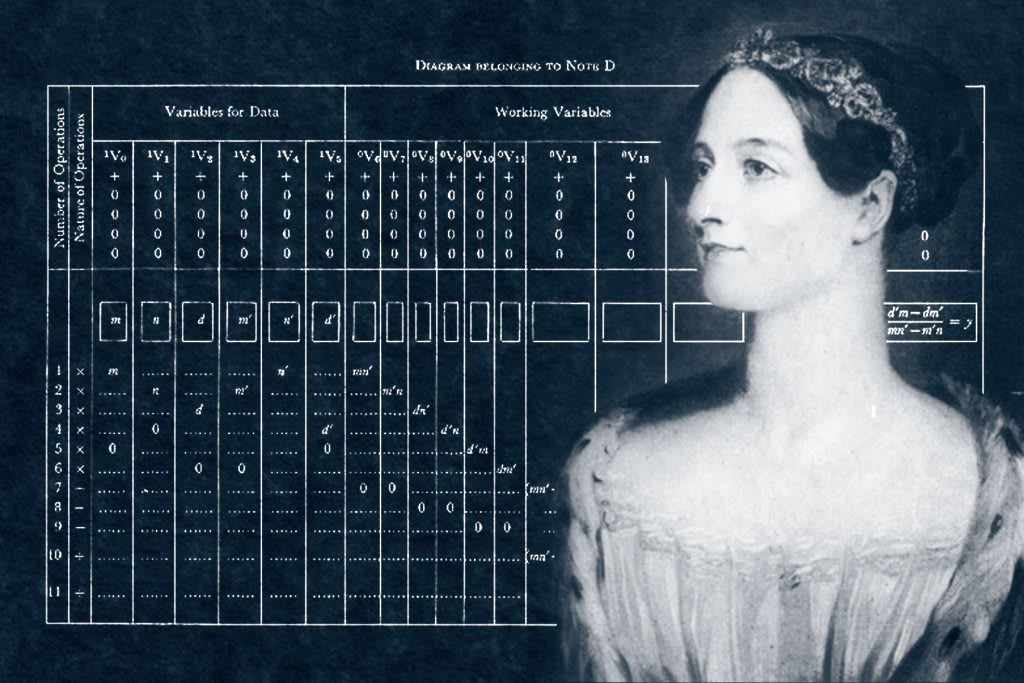
ADA was a bad girl. she had a bad childhood. it was all because of her father, people said he was famous for being a bad person.
But the story of this teenage girl is worth remembering for several reason.
First, have you heard of children who born very rich in term of money, but very poor in tern of love.
Well, that was Augusts Byron known as ADA, who was born in UK in 1815.
She was born in the middle of a furious argument between her parents, who were always fighting.
Her father was a brilliant man named Lord Byron, who was a wonderful writer but a dreadful husband and father. A month after ADA was born, he stormed out off the house, never to return.
Often people can survive without a father, since they at least have mother but in her case, her mother was almost bad as her father.
By the time ADA was 17, she was behaving badly, and had to change many tutors.
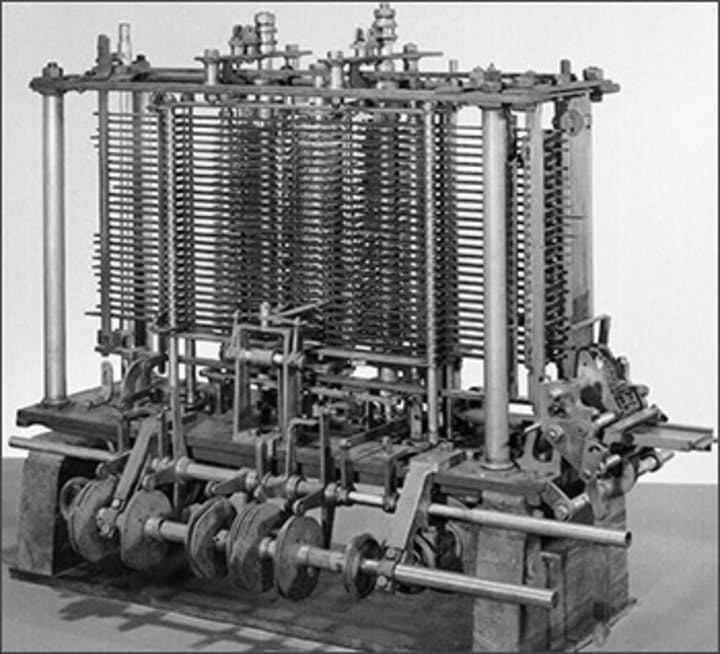
Then, when she was 18,this time a women tutor noticed that she was good at mathematics and introduced her to a man named Charles Babbage, who was creating something strange (a giant calculator).
ADA become his assistant.
He explain to her how his machine worked. She was very bright an understood it, and she wrote down the process of how the giant calculator worked. (he called it Difference Machine, because you pulled the lever and it instantly worked out the difference between two numbers).
Well if you recognize the name Charles Babbage, you will be able to guess the end of the story.
Charles Babbage is now in the history books as the inventor of the first computer which was a mechanical device. (much later, Alan Turing invented the electronic version of the computer.)

And ADA lovelace (she became famous under the family name of the man she eventually married) became the world's first computer programmer.
The next time you use a computer, maybe look up and say a word of thanks to the girl, unloved by her father or her mother, who took the one skill she had made difference to history with it.
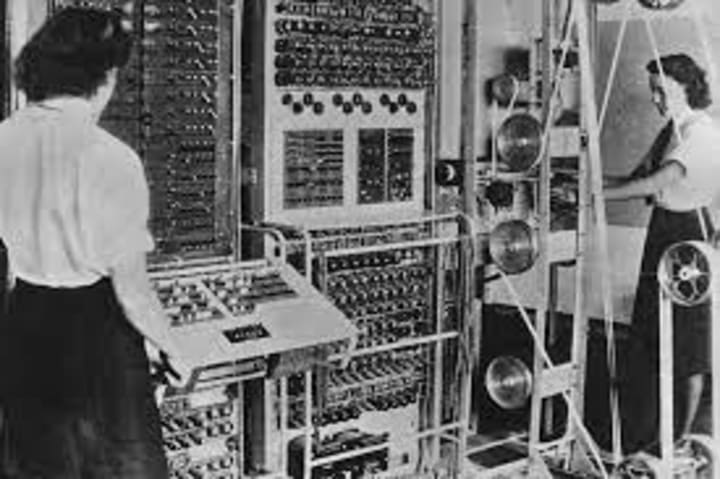
Alan Turing, in full Alan Mathison Turing, (born June 23, 1912, London, England—died June 7, 1954, Wilmslow, Cheshire), British mathematician and logician who made major contributions to mathematics, cryptanalysis, logic, philosophy, and mathematical biology and also to the new areas later named computer science, cognitive science, artificial intelligence, and artificial life.
The son of a civil servant, Turing was educated at a top private school. He entered the University of Cambridge to study mathematics in 1931. After graduating in 1934, he was elected to a fellowship at King’s College (his college since 1931) in recognition of his research in probability theory. In 1936 Turing’s seminal paper “On Computable Numbers, with an Application to the Entscheidungs problem [Decision Problem]” was recommended for publication by the American mathematical logician Alonzo Church, who had himself just published a paper that reached the same conclusion as Turing’s, although by a different method. Turing’s method (but not so much Church’s) had profound significance for the emerging science of computing. Later that year Turing moved to Princeton University to study for a Ph.D. in mathematical logic under Church’s direction (completed in 1938).
What mathematicians called an “effective” method for solving a problem was simply one that could be carried by a human mathematical clerk working by rote. In Turing’s time, those rote-workers were in fact called “computers,” and human computers carried out some aspects of the work later done by electronic computers. The Entscheidungsproblem sought an effective method for solving the fundamental mathematical problem of determining exactly which mathematical statements are provable within a given formal mathematical system and which are not. A method for determining this is called a decision method. In 1936 Turing and Church independently showed that, in general, the Entscheidungsproblem problem has no resolution, proving that no consistent formal system of arithmetic has an effective decision method. In fact, Turing and Church showed that even some purely logical systems, considerably weaker than arithmetic, have no effective decision method. This result and others—notably mathematician-logician Kurt Gödel’s incompleteness results—dashed the hopes, held by some mathematicians, of discovering a formal system that would reduce the whole of mathematics to methods that (human) computers could carry out. It was in the course of his work on the Entscheidungsproblem that Turing invented the universal Turing machine, an abstract computing machine that encapsulates the fundamental logical principles of the digital computer.
About the Creator
Zuhaib khan
I AM A TEENAGER AND WROTE STORIES ABOUT HISTORY
IF YOU LIKE MY STORIES THEN COMMENT AND LIKE
AND DON'T FORGET TO FOLLOW.
THANK YOU.
Keep reading
More stories from Zuhaib khan and writers in Education and other communities.
Portable Thickness Gauge Explained: Accurate Measurements Anywhere, Anytime
In modern industries, precision is not a luxury—it is a necessity. From ensuring product quality to maintaining structural safety, accurate thickness measurement plays a vital role. This is where portable thickness gauges come into focus. As the demand for on-site inspections grows, Portable Thickness Gauge Explained: Accurate Measurements Anywhere, Anytime becomes a topic every engineer, inspector, and technician should understand.
By Abdul Alim6 days ago in Education
Why Tailwheel Training Still Matters for Pilots in Today’s Aviation World
Tailwheel Training may sound old fashioned to some pilots, but it still plays an important role in modern aviation. Many training aircraft today use tricycle landing gear, which feels easier and more forgiving. This has led some pilots to believe that tailwheel skills are no longer needed. That idea is incorrect. Tailwheel Training teaches core flying skills that improve safety, control, and awareness in any aircraft.
By Duke Valentour6 days ago in Education
🅼🅸🅳🅽🅸🅶🅷🆃 🆂🅽🅰🅲🅺🆂
"It's 10 in Tuscon! We all know what that means... It's Time for Midnight Snacks with your man, Gerald Gee! Ready to spend the night together? Me too! I'm full of snacks and can't wait to regurgitate them all back into your hungry ears. Crack a brew! Pop some corn! Anything to get ready for one hell of a show where the talk maybe cheap but the words cut deep...
By Lamar Wiggins7 days ago in Fiction



Comments (1)
Very good keep it up