
Brain Trap: How Hidden Forces Hijack Your Thoughts and Decisions
Unmasking the Subtle Manipulations That Shape Your Beliefs, Habits, and Identity


How Hidden Forces Hijack Your Thoughts and Decisions
They say you are the sum of your thoughts. But what if your thoughts are not truly your own?
I didn’t question this idea until the day I found myself sitting in my car, gripping the steering wheel so tightly my knuckles turned white, feeling a sudden wave of panic wash over me. I couldn’t pinpoint what triggered it. I had been scrolling through my phone during my lunch break, reading news articles, checking social media notifications, clicking headlines I wasn’t even interested in. My mind felt noisy, like a radio stuck between stations, blaring static mixed with fragments of other people’s opinions. And that was the first time I wondered: Am I really in control here?
That night, I started digging. I wanted to understand why my thoughts felt hijacked—why my attention was shredded into so many tiny pieces. I learned that this was no accident. It was by design.
Every day, companies and platforms you’ve never heard of wage a silent war for your attention. Each app, news site, and social feed is engineered to pull you deeper, to keep you scrolling, to feed you micro-doses of dopamine with every notification. This is the architecture of the brain trap. You believe you are freely choosing what to engage with, but you’re actually responding to carefully calibrated cues—red badges, buzzing vibrations, recommended content calculated to inflame curiosity or outrage.
I started to see my own habits with new eyes. I realized how much of my time was spent reacting, rather than choosing. My morning routine wasn’t really mine. I’d wake up and immediately reach for my phone before I even knew why. My feed would flood me with updates—someone I barely knew got married, another person was complaining about politics, an influencer was selling a lifestyle I didn’t even want. But each of these updates planted a seed: a flicker of envy, a twinge of insecurity, an impulse to compare myself to a stranger.
I was trapped in a labyrinth of algorithms and persuasion tactics. And worse, I’d accepted it as normal.
It was around this time that I remembered an article I’d read years ago about behavioral design. The author described how slot machines are programmed to create “intermittent variable rewards”—meaning the player never knows when the next payout will come. This uncertainty triggers the brain’s reward system even more powerfully than predictable rewards. The same principle powers social media. Every time you refresh your feed or check your inbox, you’re pulling the lever. Maybe there will be something thrilling this time—a like, a comment, a piece of breaking news. Maybe there won’t. But the uncertainty keeps you hooked.
The more I learned, the more disturbed I became. I could see how the brain trap extended far beyond my phone. Advertising agencies used the same techniques to create desire out of thin air. News networks amplified sensational stories because fear and outrage were proven to generate more clicks. Even in the grocery store, shelf placement and lighting were orchestrated to steer my choices without me ever realizing it.
It all came to a head the night I stayed awake until 3 a.m., glued to my screen, consuming a stream of content that left me feeling exhausted, hollow, and angry. In that moment, I felt like a puppet—my strings pulled by invisible hands.
I decided something had to change.
The first thing I did was set my phone to grayscale mode. It was a simple trick I’d read about—a way to strip the screen of its colorful rewards. Suddenly, my apps looked dull and unappealing. The temptation to tap them reflexively began to fade.
Next, I turned off all non-essential notifications. My phone went silent for the first time in years. At first, it felt like I was missing something important, but after a few days, I realized the world kept turning without me. My anxiety began to loosen its grip.
I started tracking how I spent my time. Each time I caught myself reaching for my phone, I paused and asked: Why am I doing this? Most of the time, I couldn’t come up with a good answer. It was just habit—a learned response. The act of questioning became a small act of rebellion.
Gradually, I felt my brain beginning to clear. It was as though a fog was lifting. I could read a book again without the urge to check my notifications every five minutes. I could sit quietly without feeling restless. I could think my own thoughts without the constant intrusion of someone else’s agenda.
But the biggest realization came later: the brain trap doesn’t just steal your time or your focus. It steals your sense of self. When every decision is shaped by hidden forces, you start to forget who you were before you fell into the trap.
The process of reclaiming my mind was slow and sometimes uncomfortable. I had to confront the ways I had allowed myself to be manipulated. I had to relearn how to sit with boredom and discomfort without reaching for a digital distraction. But day by day, I felt stronger.
I started writing again—words that came from me, not a trending topic or an algorithm’s suggestion. I had conversations that weren’t interrupted by notifications. I took walks without headphones, letting my thoughts roam. These small acts felt revolutionary.
If you’re reading this and wondering whether you’re caught in the same trap, the answer is probably yes. The modern world is engineered to keep you distracted, anxious, and endlessly consuming. But you are not powerless. You can step back. You can notice. You can choose.
The brain trap is real. But so is the way out.
All it takes is the courage to look at your habits honestly—and the conviction to reclaim your attention, your decisions, and ultimately, yourself.
About the Creator
Redefining Health in a High-Performance World
In the modern era, "Health and Fitness" is often reduced to a series of aesthetic milestones—six-pack abs, a specific number on a scale, or the ability to run a marathon. However, true vitality is far more profound. It is the synergy between physical capability, nutritional wisdom, and mental resilience. This article moves beyond the surface-level trends to provide a practical, deep-thought guide to sustainable well-being.
By Being Inquisitive7 days ago in Education
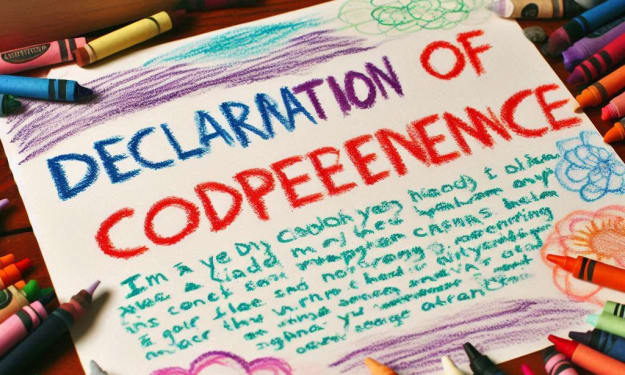
A Historic Declaration
We the People of the Husbands of the United States of America, in Order to form a more perfect Union, and I mean you...with me...establish Justice, insure domestic Tranquility, provide for the common defence, promote the general Welfare, and secure the Blessings of Liberty to ourselves, after Puberty, do ordain and establish this Declaration of Co-Dependence.
By Gerard DiLeo4 days ago in Humans


Comments (1)
W