
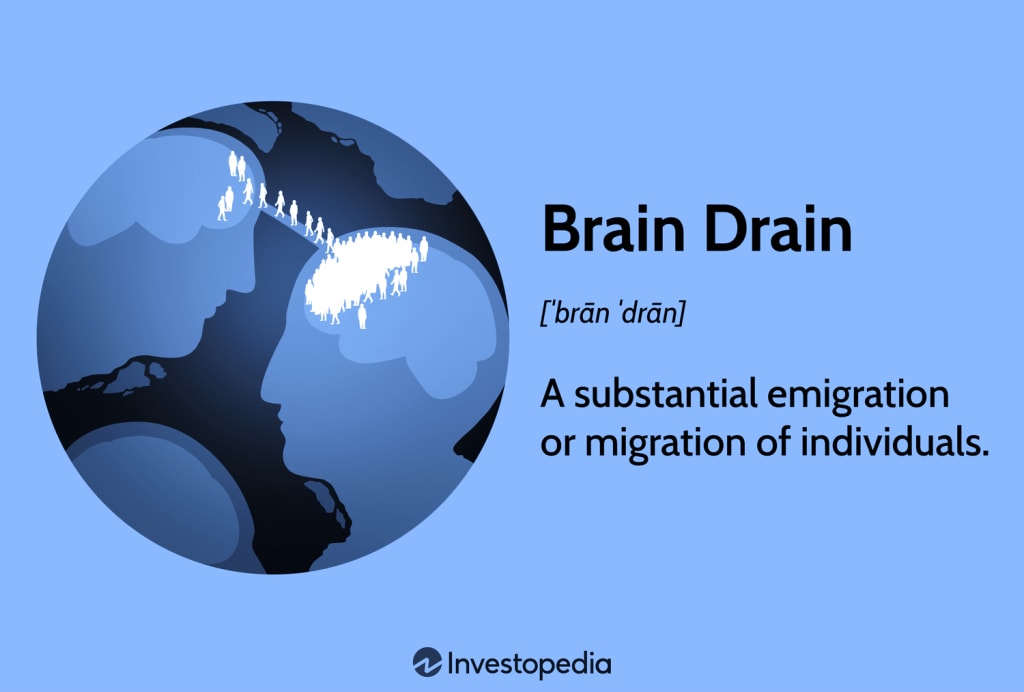
Start writing...Brain drain is the emigration of highly skilled and educated individuals from one country to another, usually to countries that offer better opportunities, salaries, and living conditions. This results in a loss of talent and expertise in the home country, which can have negative effects on its economy and development. Brain drain is often seen in developing countries, where individuals seek better education and job opportunities in more developed countries.There are generally considered to be two types of brain drain:
1. "Push" factors, which refer to the reasons why individuals leave their home country, such as lack of career opportunities, political instability, low salaries, or poor working conditions.
2. "Pull" factors, which refer to the reasons why individuals choose to migrate to a particular destination country, such as better salaries, career opportunities, better living conditions, and a higher quality of life.Brain drain is a phenomenon where talented and skilled individuals leave their home country or region to seek better opportunities elsewhere. This can have a negative impact on the economic and social development of the origin country or region. Brain drain can occur in various fields, such as science and technology, healthcare, education, and business.
Here are some examples of brain drain in different areas:
1. Science and Technology: Brain drain is a significant problem in the field of science and technology, particularly in developing countries. Talented scientists and researchers often leave their home countries to pursue better research opportunities or higher salaries in developed countries. This can lead to a lack of innovation and development in the home country.
2. Healthcare: Brain drain is also prevalent in the healthcare industry, especially in countries with a shortage of healthcare professionals. Doctors, nurses, and other healthcare workers may leave their home countries to work in countries with better working conditions, higher salaries, and more advanced medical facilities.
3. Education: Brain drain in education occurs when highly qualified teachers, professors, and researchers leave their home countries to work abroad. This can lead to a shortage of skilled educators and a decline in the quality of education in the home country.
4. Business: Brain drain in business occurs when talented entrepreneurs, managers, and executives leave their home countries to start or work for companies abroad. This can lead to a loss of business skills and knowledge in the home country, as well as a lack of investment and economic development.
In conclusion, brain drain can occur in various fields, and its impact can be significant, particularly in developing countries. It is essential for governments and organizations to address the root causes of brain drain and create an environment that encourages talented individuals to stay and contribute to their home countries.
It is difficult to determine which country experiences the most efficient brain drain because brain drain can be influenced by a variety of factors, including economic conditions, political stability, social and cultural factors, and opportunities for career advancement.
However, some studies have identified certain countries as being particularly affected by brain drain. For example, many developing countries in Africa, Asia, and Latin America experience significant brain drain, with highly skilled professionals leaving to seek better opportunities in developed countries.
On the other hand, some developed countries, such as the United States, Canada, and some European countries, attract highly skilled workers from around the world, which can be seen as a form of brain gain.
It is important to note that brain drain can have negative consequences for the origin country, such as a loss of valuable human capital, reduced innovation and development, and a weakening of the economy. At the same time, brain gain can bring benefits such as increased diversity, innovation, and economic growth to the destination country.
Overall, brain drain is a complex phenomenon that is influenced by many different factors, and its efficiency can vary depending on the specific context and circumstances.
About the Creator
Keep reading
More stories from Sakshi Verma and writers in Education and other communities.
Social media marketing
Start writing...Social media marketing is the process of using social media platforms to promote a product, service, or brand. It involves creating and sharing content on social media sites such as Facebook, Instagram, Twitter, and LinkedIn, as well as engaging with followers and potential customers. The goal of social media marketing is to increase brand awareness, drive traffic to a website or landing page, and ultimately generate leads and sales for a business. Effective social media marketing involves understanding the target audience, developing a strategy for each platform, and consistently publishing high-quality content that resonates with followers.To start social media marketing, follow these steps:
By Sakshi Verma3 years ago in Education
What Should Be Your Main Focus During an Online Limited Radiology Tech Program
Well, the short answer is that there is not a single module that you should strictly focus on. If you want to become a X-ray technician, you need to develop both technical and soft skills.
By Meaghan Howe2 days ago in Education
Precision in Motion: The Rise of Sport Shooting and Firearms in Modern Competition
Sport shooting has grown from a simple test of aim into a structured sport that demands discipline, patience, and technical skill. Today, sport shooting and firearms play a major role in global competitions, training programs, and recreational events. Athletes train for years to improve accuracy and control. They study equipment, posture, breathing, and focus. Because of this dedication, sport shooting has become a respected sport that rewards precision and calm thinking.
By Matthew Pothoffabout 20 hours ago in Education
Hottest in the Office
Dear Rafi, You’re very distracting to work around. For the first second I saw you the other day, I thought you were some type of executive. It took a moment to realize no, you were just the new guy, dressed up for the job he wants. Be still, my heart.
By Gabriel Shames3 days ago in Pride



Comments
There are no comments for this story
Be the first to respond and start the conversation.