

BONGE
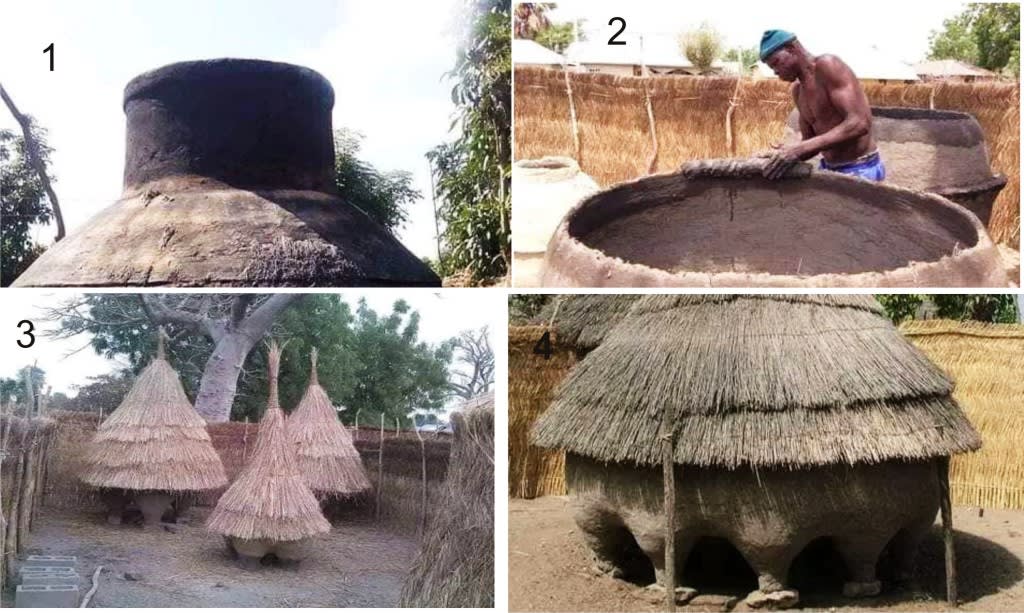
A traditional storage bank commonly seen in bwatiye communities. In Bwatiye land, grain storage are usually associated with dry climatic conditions, under which it is possible to reduce the moisture content of the harvested grain to a satisfactory storing level simply by sun-drying it.
Bonge are clay receptacles whose shape and capacity vary depending on its purpose. Bonge are kept in dwellings, they serve primarily for storing seeds, legumes and dry grains of all sort so that they may remain in good condition.
Bonge are constructed in various sizes mostly in oval shape with a narrow top. Clay, which is the basic material, varies in composition. The most commonly used for such construction work is obtained from termitaries, because the termites add a secretion which gives it better plasticity. To give it added strength and durability , certain straw materials such as grain are mixed with cow dump. The diversity of materials used explains why the capacities of bonge vary in weight. The walls are rendered as smooth as possible, inside and out in such a way as not to offer refuge for insects and their larvae. The upper part is narrow and is closed with a cone shape top usually made of thatched grass, with a generous overhang to protect the mud wall(s) from erosion, the roof is lifted for access to the Bonge. The top is reconstructed when damaged.
To commence the use of Bonge, prayers are offered in appreciation to the bountiful harvest. Afterward the seed for next harvest session, grains and legumes for storage are lowered into the Bonge. Access is restricted to prevent loophole for rodents entry. Bonge are normally named for easy reference.
Bwatiye people are very proud of Bonge. This could probably be reason a community micro finance bank was named Bonge Community Bank at Numan.
In some of the Neighbouring communities around the North east where this same thing is found is in Zaar Sayawa Land, located in Tafawa Balewa and Bogoro LGA's respectively. they are very industrious people when it comes to peasant farming as well as commercial farming in the environment. storage of grains before the next rainy season is very important.
Though in Zaar Sayawa Land it is not called Bonge, it is call ''Fungh'' meaning reservoir for grains. After the rainy season, households may open it during the dry season to fetch some and processed it for feeding and for exchange for another grain around the neighborhood or the market square where such exist.
when the rainy season draws nearer, they also thresh the remaining on a flat stony ground and also store it respectively and reserve the ones for feeding and re-planting again.
There are similarities both in Bwatiye and Zaar Sayawa Land both of the north eastern Nigeria in terms of grain storage up till noun right from the precolonial tradition.
The fungh just as bonge, is constructed using mud clay, the foundation with some stones mixed with mud clay to make it strong. and is built to pass the average height of a tall man and roofed with thatch so tick to avoid heat, moisture and rain or water from penetrating inside because it will damage the grains inside the fungh.
In the case of some wealthy individuals, they can built the two or more bonge or fungh for grain reservation hence one can not accommodate their harvest from their farm lands because some of them are into commercial farming apart from feeding themselves and their families.
In summary, both Bonge and Fungh are good ancient means of reservation in the communities mentioned till date.
About the Creator
Jordan Lawi Hassan
An Information Technology Professional as well as Business Administrator. In practical field am into Data processing, Data Entry, Graphics and Designs, online editting, Multimedia, Video and Audio editting among others.
Keep reading
More stories from Jordan Lawi Hassan and writers in Education and other communities.
What goes wrong? the hardest boiled egg
Why not good? Hard bed I grew up believing - deep down - that I didn't like hard boiled eggs. (I know, I know: disrespectful to my family.) I blame that Passover Seder, with white and gray yolks and gray yolks, painted on soft water. I didn't know what hard eggs could be: creamy without being runny and sweet without being overpowering. Hard-boiled eggs are a great companion in salads and stews, sauces and sandwiches, and they are high on my list of snacks and supplements.
By Jordan Lawi Hassan3 years ago in Education
Cover Assembly Screened in Aircraft Systems: Function, History, and Aerospace Applications
Introduction: My Research into Cover Assembly Screened Aircraft Components While studying aircraft hardware and aerospace structural parts, I recently explored a catalog listing dedicated to Cover Assembly Screened components used in aviation systems. During my research, I realized that even small parts like protective covers are essential for the reliability, safety, and longevity of aircraft electronics and mechanical assemblies.
By Beckett Dowhan3 days ago in Education
How the Sun Shapes Planetary Orbits: The Gravitational Power Behind the Solar System
The Sun’s Gravitational Dominance The Sun contains more than 99.8% of the total mass of the solar system. Because gravity depends on mass, the Sun’s enormous mass gives it overwhelming gravitational influence.
By shahkar jalal8 days ago in Education
Silken Chains
Silhouettes of the female form were given flesh and bone. Silken skin glistened under the spotlight. Dry ice rose around our Icons as they danced atop their podiums in the Square. Heralded for their beauty, their movements were slight, powerful, and sensual.
By Paul Stewart5 days ago in Fiction



Comments
There are no comments for this story
Be the first to respond and start the conversation.