

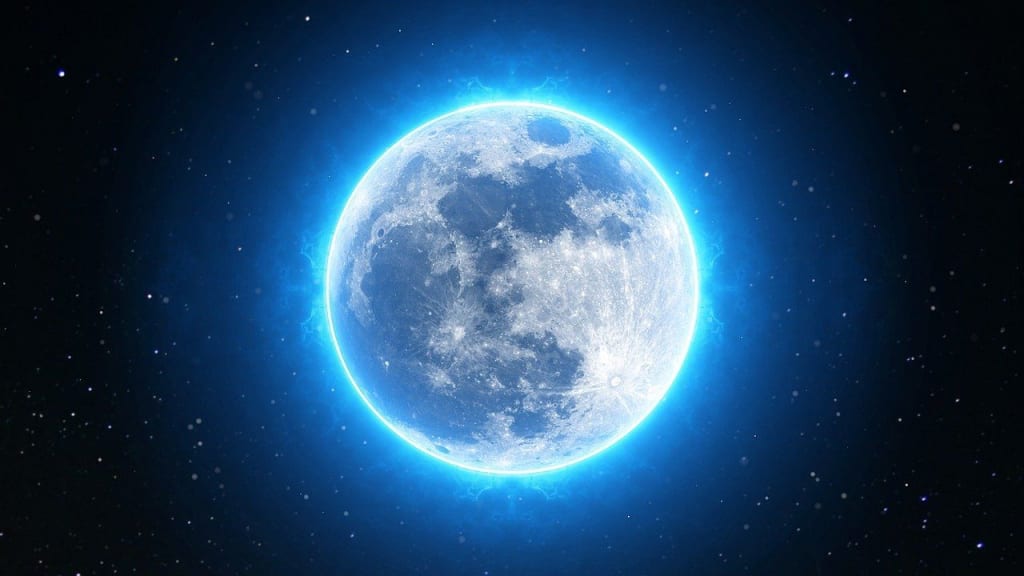
Recently there was an astronomical event called Super blue moon as it was both a “blue moon” and a “super moon”, a rare trifecta of astronomical events. When you hear someone say, "Once in a blue moon …" you know they are talking about something rare. A blue moon is not blue in color. In fact, a blue moon does not look any different than a regular, monthly full moon.
Rather, a blue moon is special because it is the "extra" Moon in a season with four full moons. This usually only happens every two-and-a-half years. Since the 1940s, the term "blue moon" has also been used for the second full moon in a calendar month. This usually happens only every two-and-a-half years.
This is a rare event because 25 percent of all full moons are supermoons, but only 3 percent of full moons are blue moons. Another reason that makes this event a rare one is that time between two consecutive super blue moons can be as much as 20 years.
The next super blue moons will occur in a pair, in January and March 2037, NASA says. Note the time and donot forget to witness one of the rarest celestial phenomena.
on the astrological significance of the super blue moon, the moon is associated with emotion intuition and the subconscious mind. The full moon is a time when the moon's energy is strongest, making it a time of heightened amotions and intuition's super blue moon amplifies the moon's energy even further, making it a time of even greater emotional and intuitive clarity. This can be a time of great insight and transformation, as you are able to see things more clearly and make changes that are in your best interests. The blue moon furthermore adds an element of surprised and unexpectedness to the supermoon, which can be both good and bad. It can open you up to new possibilities, but it can also force you to deal with unexpected changes.
• What is a super moon?
The orbit of the moon around the earth is not circular; it is elliptical, that is, an elongated or stretched-out circle.
It takes the moon 27.3 days to orbit the earth.
It is 29.5 days from new moon to new moon.
This is because while the moon is orbiting the earth, both the earth and the moon are also moving around the sun, and it takes additional time for the sun to light up the moon in the same way as it does at the beginning of every revolution around the earth.
The new moon is the opposite of the full moon as it is the darkest part of the moon’s invisible phase, when its illuminated side is facing away from the earth.
The point closest to earth in the moon’s elliptical orbit is called perigee, and the point that is farthest is called apogee.
A super moon happens when the moon is passing through or is close to its perigee and is also a full moon.
This happens with a new moon as well, just that it is not visible.
A full moon occurs when the moon is directly opposite the sun, and therefore, has its entire day side lit up.
The full moon appears as a brilliant circle in the sky that rises around sunset and sets around sunrise.
• What is a blue moon?
A blue moon is not that rare an astronomical phenomenon.
It is described as the situation when a full moon is seen twice in a single month.
Because the new moon to new moon cycle lasts 29.5 days, a time comes when the full moon occurs at the beginning of a month, and there are days left still for another full cycle to be completed.
According to NASA, this happens every two or three years.
Sometimes, smoke or dust in the air can scatter red wavelengths of light, as a result of which the moon may appear more blue than usual.
But this has nothing to do with the name “blue” moon.
About the Creator
Kalpana Dhaya
I'm writing my thoughts and I enjoy blogging
Keep reading
More stories from Kalpana Dhaya and writers in Education and other communities.
Flowers in Antarctica Are Starting to Bloom and That’s No Good News
Flowers in Antarctica Are Starting to Bloom and That’s No Good News A new study suggests that Antarctica is filling up with flowers and plants, news that rather than being a good thing, comes as a worrisome problem.
By Kalpana Dhaya2 years ago in Education
The Executive Mindset Shaping the Future of Health Technology
The healthcare industry is entering a new era defined by digital innovation, and the organizations that will thrive are those led by executives who understand the profound impact of technology. Digital transformation is no longer an optional upgrade or a series of isolated projects; it has become a fundamental shift that requires a complete rethinking of how healthcare is delivered, managed, and experienced. Artificial intelligence, telemedicine, wearable devices, and cloud-based systems are redefining the landscape, but technology alone is not enough. The success of health tech innovation depends on leaders who can cultivate a mindset focused on adaptability, strategic vision, and patient-centered care.
By Craig Kent7 days ago in Education
Online Education/E-Learning Market to Surpass USD 1,460.8 Billion by 2033
Market Overview The global Online Education or E-Learning market has experienced substantial growth as digital technologies reshape the way education is delivered and accessed. Online learning platforms enable students, professionals, and organizations to access educational resources through internet-based systems without geographic limitations. The market benefits from rising internet penetration, increasing smartphone usage, and the growing acceptance of digital learning platforms across schools, universities, and corporate training programs. These factors have created strong demand for flexible and scalable education solutions.
By Roberto Crum6 days ago in Education



Comments (2)
Nice work! Great job!
Wonderful writing! Great job! 💜🥲🏅
This comment has been deleted