
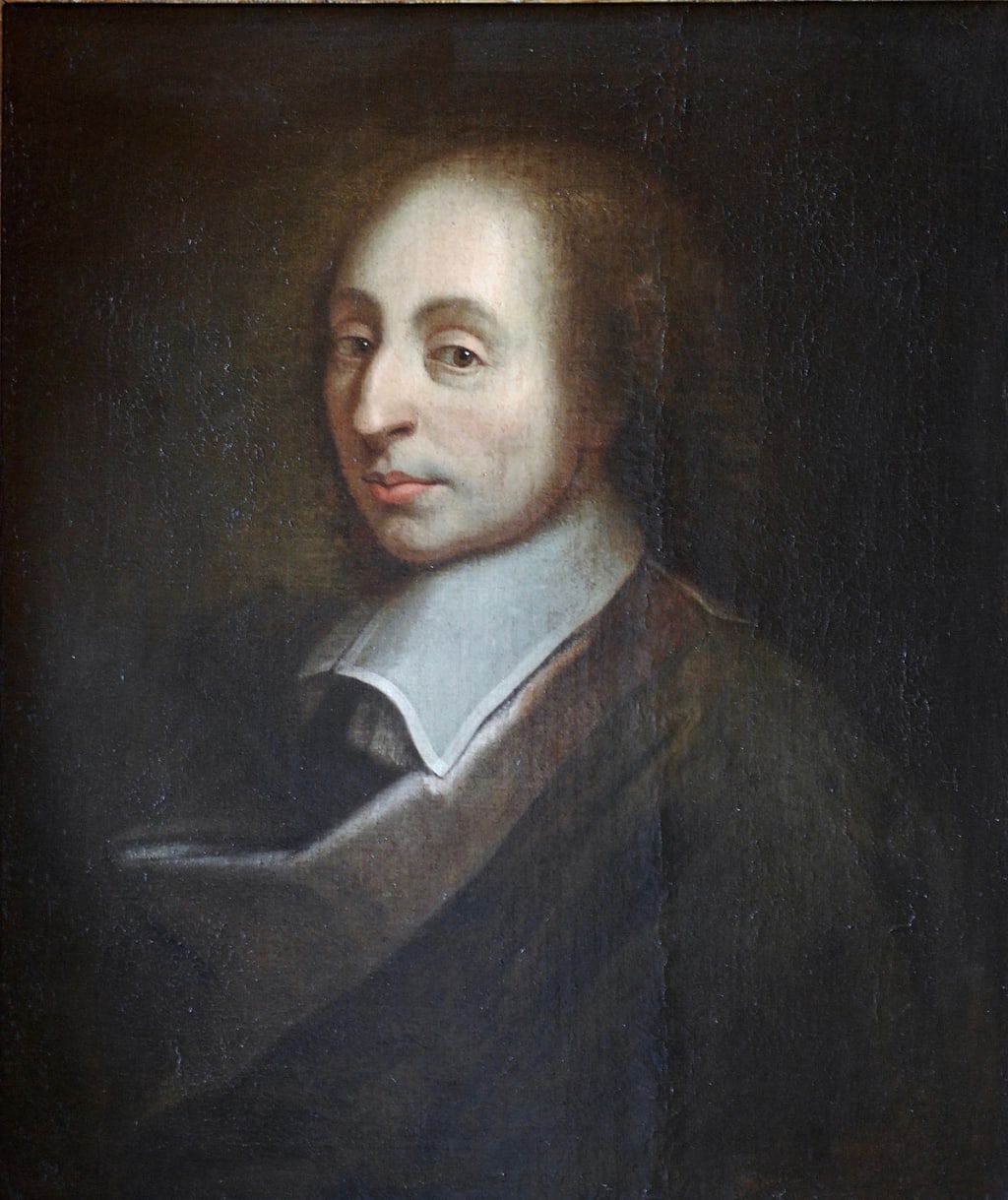
Blaise Pascal was born on June 19, 1623, in Clermont-Ferrand, France, into a family of high standing. His father, Étienne Pascal, was a local judge and a respected mathematician, which likely influenced young Blaise's early exposure to mathematics and intellectual pursuits. Tragically, Blaise's mother died when he was just three years old, leaving his upbringing primarily in the hands of his father and two sisters, Gilberte and Jacqueline.
At an early age, Pascal displayed exceptional mathematical talent. By the age of 16, he had already made significant contributions to the field of mathematics. Pascal's first major mathematical work, "Essay on Conic Sections," was completed when he was only 16 years old and earned him recognition from prominent mathematicians of the time. This achievement marked the beginning of his illustrious career.
Pascal's most famous mathematical contribution is his work on projective geometry. In his treatise, "Treatise on the Arithmetical Triangle," published in 1653, he introduced Pascal's triangle. This triangular arrangement of numbers, generated by adding the two numbers above it, has numerous mathematical properties and applications. Pascal's triangle is used in various areas, including combinatorics, binomial expansion, and number theory.
Another significant aspect of Pascal's mathematical work is his involvement in the development of probability theory. Pascal and Pierre de Fermat engaged in a famous correspondence in the mid-17th century, discussing problems related to games of chance. Their letters resulted in the formulation of principles that laid the foundation of probability theory. Pascal's contributions to this field include the concept of expected value and the development of the theory of permutations and combinations.
In addition to mathematics, Pascal also made significant contributions to the field of physics. He conducted experiments on atmospheric pressure and, in 1647, invented the Pascal's Law of Fluid Mechanics. This law states that a change in pressure at any point in an enclosed fluid is transmitted equally to all parts of the fluid. Pascal's Law forms the basis of hydraulic systems, which have extensive applications in engineering and industry.
However, Pascal's life took a significant turn in 1654 when he had a profound religious experience, known as the "Night of Fire." This experience led him to embrace a life of religious devotion and become deeply involved in theology. Pascal dedicated a significant portion of his later years to religious writings and reflections.
His most famous work in theology is "Pensées" (Thoughts). It is a collection of fragments, notes, and essays exploring various philosophical and religious themes. "Pensées" delves into topics such as faith, skepticism, the nature of man, and the existence of God. Pascal's poignant reflections on the human condition and the need for faith in a skeptical world continue to resonate with readers to this day.
One of the most well-known ideas put forth by Pascal in "Pensées" is "Pascal's Wager." This philosophical argument suggests that it is rational to believe in God, as the potential rewards of faith outweigh the risks of disbelief. Pascal posits that if God exists, belief leads to eternal happiness, whereas disbelief results in damnation. Conversely, if God does not exist, belief incurs minimal loss, while disbelief gains nothing. Thus, Pascal argues that it is more advantageous to believe in God, regardless of the existence of concrete proof.
In addition to his intellectual pursuits, Pascal also invented several practical devices. One of his notable inventions is the Pascaline, an early mechanical calculator. Although not widely adopted during his lifetime, the Pascaline laid the foundation for future developments in calculating machines and computing.
Blaise Pascal's life was tragically cut short at the age of 39. He succumbed to stomach cancer on August 19, 1662, in Paris. Despite his relatively short life, Pascal left an indelible mark on multiple disciplines. His mathematical and scientific contributions, along with his philosophical and theological writings, continue to inspire scholars and researchers across various fields.
Pascal's work not only advanced mathematics and physics but also challenged conventional thinking and explored the relationship between reason and faith. His profound insights into the human condition and his exploration of religious themes have made him one of the most celebrated intellectuals of his time.
To honor his contributions, Pascal's name is commemorated in numerous ways. The SI unit of pressure, the "pascal" (Pa), was named after him. Additionally, the programming language "Pascal" was created in the 1970s, influenced by his contributions to computer science.
Blaise Pascal's legacy remains a testament to the power of intellectual curiosity, rigorous inquiry, and the pursuit of knowledge across multiple domains. His groundbreaking ideas and achievements continue to shape our understanding of the world and inspire generations of scholars and thinkers.
About the Creator
Connected Wealth: Why Strong Networks Are Essential to Smarter Financial Planning
Financial planning is often associated with spreadsheets, forecasts, and long-term projections. While these technical elements are essential, they represent only one side of the process. Relationships, shared knowledge, and access to broader communities strengthen a truly effective financial plan. Networks—both personal and professional—play a critical role in shaping smarter, more resilient financial strategies.
By Lee Generous3 days ago in Education
Ensuring Service Quality Amidst Business Expansion
Business expansion is often seen as a milestone of success. It reflects growth, profitability, and a wider reach. However, with this growth comes a critical challenge that can define a company's long-term sustainability—maintaining service quality. As operations stretch across new markets, larger customer bases, and more complex systems, the risk of service decline increases. Customers today expect consistent, high-quality experiences regardless of where or how they interact with a brand. This makes service quality not just a priority, but a cornerstone of growth strategy.
By Devin Doyle of Newport Beach7 days ago in Education



Comments
There are no comments for this story
Be the first to respond and start the conversation.