
Black Holes — Gateways to the Unknown
Few objects in the universe inspire as much awe, mystery, and fascination as black holes. These cosmic giants defy our normal understanding of space, time, and physics. They are invisible, yet their presence shapes galaxies. They destroy stars, yet they may also give birth to new cosmic structures. Scientists believe black holes may even hold clues to the origins of the universe itself. In this article, we will explore what black holes are, how they form, their types, their mind-bending physics, and the latest discoveries that continue to challenge our understanding of reality

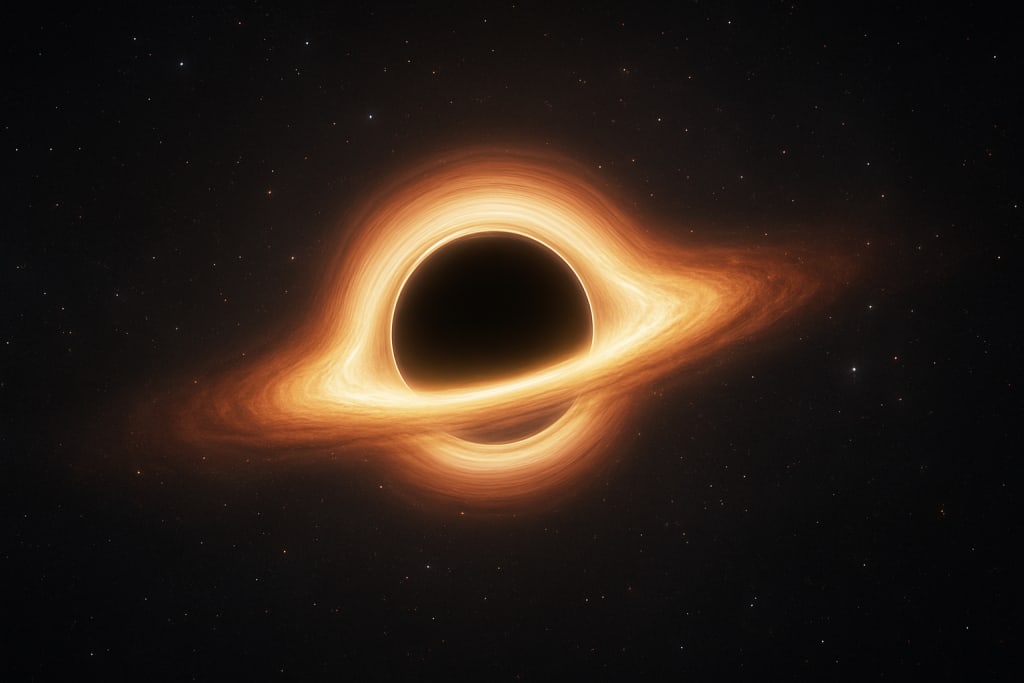
What Is a Black Hole?
A black hole is a region in space where gravity is so strong that nothing can escape, not even light. The boundary around a black hole is called the event horizon, a point beyond which escape is impossible.
Black holes form when matter is compressed into an incredibly small area, causing gravity to become infinitely strong at the central point called the singularity.
How Do Black Holes Form?
Most black holes begin their lives as massive stars.
1. Formation from a Massive Star Collapse
When a massive star (8+ times the mass of our Sun) exhausts its nuclear fuel, it collapses under its own gravity. The core collapses into an extremely dense object:
If core mass < 3 Suns → neutron star
If core mass > 3 Suns → black hole
The outer layers explode in a supernova, leaving a dark core behind.
2. Formation of Supermassive Black Holes
These giant black holes sit at the centers of galaxies, including our Milky Way.
Theories of their formation include:
Merging of smaller black holes
Collapse of gigantic gas clouds
Direct formation in the early universe
These black holes contain the mass of millions or billions of stars.
3. Primordial Black Holes
Some theories suggest tiny black holes formed fractions of a second after the Big Bang. These are hypothetical but may explain dark matter.
Types of Black Holes
Black holes come in several sizes and categories.
1. Stellar Mass Black Holes
Mass: 5 to 100 Suns
Formed from dying stars
Scattered throughout galaxies
2. Intermediate-Mass Black Holes
Mass: hundreds to thousands of Suns
Rare and difficult to detect
Found in star clusters and dwarf galaxies
3. Supermassive Black Holes
Mass: millions to billions of Suns
Located at galactic centers
Example: Sagittarius A* at the center of the Milky Way
4. Mini Black Holes (Hypothetical)
Microscopic in size
Could have formed at the Big Bang
Might evaporate through Hawking radiation
📍 The Event Horizon: The Point of No Return
The event horizon is the boundary surrounding a black hole. Once an object crosses it, it can no longer escape.
If you were falling toward a black hole:
Time would slow down from an outside observer’s perspective
Your image would freeze at the event horizon
Light would stretch into red wavelengths (redshift)
You would never be seen crossing the horizon
From your perspective, however, you would fall straight in with increasing acceleration.
What Happens Inside a Black Hole?
This remains one of the biggest mysteries in physics. According to general relativity:
Gravity becomes infinite
Space and time collapse
All matter compresses into a singularity
But quantum physics predicts something different. We currently do not have a single theory that explains what truly happens inside.
Spaghettification — The Tidal Forces
If you fall into a black hole feet-first, the gravitational pull on your feet will be much stronger than the pull on your head. This stretches your body like spaghetti—a process known as spaghettification.
This happens only in smaller black holes.
In a supermassive black hole:
The event horizon is so large
Tidal forces at the horizon are weak
You could cross the horizon without noticing anything unusual.
🌠 Black Holes and Galaxies
Supermassive black holes play a crucial role in the formation and stability of galaxies.
Their gravity helps anchor galaxies
They influence star formation
They release massive energy through accretion disks
Accretion Disk
Before falling into a black hole, gas and dust form a rotating disk around it. Friction in this disk heats the material up to millions of degrees, creating bright X-rays that astronomers can detect.
Some black holes shoot jets of charged particles for thousands of light-years, powered by magnetic fields near the event horizon.
How Do Scientists Detect Black Holes?
Even though black holes emit no light, astronomers detect them through:
1. Gravitational Effects
Nearby stars orbit an invisible massive object
If a star wobbles or orbits rapidly, a black hole may be present
2. Radiation from Accretion Disks
Gas falling into a black hole emits:
X-rays
Gamma rays
Visible light
3. Gravitational Waves
When two black holes collide, they release ripples in spacetime. In 2015, LIGO detected such waves—confirming Einstein’s prediction.
4. Direct Images
In 2019, scientists released the first image of a black hole (M87*), showing a glowing ring around a dark center.
Black Holes and Time Travel — Science or Fiction?
Black holes distort space and time. Some theories propose:
1. Wormholes
A black hole could theoretically connect two distant points in space-time. But wormholes may be unstable and collapse instantly.
2. Time Dilation
Near a black hole, time passes slowly. This means:
A spacecraft orbiting a black hole
Could return to Earth far in the future
This is real physics, not science fiction.
Information Paradox — The Greatest Puzzle in Physics
According to quantum mechanics, information cannot be destroyed.
But if a black hole swallows something, where does the information go?
Stephen Hawking suggested that black holes emit Hawking radiation, eventually evaporating. But what happens to the information?
This remains one of the greatest unsolved mysteries in science.
Modern Discoveries and Research
Recent breakthroughs include:
1. Imaging Black Hole Shadows (Event Horizon Telescope)
First image: M87* (2019)
Second image: Sagittarius A* (2022)
2. Black Hole Mergers
LIGO and Virgo detect multiple collisions each year.
3. The Idea of Black Hole Stars
Some researchers propose black holes wrapped in dark matter halos formed in the early universe.
4. Rogue Black Holes
Some black holes wander through galaxies, consuming gas and stars in their path.
Conclusion
Black holes are not mere cosmic monsters—they are essential players in the evolution of the universe. They shape galaxies, influence star formation, and challenge our understanding of space and time. As telescopes become more powerful and gravitational-wave observatories expand, we continue discovering new truths about these mysterious cosmic giants.
The study of black holes brings us closer to understanding the universe’s deepest secrets—and perhaps the very nature of reality itself.
About the Creator
Keep reading
More stories from shahkar jalal and writers in Education and other communities.
Exploring Parallel Universes: A Simple Guide
What Exactly Are Parallel Universes? A parallel universe is a hypothetical world that exists in addition to our own. These universes might have different histories, different physical laws, or even different versions of you and me.
By shahkar jalal2 months ago in Education


Comments
There are no comments for this story
Be the first to respond and start the conversation.