
"Black Holes: Cosmic Monsters of Space and Time"
*"The Formation, Evolution, and Strange Effects of Space’s Dark Giants"*
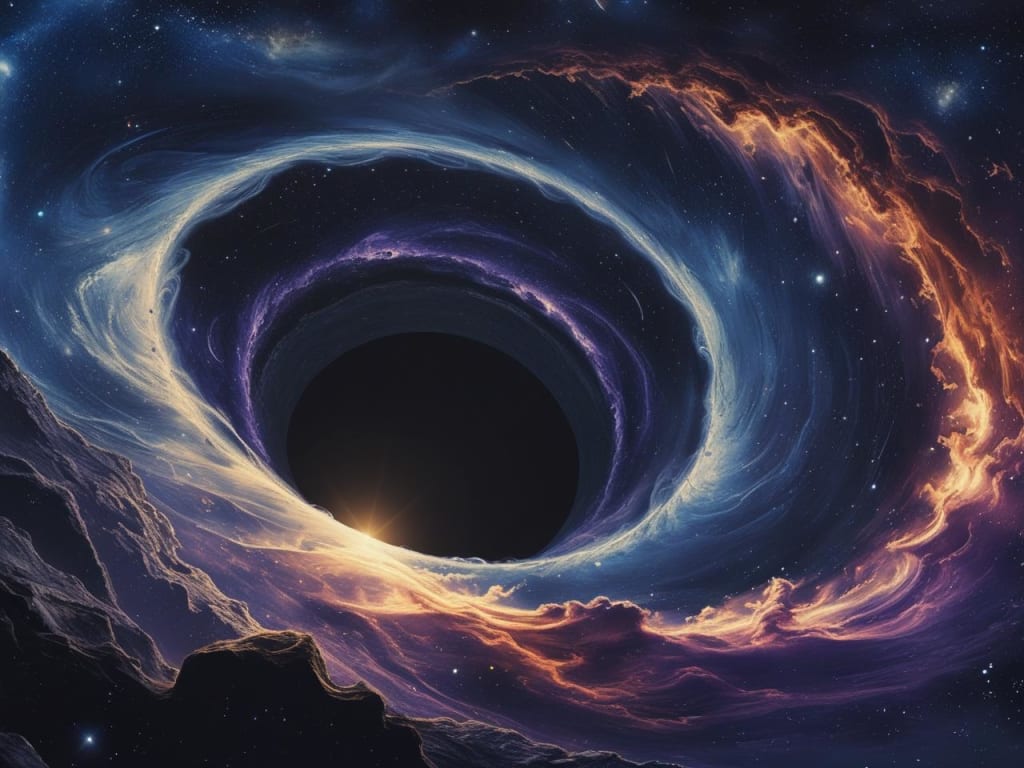
*Black Holes: Cosmic Monsters of Space and Time*
In the vast expanse of space, there exist phenomena so mysterious and powerful that they defy our understanding of the universe. Among these cosmic wonders are black holes, regions of spacetime where gravity is so strong that nothing, not even light, can escape. Black holes have captivated the imagination of scientists and the public alike, and their study has led to groundbreaking discoveries in astrophysics and cosmology.
*What are Black Holes?*
A black hole is formed when a massive star collapses under its own gravity, causing a massive amount of matter to be compressed into an incredibly small space. This compression creates an intense gravitational field that warps the fabric of spacetime around the black hole. The point of no return, known as the event horizon, marks the boundary beyond which anything that enters cannot escape.
*Types of Black Holes*
There are four types of black holes, each with distinct properties and formation mechanisms:
1. *Stellar Black Holes*: These are the smallest and most common type of black hole, formed from the collapse of individual stars.
2. *Supermassive Black Holes*: Found at the centers of galaxies, these black holes can have masses millions or even billions of times that of the sun.
3. *Intermediate-Mass Black Holes*: Black holes with masses that fall between stellar and supermassive black holes, thought to be formed by the merger of stellar black holes.
4. *Primordial Black Holes*: Hypothetical black holes formed in the early universe before the first stars formed.
*The Power of Black Holes*
Black holes are cosmic monsters that can have a profound impact on their surroundings. They can:
1. *Warp Spacetime*: Black holes distort spacetime, creating gravitational lensing effects that can bend and magnify light from nearby stars.
2. *Consume Matter*: Black holes feed on surrounding matter, including stars, planets, and gas, releasing enormous amounts of energy in the process.
3. *Emit Radiation*: As matter accretes onto a black hole, it heats up and emits radiation, including X-rays and gamma rays.
4. *Influence Galaxy Evolution*: Supermassive black holes can regulate star formation and shape the structure of galaxies.
*The Mysteries of Black Holes*
Despite significant advances in our understanding of black holes, many questions remain unanswered:
1. *Information Paradox*: What happens to the information contained in matter that falls into a black hole?
2. *Singularity*: The laws of physics as we know them break down at the center of a black hole, known as the singularity.
3. *Black Hole Formation*: The exact mechanisms behind black hole formation, particularly for supermassive black holes, are still not well understood.
*Observational Evidence for Black Holes*
While black holes themselves are invisible, their presence can be inferred from the effects they have on their surroundings. Observational evidence for black holes includes:
1. *X-rays and Gamma Rays*: Telescopes can detect X-rays and gamma rays emitted by hot gas swirling around black holes.
2. *Radio Waves*: Radio telescopes can detect radio waves emitted by matter as it spirals into a black hole.
3. *Gravitational Waves*: The detection of gravitational waves by LIGO and VIRGO have provided strong evidence for the existence of black holes.
*The Impact of Black Hole Research*
The study of black holes has far-reaching implications for our understanding of the universe:
1. *Cosmology*: Black holes can provide insights into the formation and evolution of galaxies.
2. *Quantum Mechanics*: The study of black holes has led to new understanding of the interplay between gravity and quantum mechanics.
3. *Astrophysics*: Black holes can help us understand the behavior of matter in extreme environments.
*Conclusion*
Black holes are cosmic monsters that continue to fascinate and intrigue us. Their study has led to significant advances in our understanding of the universe, from the behavior of matter in extreme environments to the evolution of galaxies. As we continue to explore the mysteries of black holes, we may uncover new insights into the fundamental laws of physics and the nature of spacetime itself.
About the Creator
Keep reading
More stories from Syed Ghazi and writers in Education and other communities.
The Grateful Ant and the Helpful Pigeon
Chapter 1: The Ant’s Peril The golden sun hung high over the forest, its rays filtering through the emerald leaves of a towering banyan tree. Below, a narrow stream gurgled over smooth pebbles, its waters cool and inviting—unless you were an ant.
By Syed Ghazi8 months ago in Fiction
The Future of Entrepreneurship: Key Trends Shaping the Next Decade
Entrepreneurship is entering an exciting new era. As technology advances and societal needs shift, business owners must stay adaptable to thrive. The next decade promises transformative change, and understanding the trends shaping entrepreneurship is crucial. Here are the key trends shaping the future of entrepreneurship and how they will impact entrepreneurs and their businesses.
By Greg Warnock2 days ago in Education



Comments (1)
Black holes are mind-blowing. I remember learning about how they form and the different types. It's crazy how they warp spacetime and consume matter. Fascinating stuff! The way they can bend light through gravitational lensing is really cool. I've always been intrigued by these cosmic phenomena and how much we're still discovering about them.