
Black Holes: Cosmic Enigmas Shaping the Universe
Black holes are among the most fascinating and mysterious phenomena in the cosmos. These invisible giants challenge our understanding of physics, space, and time.

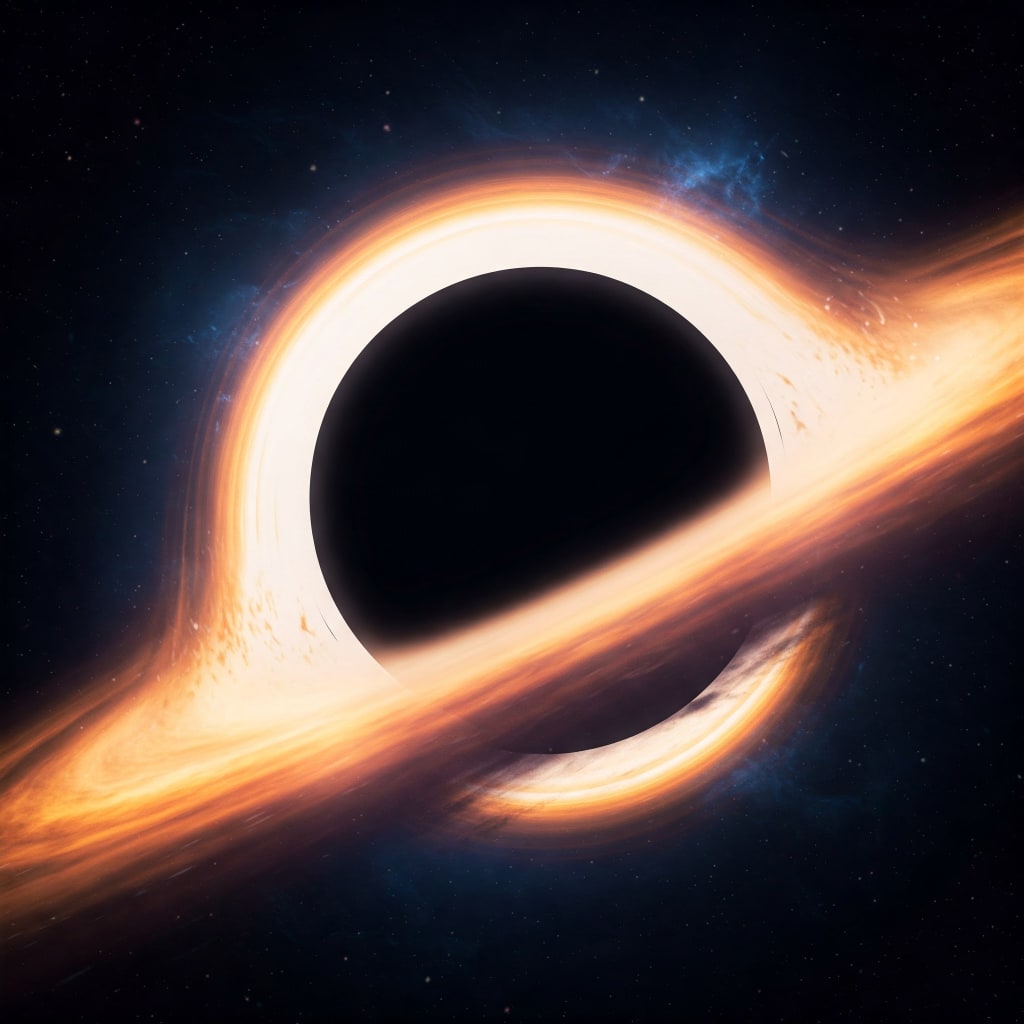
A black hole forms when a massive star exhausts its nuclear fuel and collapses under its own gravity. This collapse creates a singularity—an infinitely dense point—surrounded by an event horizon, the boundary beyond which nothing can return. Anything that crosses this boundary, including light, is lost to the black hole forever.
There are three main types of black holes: stellar-mass black holes, intermediate black holes, and supermassive black holes. Stellar-mass black holes are typically 5 to 100 times the mass of the Sun and result from dying stars. Intermediate black holes are a rare and relatively new category, weighing in at hundreds or thousands of solar masses. The most mysterious and powerful are the supermassive black holes, found at the centers of galaxies, including our own Milky Way, where the supermassive black hole Sagittarius A* resides.
The Formation of Black Holes
The process of black hole formation begins with the death of a massive star. When such a star runs out of nuclear fuel, it can no longer support its own weight. The core collapses, and if the mass is sufficient, it forms a black hole. Other processes, such as the collision of neutron stars or early-universe phenomena, can also give birth to black holes.
Supermassive black holes, however, are still a mystery. Scientists believe they may form from the merging of smaller black holes, or they may have originated from massive gas clouds that collapsed during the early stages of galaxy formation.
How Black Holes Shape the Universe
Despite their destructive reputation, black holes are not merely cosmic vacuum cleaners. They play a fundamental role in shaping galaxies and influencing cosmic structures. Supermassive black holes, for instance, help regulate star formation by releasing enormous energy as matter falls into them. This process, known as feedback, can blow away gas and dust, preventing new stars from forming too quickly and allowing galaxies to evolve more gradually.
Black holes also warp space and time. According to Einstein’s General Theory of Relativity, a massive object like a black hole distorts the fabric of space-time, causing nearby matter and light to bend around it. This phenomenon, called gravitational lensing, allows astronomers to detect black holes indirectly by observing how light from stars and galaxies bends around invisible objects.
Modern Discoveries and the Future of Black Hole Research
In 2019, scientists with the Event Horizon Telescope (EHT) collaboration made history by capturing the first-ever image of a black hole’s shadow in the galaxy M87. This groundbreaking achievement confirmed many predictions of Einstein’s theories and offered a new window into black hole physics.
More recently, gravitational wave observatories like LIGO and Virgo have detected ripples in space-time caused by black hole mergers. These observations provide invaluable data about the population and properties of black holes throughout the universe.
In the future, missions like the James Webb Space Telescope and the Laser Interferometer Space Antenna (LISA) promise to uncover even more secrets, including how black holes form, grow, and interact with their surroundings.
Conclusion
Black holes are not merely cosmic destroyers—they are essential players in the grand narrative of the universe. From shaping galaxies to testing the limits of physics, black holes serve as gateways to understanding the most fundamental laws of nature. As science advances, we are only beginning to unlock their mysteries, and each discovery brings us closer to answering the age-old question: what lies beyond the event horizon?
About the Creator
monodip
Hi, I’m Monodip Acharjee — a content creator, storyteller, and multi-passionate entrepreneur. I believe in the power of words to inspire, connect, and bring ideas to life. Through my writing on Vocal Media
Do you really need to take 10,000 steps a day?
While most people avoid spending the night in jail, Jean Béliveau jumped at the opportunity. For the past three years, Béliveau had been walking from country to country, with the goal of circumnavigating the globe on foot. This required sleeping in tents, strangers’ homes, and the occasional jail cell along the way. But this morning, as Béliveau was ready to leave, the police chief, who had agreed to his sleeping arrangement, was nowhere to be found, and the guards weren’t buying his story. Few people have the time or desire to walk such extreme lengths.
By Munesh Yadavabout 21 hours ago in Education
What’s the best position to sleep in?
In the 1970s, psychoanalyst Samuel Dunkell proposed a curious, albeit almost completely unsubstantiated, theory that the position you sleep in reflects your personality. For example, preferring to snooze in the so-called royal position indicated self-confidence, while sleeping semi-fetal meant you’re sensible and well adjusted. While Dunkell’s ideas lack any definitive proof, how we sleep can impact our health. So, what’s the best position to sleep in? Sleep positions go by countless creative names—
By Munesh Yadavabout 20 hours ago in Education




Comments
There are no comments for this story
Be the first to respond and start the conversation.