
Best Vibe Coding Platforms for Building AI-Native Products
Compare vibe coding tools, AI-native development platforms, and no-code solutions for startups, developers, and product teams.
Vibe coding platforms are transforming how teams develop AI-native products by enabling the conversion of ideas into functional software through natural language and AI collaboration. They help startups and enterprises move faster from concept to execution without losing alignment.
Think about those times when your meeting room is charged with a genuinely great idea. It could streamline a core process or even open a new revenue stream. The vision is clear, vivid, and the whiteboard proves it. The vibrant energy starts to fade, however, when it comes to translation. You wait for a first draft, for something tangible to finally emerge from the planning stage. This gap is where momentum is most fragile.
What if you could compress that timeline instead? This is the practical promise now offered by vibe coding, driven by AI collaboration and increasingly supported by vibe coding platforms designed to accelerate early product execution. It is a development approach that allows teams to describe logic and interfaces in plain language and see working software emerge as a true starting point.
The platforms enabling this are varied, each with a distinct philosophy. Your choice will decide your workflow. Below is an evaluation of the most capable options among today’s best vibe coding platforms, followed by a selection framework. The goal is not just to be faster, but to be more precisely aligned from the very first line of code.
What is Vibe Coding?
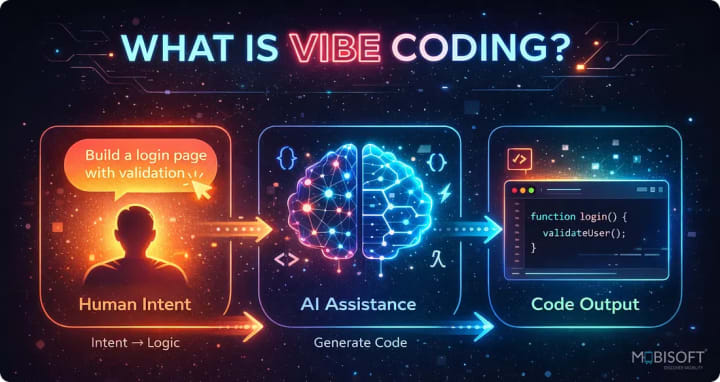
Vibe Coding Shifts Development from Manual Execution to Intent-Driven AI Collaboration.
Vibe coding is a term that emerged in late 2024 to describe AI-driven software development where developers and non-developers alike describe what they want in natural language, and AI generates working code and applications. It is unlike traditional coding that requires deep technical knowledge of programming languages and frameworks. With vibe coding, you can communicate your intent conversationally while the AI handles the technical implementation.
This approach has been popularized by the rapid advancement of large language models (LLMs) like Claude, GPT-4, and Gemini, which now power many vibe coding tools capable of understanding complex requirements and generating production-quality code. The term reflects the intuitive, natural way users interact with these systems.
For teams evaluating when and where vibe coding fits into their roadmap, a structured AI strategy consulting approach helps align experimentation with long-term business goals.
Platform Categories
The platforms in this guide fall into three distinct categories:
Web-Based AI App Builders
Imagine a different starting point. You describe what you need in plain language, just as you explained it to your team. The platform in your browser listens. Then it begins constructing not just a front-end, but a complete application. It layers the user interface, spins up the necessary backend logic, and prepares the foundation for data. These tools aim to deliver a working, deployable product from a conversation.
- Examples: Replit, Bolt.new, Lovable, v0 (by Vercel)
- Best for: Non-developers, rapid prototyping, full-stack apps
- Skill level: Beginner to Intermediate
AI-Enhanced Desktop IDEs
These are traditional integrated development environments enhanced with AI capabilities. They integrate into your existing workflow and codebase, acting as an AI pair programmer.
- Examples: Cursor
- Best for: Developers who want to stay in their IDE workflow
- Skill level: Intermediate to Advanced
Command-Line AI Tools
These are terminal-based tools that integrate AI into your command-line workflow. They work alongside your existing tools and IDEs.
- Examples: Claude Code, ChatGPT Codex, Gemini CLI, OpenCode
- Best for: Advanced developers comfortable with terminal workflows
- Skill level: Advanced
Vibe coding works best when integrated with broader artificial intelligence services that address data pipelines, model selection, and system architecture.
Leading Vibe Coding Platforms for Teams
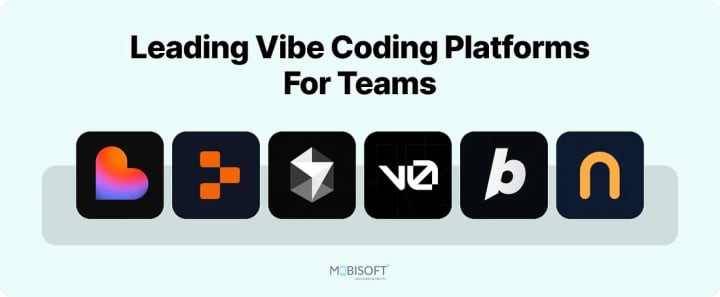
1. Lovable: For Teams With Mixed Skill Sets
Website: https://lovable.dev/
Lovable believes software should start with a dialogue. Its foundation is that simple truth. The platform is designed for teams where product vision, design intent, and engineering reality must align from the very first moment. It brings everyone into the same creative space, making it well-suited for teams exploring vibe coding platforms for AI development. Product leaders, designers, and engineers can build a shared understanding from the ground up, using conversation as their primary tool. This is a collaborative creation, paced by discussion.
Strengths:
Turns natural language discussions directly into functional code, demystifying the build phase.
- Live previews sync with code generation, making feedback immediate and precise.
- The guided, conversational interface dramatically reduces the learning curve for non-coders.
- Excellent for aligning cross-functional teams on technical scope and feasibility early on.
- Lovable v2 (2025) introduced multiplayer coding, improved chat mode, and better error handling.
It is a remarkable tool for collaboration and early-stage prototyping. However, its conversational nature can become a constraint when implementing highly custom business logic or integrating with obscure, legacy systems. It thrives in environments where clarity of communication is as valuable as the code itself.
2. Replit and AI Agent-Based Collaboration
Website: https://replit.com/
Some ideas are too fragile for formal processes too soon. They need a space where teams can think, build, and react together without the overhead of local setups or branch permissions. Replit provides this as a cloud-based development environment where multiple contributors can write, edit, and test code in real time, from anywhere. Its integration of AI agents automates the mundane tasks, freeing the team to focus on the core creative challenge. This is one of the reasons it is often evaluated alongside other vibe coding platforms for rapid experimentation.
Strengths:
- Enables true real-time collaboration in a unified, browser-accessible workspace.
- AI agents handle routine setup and coding tasks, accelerating initial prototyping.
- Perfect for collaborative brainstorming, drafting, and internal demo creation.
- Reduces the friction of onboarding contributors to a new project.
- Replit Agent 3 (2025) offers extended autonomous development with up to 200 minutes of runtime.
Remember, the flexibility it offers is not inherently structured for governance, security, and scalability in the future. It is where you nurture a promising spark before moving it to a more controlled environment.
3. Cursor: For a Developer-Focused Environment
Website: https://cursor.com/
While many platforms generate applications from prompts, Cursor takes a fundamentally different approach. It is less an automated builder and more like an expert pair programmer deeply integrated into your own development environment. It operates within a familiar IDE (as a VS Code fork), allowing engineers to maintain their established workflows, version control, and tooling. This makes it a strong option for teams comparing vibe coding tools for developers rather than no-code alternatives. You steer it using detailed prompts or adjustments within your active project. It answers with targeted code suggestions, structural refinements, or clear explanations. This approach serves teams that see AI as an amplifier for their own skills. It is for those who want a capable partner, not a substitute for their own expertise.
Strengths:
- Integrates seamlessly into existing developer environments and workflows, avoiding disruptive context switching.
- Provides deep, context-aware assistance for code generation, refactoring, and complex problem-solving.
- Produces reliable, production-ready code that feels like a natural extension of the team’s own work.
- Cursor v2 (late 2024) introduced an improved Composer interface and real-time collaboration features.
The platform demands technical proficiency. Its power is unlocked by those who can ask the right questions and critically evaluate its suggestions. For a skilled engineering team, it doesn’t change the game. It simply helps them play it at a remarkably higher level, turning intricate challenges into manageable tasks.
4. v0 by Vercel: For Rapid UI and Full-Stack Development
Website: https://v0.app/ (formerly v0.dev)
IMPORTANT UPDATE: Vercel has rebranded this platform from v0.dev to v0.app and significantly expanded its capabilities beyond just React component generation.
For teams where the front-end is a constant negotiation, v0 has evolved from a simple UI generator into a full agentic AI builder. Originally designed to translate simple prompts into React components, v0 now handles planning, task creation, database connections, and full-stack app generation. You descuyribe what you want, and v0 figures out the right steps, remembers what you’ve built, and handles the complexity across every aspect of an app, positioning it among emerging AI vibe coding platforms for product teams.
Strengths:
- Agentic AI capabilities that move beyond trial-and-error prompts to intelligent, autonomous development.
- Can generate complete full-stack applications, not just UI components.
- Handles databases, APIs, and backend infrastructure alongside frontend design.
- Live preview function fosters real-time collaboration and alignment.
- Outputs clean, standard React and Tailwind CSS code that is easy for developers to extend.
- Native integration with Vercel’s deployment platform for instant hosting.
It is a powerful tool for closing the loop between concept and prototype. Think of it for rapidly building functional MVPs, landing pages, or internal dashboards where you need both frontend polish and backend functionality.
5. Bolt.new: Full-Stack in the Browser with WebContainers
Website: https://bolt.new/
For engineering teams that live in Git, the idea of AI-generated code can feel detached from the rigorous controls of a production pipeline. Bolt addresses this by embedding prompt-driven development directly into a browser-based workflow powered by StackBlitz’s WebContainers technology. You describe a feature or a component, and Bolt generates the corresponding code while giving AI models complete control over the entire environment, including the filesystem, node server, package manager, terminal, and browser console. This makes Bolt a strong option among vibe coding platforms designed for structured engineering workflows.
Strengths:
- Full-stack development entirely in the browser with no local setup required.
- WebContainers technology runs Node.js and installs packages directly in your browser.
- AI has complete environment control for autonomous app development.
- Supports all major JavaScript frameworks and Node packages out of the box.
- Powered by Claude 3.5 Sonnet for high-quality code generation.
- Went from 0 to $4M ARR in 4 weeks after launching (2024).
This approach brings AI-assisted development into environments where change management is critical. The trade-off is that it requires some technical knowledge and may involve longer iteration cycles than more visual tools. It is not for quick, disposable prototypes; it’s for teams that want to move faster without breaking their development flow.
Read More: Best Vibe Coding Platforms for Building AI-Native Products
About the Creator
Keep reading
More stories from Mobisoft Infotech and writers in Education and other communities.
Schools That Ignore Bus Tracking Technology Are Putting Students at Risk
Every day, parents trust schools to transport their children safely. But what happens when a bus is delayed, takes a wrong turn, or worse—never reaches its destination? For decades, school transportation has relied on outdated systems, leaving administrators, parents, and students vulnerable to uncertainty and risk. Schools that continue to ignore bus tracking technology are failing to address a serious safety issue.
By Mobisoft Infotech2 months ago in Education
Best Laptop for Pro Tools
If your Pro Tools session ever freezes mid-recording, crackles during playback, or struggles with heavy plug-ins, that’s not your skills, that’s your laptop holding you back. Pro Tools needs serious power, stable performance, and good cooling to run smoothly.
By Projectorsea5 days ago in Education
Back to the Roots: Why Tailwheel Skills Continue to Shape Better Pilots
Modern cockpits often feature advanced avionics, automation, and tricycle landing gear that simplifies ground handling. However, tailwheel aircraft still occupy an important place in aviation training and culture. Tailwheel training demands precision, coordination, and constant awareness, which is why this endorsement continues to matter. By challenging pilots in unique ways, tailwheel aircraft build skills that translate directly into safer and more confident flying.
By Duke Valentour2 days ago in Education
The Devil's Triangle
The sails ruffled in the breeze as we cruised along. The Sea Breeze was a mid-size catamaran that sailed out of Royal Naval Dockyard in Bermuda. We had booked this trip weeks in advance and were now looking at our Captain, Spike and two boat hands. Paddy and Wilson seemed like nice guys, joking around with the passengers and telling us some stories about Bermuda that only locals would know. Their island accents sounded almost British but they were pleasant to listen to.
By Barbara Gode Wilesabout 23 hours ago in Fiction


Comments
There are no comments for this story
Be the first to respond and start the conversation.