
Beach Days on Mars? Scientists Think It Once Had Sandy Shores
Space

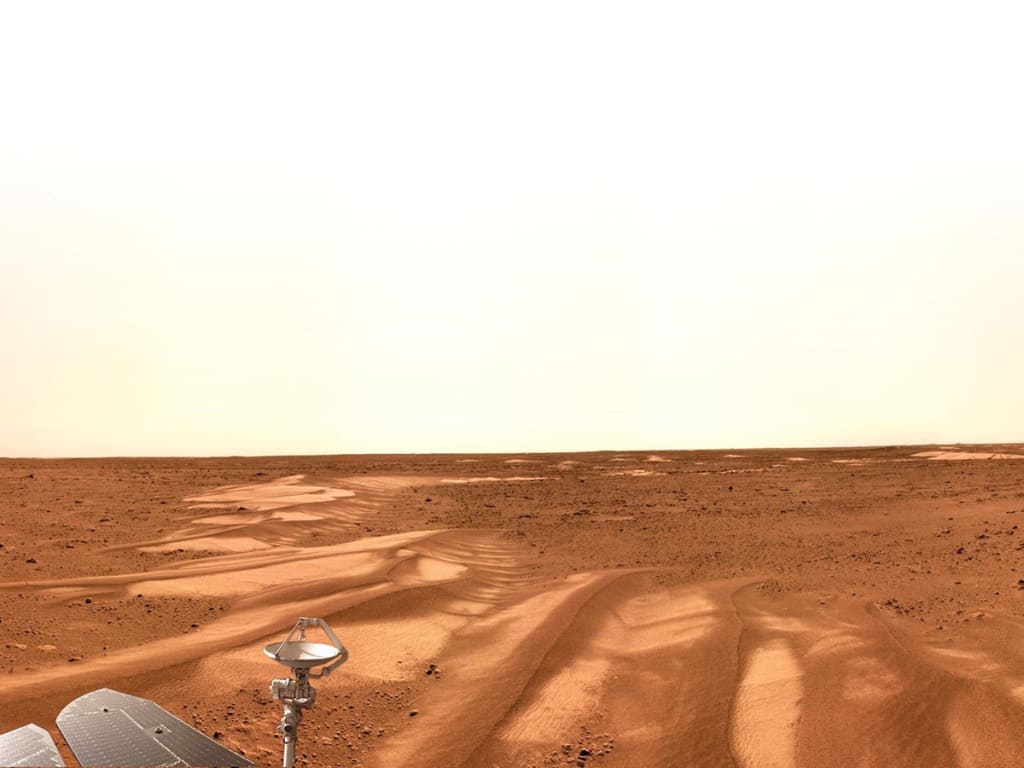
Believe it or not, Mars may have once had sun-soaked beaches. That’s the surprising conclusion of a new study published in the Proceedings of the National Academy of Sciences (PNAS).
An international team of scientists — including researchers from Penn State University — analyzed new data from China’s Zhurong rover and uncovered something remarkable beneath the Martian surface: ancient sedimentary layers that look strikingly like the ones found along Earth’s beaches. Their findings provide some of the strongest evidence yet that Mars once had a massive ocean — and possibly the right conditions for life.
Zhurong Digs Deep into Martian History
When the Zhurong rover touched down in 2021 in a region known as Utopia Planitia, it carried with it a powerful scientific tool: a ground-penetrating radar. Unlike its predecessors, Zhurong had the ability to scan beneath the Martian surface, using radio waves to peer into the planet’s geological past.
What it “saw” under the dust and rock surprised everyone. The radar detected layered sediment formations beneath the surface — sloped, rhythmic structures that mirrored the geological signatures of coastal deposits here on Earth. These types of formations are typically created by the repeated action of waves, tides, and retreating shorelines, suggesting Mars may have once had an ocean lapping against its dusty shores.
This wasn’t just a lucky coincidence. The structure, angle, and consistency of the layers couldn’t be explained by wind erosion, lava flows, or river activity. All signs pointed to a dynamic coastline, carved by the motion of water.
A Strong Case for Ancient Oceans
Scientists have long speculated about the possibility of a Martian ocean, particularly in the northern lowlands. But until now, most of the evidence came from surface features — like dry riverbeds and channels — that could also be caused by other forces. What makes this study so exciting is the subsurface confirmation.
By comparing Zhurong’s underground radar readings with similar sedimentary formations on Earth, the research team concluded that these Martian layers were most likely laid down by a retreating shoreline — the hallmark of an ancient ocean gradually drying up.
Even more compelling, the data indicates that the shoreline itself shifted over time, hinting at environmental changes like climate shifts or tectonic activity. This points to a planet that was once far more alive and dynamic than the cold, barren Mars we see today.
Mars: From Desert to Blue World?
The idea that Mars once held large bodies of water isn’t entirely new, but this latest discovery adds another layer of credibility — quite literally. The formations Zhurong uncovered suggest that much of the northern hemisphere of Mars may have once been submerged under a vast, salty sea.
Scientists believe this ocean may have existed for tens of millions of years, providing a stable, warm, and wet environment — the kind of conditions life could potentially thrive in. If microbial life ever did evolve on Mars, this watery period would have been its best chance.
Planetary scientist Michael Manga of the University of California, Berkeley, called Zhurong’s ground-penetrating radar a “game-changer.” It allows researchers to explore not just the visible terrain, but also what lies beneath — and that’s where Mars is really hiding its secrets.
Looking Ahead: Searching for Signs of Life
These findings have reignited interest in Mars’ watery past — and its biological potential. As rovers like NASA’s Perseverance and China’s Zhurong continue to gather data, scientists are gaining a clearer picture of Mars as a planet that once had weather systems, flowing water, and perhaps even thriving ecosystems.
Could the next big discovery be fossilized microbial life hidden beneath the sands of an ancient beach? That’s the hope. And with more missions planned and technology advancing, we may not have to wait too long for an answer.
So next time you picture Mars, don’t just think of red dust and craters. Imagine waves crashing against Martian cliffs, tides rolling in on a copper-hued shoreline, and a world that might have once looked just a little bit like Earth — with its own version of beach days.
About the Creator
Keep reading
More stories from Holianyk Ihor and writers in Education and other communities.
Warp Drive: Part 2 – The Warp Field Coil
For centuries, humanity has dreamed of reaching distant stars. But space, vast and unforgiving, hasn’t made that dream easy. Even our closest stellar neighbor, Alpha Centauri, is 4.367 light-years away. With today’s fastest spacecraft, that journey would take tens of thousands of years. Clearly, conventional propulsion just won’t cut it for interstellar travel.
By Holianyk Ihor8 months ago in Education
Speak and Be Heard: A Beginner’s Guide to Becoming a Podcast Host and Growing Your Audience
Becoming a podcast host is an exciting way to share your ideas, inspire others, and build a strong community. Whether you want to teach, entertain, or have great conversations, podcasting gives you a voice that can reach people around the world. But starting a podcast and growing an audience takes more than just a microphone. It requires planning, patience, and a real connection with your listeners. In this guide, you'll learn how to become a podcast host and grow your audience step by step.
By Spencer Hakimian4 days ago in Education



Comments (1)
This is fascinating stuff. The idea of Mars having beaches is mind-blowing. It makes me wonder how different life could've been there if that ocean was around. I'm curious, though, how certain are they that these layers were formed by an ocean and not some other process we haven't thought of? Also, what does this mean for future Mars exploration? Gonna be interesting to find out.